When did Super Bowl coaches and CEOs start being so … decent? 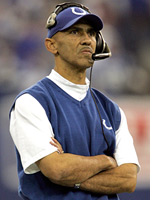
Colts coach Tony Dungy Nice Guys Finish First
When did Super Bowl coaches and CEOs start being so … decent?
By Daniel Gross
Posted Thursday, Feb. 1, 2007, at 6:56 AM E.T. The two Super Bowl head coaches, Lovie Smith of the Chicago Bears and Tony Dungy of the Indianapolis Colts, are exceptional in the exclusive fraternity of successful football coaches. It’s not because they’re African-Americans. It’s because they’re not jerks. For years, the archetypal gridiron coaches have been yellers like Bill Parcells, who relishes questioning the manhood of players and the intelligence of reporters, or ungracious grumps like Bill Belichick of the Patriots, who this season refused to shake hands with his former assistant Eric Mangini, after the Mangini-coached New York Jets beat the Pats. But as Karen Crouse notes in the New York Times, Dungy is a “civilized man in a coarse profession. He doesn’t berate his players or stalk the sideline. He doesn’t spew profanity or chew tobacco.” Earlier this month, Smith, who once worked for Dungy, told the Times that he learned the value of being nice from his old boss. “We talked about how to do it, being a teacher instead of screaming and yelling, all that stuff.” Smith and Dungy are fully capable not just of shaking hands with opponents, but of hugging them and breaking bread with them. As MSNBC’s Steve Silverman writes, before Indianapolis played the Kansas City Chiefs in the wild-card game earlier this year, Dungy, Smith, and Kansas City Chiefs coach Herman Edwards had dinner together with their families. Business and politics—two famously combative and competitive spheres—love to borrow from the culture of sports leadership. (Fiery former college football coach Lou Holtz spoke at last week’s congressional Republican retreat. Like congressional Republicans, Holtz had his last winning season in 2004.) And it’s clear that nice is on the ascendance in the corporate sector as well as on the gridiron. A couple of years ago, the hot new advertising man with a first-person book on how to succeed in business was tough-talking, boorish, foul-mouthed Donny Deutsch. Today, the hot new advertising executives with a book about how to do business better are two women, Robin Koval and Linda Thaler of Kaplan Thaler. The Power of Nice: How To Conquer the Business World With Kindness is a wholly inoffensive pocket-sized tract, complete with a yellow smiley-face on the cover, about how nice guys (and gals) can finish first, make lots of money, live longer, and get lovely book-jacket photos. It contains anecdotes about social-science research that prove people respond more to niceness than to fear and anger, and several Pay It Forward examples of good deeds rewarded. (Being nice to Donald Trump’s wife at a photo shoot led to a role for the executives on The Apprentice. That’s a case where nice led to dreck.) They advise readers to take pains to exercise their “niceness muscles.” (Note to Kaplan and Thaler: For the paperback edition, please tell readers where these muscles are. I spent an hour looking for mine, to no avail.) The nice meme goes against the grain of the long-dominant take-no-prisoners approach that views business as one long war, or football game. That’s how Jack Welch, perhaps this generation’s leading executive coach, sees the workplace. In his no-crying-zone, firing people is an act of kindness and shuffling executives around the globe every few years, their families be damned, is an act of generosity. Welch’s tough-guy approach still sells books and inspires executives, but it’s not exactly taking the marketplace by storm. Look at the divergent fates of two of Welch’s best-known protégés. Robert Nardelli took Welch’s ethos with him to Home Depot. Earlier this year, after having alienated shareholders, employees, and board members with his imperious style, Nardelli was essentially fired. Meanwhile, Welch’s successor, Jeff Immelt, seems to have a much higher emotional IQ than Nardelli or Welch. He smiles a lot and says the right things about executive pay and global warming. You wouldn’t mind leaving your kids in his care for an afternoon. Or consider the evolution of Bill Gates. In the 1990s, America’s richest man was seen by many as a cut-throat monopolist, feared and respected more than loved. He’s been reborn this decade as a cuddly mensch, bringing the same focus to curing malaria and HIV as he did to crushing rival software companies. Now, it’s easy to exaggerate the triumph of nice. Corporate America and professional sports remain spheres in which the bottom line is all that matters. Shareholders and fans will forgive their managers for being jerks so long as they post results. But corporate culture always evolves. And among executives it is surely trendier to be culturally sensitive, environmentally conscious, and concerned about income inequality than it was in the past decade. Why? In the 1990s, with stock ownership expanding at a rapid rate—the percentage of households owning mutual funds or stock more than doubled in the decade—Americans suddenly cared a great deal about corporate profits, since that’s what boosted stock prices. But in this decade, ownership hasn’t expanded, and it’s clear that gains are not being as broadly shared as they were in the 1990s. Meanwhile, as the stocks of gigantic companies like General Electric, Wal-Mart, Microsoft, and Home Depot are having difficulty gaining traction even as they post favorable results, CEOs know they can’t be respected public figures on the basis of stock performance alone, as Welch was during the ’90s. As shares of GE have badly underperformed the S&P 500 for the last five years, Immelt’s winning personality and eagerness to exercise his nice muscles have insulated him from shareholder wrath. There’s a frailty to the power of nice, in business and sports. Dungy’s Colts needed a last-minute touchdown to beat Belichick’s Patriots in the AFC championship game. A fumble or an interception, and analysts would be questioning Dungy’s laid-back style. Just so, a few poorly conceived ad campaigns could cause Kaplan Thaler to lose its mojo. Immelt might find the nice-guy act wearing thin if GE continues to underperform the market. And this Sunday, in the Super Bowl, one of the nice guys will finish last. Daniel Gross (www.danielgross.net) writes Slate‘s “Moneybox” column. You can e-mail him at moneybox@slate.com.
|
|
 | 
Donna McWilliam/Associated Press A fuel delivery to a service station in Keller, Tex. Exxon Mobil reported that it earned $39.5 billion in 2006. Exxon and Shell Report Record Profits for 2006 HOUSTON, Feb. 1 — Oil prices have fallen, but Exxon Mobil and Royal Dutch Shell left their smaller competitors in the dust and reported record annual profits Thursday. By making $180 million a day between them, the two largest publicly traded oil companies displayed their ability to ramp up production worldwide over the year, even in unstable places like Chad and Nigeria. Growth may be slowing and is likely to continue to do so in the future, but these two companies showed they could navigate the year’s volatile energy prices that caused smaller companies to stumble in their fourth-quarter profits. The expanding profits at Exxon Mobil and Shell, however, may also make them big targets for the Democratic Congress whose leaders want oil companies to pay higher taxes and work to curb global warming. Analysts said that with oil prices rebounding again with more frigid weather, the entire industry is almost assured of seeing strong profits again this year. Production in Mexico and Venezuela is declining because of politics, poor management, investment shortfalls and aging fields. And in Russia, production is slowing because of tensions between the government and foreign oil and gas companies over big investments. With worldwide crude inventories full, Saudi Arabia is keeping production in check to maintain its influence over pricing. Energy consumption in China and India, meanwhile, continues to soar. Just a few weeks ago, many traders were predicting that oil would fall below $50 a barrel. But now the consensus of traders is that $50 is more likely a floor, so that big profits should continue in an industry that is swimming in cash. “Only a few months ago, I thought oil prices could go down to $40 and natural gas prices to $5,” laughed Fadel Gheit, senior energy analyst at Oppenheimer & Company, who has since tossed out those expectations. As for the earnings, he said: “The brutal focus on efficiency makes Exxon Mobil head and shoulders above everybody else. They arrive ahead of all the passengers, even those traveling on the same train.” Exxon reported annual profit of $39.5 billion, or $6.62 a share, for 2006 — its second consecutive annual record. Once again, the profit was the largest reported by any American company in history. While Exxon’s fourth-quarter results were actually down a bit from the year before, the enormity of its annual profits had Democratic politicians shaking their heads. Under Democratic control, the House of Representatives quickly passed legislation last month to raise nearly $15 billion in taxes and royalties and use that money to finance research for alternative fuels. Many in the Senate support similar legislation, which may get a boost from a common perception in Congress that large oil companies are richer than ever and not doing their part to curb global warming. As soon as Exxon Mobil released its earnings, Representative Edward J. Markey of Massachusetts, who is a leading Democratic spokesman on energy issues, accused the company of using its “outlandish profits” to lobby for energy policies that benefit it rather than the American people. “The hypocrisy of the oil and gas lobbyists is so high that even as these record profits gush from their company balance sheets, they try to block all attempts to recover the royalties they owe the American taxpayer,” Mr. Markey, who is on the House Energy and Commerce Committee, said in a statement. Apparently sensitive to perceptions, Shell did not announce that its annual profit was a company record. The profitable results of the two companies came after reports by other energy companies in recent days that slipping commodity prices, rising steel and labor costs and higher royalties and taxes had hurt their bottom lines. Exxon’s refining and chemical businesses benefited from the dip in gas prices, giving it a cushion that the smaller companies did not have. Its worldwide oil production increased modestly over the year, though it declined slightly in the fourth quarter. Shell reported a 21 percent rise in its fourth-quarter earnings, to $5.28 billion. That was mostly a result of a 4.1 percent increase in daily production of oil, to 3.65 million barrels, in the quarter. The company also continued to profit from its superior marketing and refining ability outside the United States. Shell’s income in 2006 was $25.44 billion, up from $25.3 billion in 2005. Shell predicted oil and gas production growth of 1 percent to 2 percent annually through 2010, and slightly more after that. Exxon reported profit of $10.25 billion, or $1.76 a share, in the fourth quarter. That represented a decline of 4.3 percent from the fourth quarter of 2005, when energy prices soared after Hurricanes Katrina and Rita. Shares of Exxon Mobil rose 98 cents, or 1.32 percent, to $75.08, while American depository receipts of Shell rose $1.23, or 1.80 percent, to $69.48. Occidental Petroleum, ConocoPhillips, Hess and several other oil companies have reported drops in quarterly profits in recent days, but those results are in comparison to record or near-record in the quarters a year earlier. Exxon executives concede that the company faces some big potential hurdles in the coming months should OPEC countries cut production quotas and negotiations go badly over transfer of control of operations in Venezuela. Nicole Decker, an oil analyst at Bear Stearns, cautioned that 2007 could be a problematic year for oil companies because increased steel and labor costs “have not been reflected in the bottom line yet.” She added that while she could imagine oil prices rising above $60 in the coming months, “I don’t think anybody thinks oil prices will go up to where they once were.” She said increased production in Malaysia and Azerbaijan this year could help nudge down prices. The lower fourth-quarter profits at many oil companies mostly reflected declines in oil and gas prices at the end of last year. Oil prices for the quarter ranged from $55 to $63 a barrel, averaging just shy of $60. That represented a 15 percent decline from the third quarter, but less than 1 percent lower than the fourth quarter of 2005. Oil prices for all of 2006 averaged $66, or $10 higher than in 2005, according to a recent Citigroup report on the energy industry. Oil prices reached a high of $77 in July, but they dipped to as low as $52 in recent weeks. Prices have firmed up lately on speculation among traders that fuel supplies in much of the United States will decline in the coming weeks because of cold weather and better-than-expected economic growth. Prices edged down slightly Thursday, to $57.30, and are about 10 percent lower than a year ago.
|
|
| The Colts’ brilliant, nerdy, socially stunted quarterback 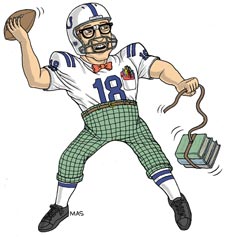
Rain Manning
The Colts’ brilliant, nerdy, socially stunted quarterback.
By Tommy Craggs
Posted Thursday, Feb. 1, 2007, at 5:01 PM E.T. It comes to us from sportswriter Peter King that this past summer, in training camp, Peyton Manning developed a fancy new practice method in which a team cameraman took up a spot in the defensive secondary. From there, he would train his camera on Manning’s eyes, videotaping them, presumably to give the Indianapolis Colts quarterback an idea of how an opposing cornerback might read him. King, alas, doesn’t dwell on this any longer. But this sort of thing—the kind of creepily involved training a quarterback might undergo if he were coached by Philip K. Dick—goes to the heart of the world’s problem with Peyton Manning. The Colts quarterback, it seems, is a big ol’ dork. Manning’s stardom has always been problematic. He is indisputably the best quarterback of our day, one of the greats of all time, the scion of an eminently likable signal-calling dynasty, a player who combines prodigious physical gifts and an instinctive feel for the game. And yet, on the eve of the biggest game of his career, he finds himself scorned, mocked, and generally loathed in any part of the country that is not Indianapolis, Tennessee (where he played college ball), the Garden District of New Orleans (where he was raised), or Madison Avenue (where he pitches Gatorade, DIRECTV, Sprint, ESPN, MasterCard, and Reebok, among others). A victory on Sunday, and Canton can go ahead and commission the bust. But nobody, not even Time magazine, wants to cheer for him. Of course, if we’re to believe any of the journalism escaping from Miami this week, the formerly petulant Manning has, at last, “matured.” He is “new and improved,” a far, far cry, apparently, from that awful, callow thing who tossed a league record 49 touchdowns two years ago. Manning, it is said, has finally figured out how to win the Big Game, something he has supposedly failed to do over his previous eight years in the league. It goes without saying that these are entirely phony story lines, cheap even by the standards of Super Bowl week, where sensible journalism goes to die. (For one thing, this all presumes the quarterback is the author of everything that transpires on the field and is therefore responsible for the outcome of the Big Game. Somebody should tell Jerry Kramer.) But the pundits’ point is abundantly clear: Manning has finally achieved greatness because he no longer comports himself, if I may channel Chuck Klosterman for a moment, like Samuel “Screech” Powers. Appraising a Great Quarterback is a messy business, and not just on account of the football. A Great Quarterback is an American mascot, having wholly supplanted the cowboy as the country’s standard of manliness. He has all the qualities desired in a leader. He is quiet and smoldering and unafraid to get a little dirt on the uniform; a field general, tactically brilliant, unfailingly chivalrous. Sammy Baugh fits. So do Otto Graham, Johnny Unitas, Joe Montana, Brett Favre, and Tom Brady. Erwin Rommel, too, but that’s another story. One thing a Great Quarterback cannot be, however, is a nerd. More than any sport, football has been slow to embrace its inner geek (or outer geek, for that matter). It is a game still played by a fraternity of big, violent men according to a macho code. That’s why Manning, in the popular imagination, remains somewhere on the edges. Manning has never been a jock. He doesn’t look the part, all pouts and frantic gestures. He geekily immersed himself in football’s nuances at an early age, learning seven-step drops as a 4-year-old and shortly thereafter developing an almost autistic devotion to film study. In college, Todd Helton, the baseball player and former Tennessee quarterback, dubbed Manning “R2-D2.” (It’s interesting to note that if Manning were a head coach today, the obsessive film study and attention to detail would get him labeled a genius, a la Belichick.) All this came at some expense to Manning’s social development, it would seem. A 1999 profile in Sports Illustrated spent most of its time chortling good-naturedly over Manning’s various gaucheries: the name written on the inside of the jeans; the bafflement over a can opener; the underwear turned inside out (so he wouldn’t have to use the confounding washing machine). As a childhood friend of Manning’s told SI: “He’s too easy to make fun of. He’s mature beyond his years as a public figure, and he has an amazing grasp of what to do on the field, but he can’t do anything else on his own. He’s always going to be the guy who steps in dog poop, and every time he eats a sandwich or a hamburger, he’ll end up with ketchup down his leg, mustard on his ear.” Rain Man, the quarterback. Manning, at times, is every bit as insufferable as he’s reckoned to be. There are the occasional impolitic quotes, and you can frequently discern the sense of entitlement of a kid born into football royalty. He gives very little of himself, preferring instead the careful cultivation of his own image—in bars, Manning would sometimes keep his beers out of sight, fearing what people might think of him. This is partly why so many fans and writers recoil at his many commercials. (The other reason is their sheer ubiquity, and Manning’s, which is a comical complaint coming from the very media that enable Manning’s ubiquity.) “His affability takes on an overtone of insincerity,” writes one critic. “After the fourth Peyton Manning endorsement, it takes a pretty lunkheaded viewer not to realize he’s only in it for the money.” No, it takes a lunkheaded viewer not to realize it after the first commercial. Besides, the spots aren’t all that bad. The most memorable of the bunch has him cheering on a series of commoners, in the manner of a rabid sports fan: “Let’s go, insurance adjusters, let’s go!” For what it’s worth, he has a better comic instinct than Tom Brady. None of this stuff is Manning’s problem, though. This lies with the fans, who now seem to indulge in a sporty sort of phrenology, by which the character of a man is sussed from a MasterCard commercial and a highlight on ESPN. “It’s just impossible to root for the guy,” wrote Matt Taibbi in one sustained rant, “which is not something one says about all the other Great Quarterbacks Who Do Not Play For Us. Brett Favre, an unmistakably three-dimensional human being, is easy to root for.” Or there’s this: “He is not a person you would invite over for dinner, nor is he a person that you would want to spend your Saturday with. Rather, he is the person you would be wondering about. Some people would feel sorry for him.” Oops! That one’s about Bill Gates. Sorry. It’s time, I think, for football to embrace its poor Screech, Peyton Manning. Let the dorks into the fraternity. After all, we nerds are one of the NFL’s sustaining life forces, with our fantasy football and our Football Outsiders and our Madden NFL 07. Like the man says: Let’s go, insurance adjusters, let’s go! Tommy Craggs is a writer in New York.
|
|
| Brooklyn 
Poor Columbia Street. In Manhattan, streets are completely torn up, repaired, and repaved and functional in a day. But for the past 6 months this street on the edge of Carroll Gardens and Red Hook has been in a stages of distinct disrepair, each frustrating in its own particular way. There were the potholes of the summer, the big dig of the fall -when all the concrete and asphalt were removed and new concrete poured- and the seemingly intentional crevices the new concrete came with, which were worse than the potholes. But all that uneven walking couldn’t hide the fact that it’s lined with some interesting bars, and a month ago it gained something kind of novel for the area, a tapas bar.

This “Mediterranean Kitchen” and wine bar that seemed as obvious as it was welcome. Sure, nearly every neighborhood has their own version, but Columbia Street didn’t have theirs. And some fresh tasting Mediterranean fare sounded just like what it needed. It seemed especially so when you looked inside. The many light fixtures bathed the large room in low yellow light, and the dark furniture made it feel like a place to get comfortable.
Unfortunately, things were in the usual first day disarray when we went on opening night, which was equally annoying (they didn’t know how properly pop the cork) and hilarious (they filled the enormous red wine glass to the tip-top). The food looked good, but it lacked focus. The long menu wandered through nearly every country in the Mediterranean from Turkey to Morocco, and there weren’t that many wines by the glass. But things have changed in the past month, both for the neighborhood and the bar. One quiet day, Columbia was paved perfectly smooth, and on our revisit to Mazzat, things were running much more smoothly as well. The bartenders were confident and more inviting. The food looked even better and came out on time and hot. The biggest seller is the Moroccan Chicken Cigars, which look like spring rolls, and are loaded with herbs and extra moist chicken. These improvements have translated into larger crowds. And for that we’re happy.
It still needs some focus, but it’s worth it right now for the atmosphere alone. Mazzat
208 Columbia Street, Brooklyn
(718) 852-1652 |
|
| Colts and Bears and Kevin Federline 
Clockwise from top left, ads for Doritos, Emerald Nuts, Snickers and Nationwide Financial, featuring Kevin Federline. In recent years, marketers have tried to extend the attention a Super Bowl ad gets by offering previews and postgame access to the spots through the Internet. Colts and Bears and Kevin Federline If you think politics makes strange bedfellows, consider the advertising hookup that grabbed so much attention this week: Nationwide Insurance and Kevin Federline. What’s a nice advertiser like Nationwide doing with a semi-celebrity like Mr. Federline? After all, in most coverage of his tempestuous marriage to Britney Spears, he seemed like an accident waiting to happen — an odd choice to appear in ads for a blue-chip financial marketer. You can attribute, or blame, the beginning of the beautiful friendship to the new rules of Super Bowl selling. It has always been a big gamble to buy commercial time during the Super Bowl, a k a the annual midwinter American festival of football and commercialism. The spots are usually the most expensive of the year because the game is usually the most watched TV show of the year, drawing around 90 million viewers. On Sunday, for Super Bowl XLI, CBS is charging a record price, averaging an estimated $2.6 million for each 30-second spot, compared with $2.5 million last year. For years, the commercials that appeared during each game were here and gone in seconds; blink, and you missed them. So while sponsors spent lavishly to woo viewers to watch the spots — stuffing the commercials with attention-getting devices like stars, special effects and surprise endings — the hoopla had an expiration date. Now, thanks to the Internet, Super Bowl commercials are like gifts that Madison Avenue tries to keep on giving. As soon as the game ends, video clips of the spots are posted online, on the Web sites of sponsors like fedex.com; the networks that broadcast the game like cbs.sportsline.com; and Internet media companies, among them ifilm.com, msn.foxsports.com, sports.aol.com and youtube.com. “The commercials live on, and continue to resonate,” said Bart Cleveland, creative director at McKee Wallwork Cleveland, an agency that conducts an annual online commercial poll (adbowl.com). As a result, the stakes have risen even higher for the two dozen or so marketers that decide to buy Super Bowl spots. Failure that once lasted a day or so now has an indefinite shelf life. What the highly topical Mr. Federline brings to Nationwide is instant recognition, a first leg up before the opening kickoff. The idea was to capitalize on all the recent publicity surrounding Mr. Federline’s relationship with Ms. Spears. (His recent experiences were considered a perfect way to illustrate the Nationwide ad theme, “Life comes at you fast” — and sell annuities “that could guarantee you income for life.”) So far, the plan seems to be working. In a Nielsen BuzzMetrics survey of Super Bowl spots, released Jan. 24, the Nationwide commercial finished first, with 26 percent of all blog discussions about the ads in the game. On one day, Jan. 17, according to the survey, the Federline spot accounted for 49 percent of all online conversations about Super Bowl ads. In addition to surveys like the Ad Bowl, gauging opinions about the best and worst commercials, there are now data collectors like Nielsen BuzzMetrics and Nielsen/NetRatings that measure for days afterward how many — or how few — people are visiting Web sites to watch the spots or posting comments on blogs about ads they liked or hated. Although there are not yet official national ratings for TV commercials, TiVo provides second-by-second data measuring how many households equipped with TiVo digital video recorders watched — or re-watched — Super Bowl commercials. (Most years, a commercial has been the most watched moment of the game rather than a play.) One company, FKF Applied Research, is even teaming up with the Ahmanson Lovelace Brain Mapping Center at the University of California, Los Angeles, to gather brain-scan images that will measure emotional reaction to the commercials. “The Super Bowl ‘echo effect’ has been dialed up dramatically,” said Peter Blackshaw, chief marketing officer at Nielsen BuzzMetrics, part of the Nielsen Company. “It’s the ultimate torture test.” That means the marketing hype machine is being cranked to 11, as the band from “This Is Spinal Tap” would say, with advertisers scrambling to supplement their Super Bowl marketing plans with a panoply of ploys, all meant to stimulate interest in the commercials after the game as well as before and during. The elements include offering online previews of spots, as Nationwide started doing Monday on its Web site (nationwide.com); sponsoring contests for consumers to create Super Bowl ads, as the Frito-Lay division of PepsiCo is doing for its Doritos brand of snack chips; buying key words from search-engine Web sites, to entice computer users; producing alternate versions of commercials; and posting online behind-the-scenes video clips or “deleted” moments. “In the past, a commercial was filmed and then we determined if there was a component that could be leveraged,” said Andrew Burke, vice president for marketing at Diamond Foods, which is running a commercial in the third quarter for the Emerald brand that promotes nuts as an energy source. “Now, an expanded campaign was part of the upfront planning.” The Emerald Web site (emeraldnuts.com) is chockablock with content aiming to pique curiosity about the commercial, featuring the crooner Robert Goulet and created by Goodby, Silverstein & Partners, part of the Omnicom Group. There are video clips with mock warnings about midday energy slumps; sound bites from Mr. Goulet in which he utters phrases like, “Click there, you know you want to”; and e-mail messages that can be sent to friends. After the Emerald commercial appears, the Web site will be freshened with new material. Likewise, the candy maker Mars is adding bells and whistles, centered on a Snickers commercial in the game’s first quarter by TBWA/Chiat/Day, part of the TBWA Worldwide division of Omnicom. Through game time, visitors to a Web site (snickerssatisfies.com) can watch the first five seconds of the spot. After the commercial runs on TV, the online clip will be replaced with the full spot — and three alternative endings. The visitors can vote for their favorite, and the next time the spot runs it will conclude with the winning ending. Steven R. Schreibman, vice president for advertising and brand management at Nationwide Financial, said the goal was for a Super Bowl commercial “to have a life outside the Super Bowl.” “The media landscape has changed so much,” he said. “There are different expectations.” The Nationwide plans encapsulate that change. This year’s efforts extend far beyond the Super Bowl efforts of just a year ago, Mr. Schreibman said, when the company ran a humorous commercial featuring the model Fabio. “We’re trying to leverage it this time in as many ways as we can,” he added. First, the decision was made to feature Mr. Federline in the spot — created by TM Advertising, part of the Interpublic Group of Companies — rather than an established celebrity like Fabio. The Nationwide Web site, in addition to the preview of the spot, presents video clips from the making of the commercial; eight versions of Mr. Federline rapping the “Nationwide is on your side” jingle; an e-mail feature to send the commercial to friends; and a version of the music as an MP3 file. Mr. Federline, who sings a mock rap song in the commercial, called “Rollin’ V.I.P.,” is even being incorporated into the “get a quote” feature of the Web site. A banner ad urges, “Let Nationwide keep you rollin’ like a V.I.P.” (Estimates are that Nationwide paid Mr. Federline $250,000 to $500,000 for the campaign.) The initiatives extend beyond the Nationwide Web site. For instance, there are clips of Mr. Federline on YouTube and so-called leaked versions of the spot on Web sites like liveleak.com. Nationwide also bought keywords from Google so that if you type “Super Bowl advertising” into the search box on the home page, a link to nationwide.com appears atop the sponsored links. “They are checking off all the right boxes for maximizing ‘buzz’ leading up to the event,” said Max Kalehoff, vice president for marketing at Nielsen BuzzMetrics. During a spate of personal appearances to promote the spot, Mr. Federline said that “it’s definitely been amazing to watch” the publicity build around his commercial. (He is to join Nationwide executives at the game in Miami, too.) As for being the subject of still more publicity, “people talking about your work is a lot better than people talking about your personal life,” Mr. Federline said, laughing. “I’m happy.” Will he and Nationwide be happy after the game? Stay tuned.
|
|
| Ryan Seacrest Nervous  Ryan Seacrest Nervous About How Audiences Will Respond To Slightly Shorter Haircut February 2, 2007 | Issue 43•05 BURBANK, CA—American Idol host Ryan Seacrest announced on his syndicated radio show Monday that he will unveil a slightly shorter haircut on the top-rated reality show next week. “Don’t worry: It’s still going to be parted slightly to the left, and it will still have blond highlights, but it will be shorter—not crazy-short, but shorter,” Seacrest said. “And count on the fact that it will be spiky. Possibly even more so. Some may resent the change, but change is necessary if we want to keep Idol fresh and vital.” Later that same day, Seacrest told Access Hollywood‘s Billy Bush that Idol fans “needn’t fear” about his wardrobe, which is contractually obligated to stay stylistically unaltered through late 2008. |
|
| 
Johan Spanner for The New York Times VACATED Sunni areas in the Baghdad neighborhood of Mansour began emptying out six months ago. Many businesses have closed down on this once-bustling shopping street. It Has Unraveled So Quickly BAGHDAD A PAINFUL measure of just how much Iraq has changed in the four years since I started coming here is contained in my cellphone. Many numbers in the address book are for Iraqis who have either fled the country or been killed. One of the first Sunni politicians: gunned down. A Shiite baker: missing. A Sunni family: moved to Syria. I first came to Iraq in April 2003, at the end of the looting several weeks after the American invasion. In all, I have spent 22 months here, time enough for the place, its people and their ever-evolving tragedy to fix itself firmly in my heart. Now, as I am leaving Iraq, a new American plan is unfolding in the capital. It feels as if we have come back to the beginning. Boots are on the ground again. Boxy Humvees move in the streets. Baghdad fell in 2003 and we are still trying to pick it back up. But Iraq is a different country now. The moderates are mostly gone. My phone includes at least a dozen entries for middle-class families who have given up and moved away. They were supposed to build democracy here. Instead they work odd jobs in Syria and Jordan. Even the moderate political leaders have left. I have three numbers for Adnan Pachachi, the distinguished Iraqi statesman; none have Iraqi country codes. Neighborhoods I used to visit a year ago with my armed guards and my black abaya are off limits. Most were Sunni and had been merely dangerous. Now they are dead. A neighborhood that used to be Baghdad’s Upper East Side has the dilapidated, broken feel of a city just hit by a hurricane. The Iraqi government and the political process, which seemed to have great promise a year ago, have soured. Deeply damaged from years of abuse under Saddam Hussein, the Shiites who run the government have themselves turned into abusers. Never having covered a civil war before, I learned about it together with my Iraqi friends. It is a bit like watching a slow-motion train wreck. Broken bodies fly past. Faces freeze in one’s memory in the moments before impact. Passengers grab handles and doorframes that simply tear off or uselessly collapse. I learned how much violence changes people, and how trust is chipped away, leaving society a thin layer of moth-eaten fabric that tears easily. It has unraveled so quickly. A year ago, my interviews were peppered with phrases like “Iraqis are all brothers.” The subjects would get angry when you asked their sect. Now some of them introduce themselves that way. I met Raad Jassim, a 38-year-old Shiite refugee, in a largely empty house, recently owned by Sunnis, where he now lives in western Baghdad. He moved there in the fall, after Sunni militants killed his brother and his nephew and confiscated his large chicken farm north of Baghdad. He had lived with Sunnis his whole life, but after what happened, a hatred spread through him like a disease. “The word Sunni, it hurts me,” he said, sitting on the floor in a bare room, his 7-year-old boy on his lap. “All that I have lost came from this word. I try to avoid mixing with them.” “A volcano of revenge” has built up inside him, he said. “I want to rip them up with my teeth.” In another measure of just how much things have changed, Mr. Jassim’s Shiite neighborhood is relatively safe. The area is now largely free of Sunnis, after Shiite militias swept it last year, and it runs smoothly on a complex network of relationships among the local militias, the police and a powerful local council. His street is dotted with fruit stands. Boys in uniforms roughhouse. Men sit in teahouses sipping from tiny glass cups. Just to the south, the Sunni neighborhood of Dawoodi is ghostly at almost any time of day. Wide boulevards trimmed with palm trees used to connect luxury homes. Now giant piles of trash go uncollected in the median. A serious problem is dead bodies. They began to appear several times a week last summer on the railroad tracks that run through the neighborhood. But when residents call the police to pick up the bodies, they do not come. The police are Shiite and afraid of the area. “Entering a Sunni area for them is a risk,” said Yasir, a 40-year-old Sunni whose house is close to the dumping ground. A few weeks ago, a woman’s body appeared. It was raining. Yasir said he covered her with blankets and called the police. A day later the police arrived. They peeked under the waterlogged blanket and drove away. It was another day before they collected the body. They took it at night, turning off their headlights and inching toward the area like thieves. For those eager to write off Iraq as lost, one fact bears remembering. A great many Shiites and Kurds, who together make up 80 percent of the population, will tell you that in spite of all the mistakes the Americans have made here, the single act of removing Saddam Hussein was worth it. And the new American plan, despite all the obstacles, may have a chance to work. With an Iraqi colleague, I have been studying a neighborhood in northern Baghdad that has become a dumping ground for bodies. There, after American troops conducted sweeps, the number of corpses dropped by a third in September. The new plan is built around that kind of tactic. But the odds are stacked against the corps of bright young officers charged with making the plan work, particularly because their Iraqi partner — the government of Prime Minister Nuri Kamal al-Maliki — seems to be on an entirely different page. When American officials were debating whether to send more troops in December, I went to see an Iraqi government official. The prospect of more troops infuriated him. More Americans would simply prolong the war, he said. “If you don’t allow the minority to lose, you will carry on forever,” he said. The remarks struck me as a powerful insight into the Shiites’ thinking. Abused under Mr. Hussein, they still act like an oppressed class. That means Iraqis are looking into a future of war, at least in the near term. As one young Shiite in Sadr City said to me: “This just has to burn itself out.” Hazim al-Aaraji, a disciple of the renegade Shiite cleric Moktada al-Sadr, understands this. A cleric himself, he is looking for foot soldiers for the war. On a warm October afternoon, as he bustled around his mosque in western Baghdad, he said the ideal disciples would have “an empty mind,” and a weapon. Surprised by the word choice, an Iraqi friend I was with stopped him, to clarify his intent. Once again, he used the word “empty.” The frank remark spoke of a new power balance, in which radicals rule and moderates have no voice. For many families I have become attached to here, the country is no longer recognizable. I met Haifa and her husband, Hassan, both teachers, in a driveway in western Baghdad. They had just found the body of their 12-year-old son, who had been kidnapped and brutally killed, and were frantic with grief. They finally decided to leave Iraq, but its violence tormented them to the end. They paid a man to drive them to Jordan, but he was working with Sunni militants in western Iraq, and pointed out Hassan, a Shiite, to a Sunni gang that stopped the car. Over the next several hours, Haifa waved a tiny Koran at men in masks, pleading for her husband’s release, her two remaining children in tow. Hassan, meanwhile, knelt in a small room, his hands behind his back. His captors shot a man next to him in the neck. Haifa, a Sunni, eventually prevailed on them to let him go. The family returned to Baghdad, then borrowed money to fly to Jordan. Now they live there, in a tiny basement apartment without windows in a white stone housing project on the side of a hill. Like many Iraqis there, they live in hiding. Residency permits cost $100,000, far beyond their means. Hassan cannot work, nor even risk leaving the house during the day for fear the Jordanian police will deport him. He tries not to talk to people, afraid someone will recognize his Iraqi accent. He doesn’t bargain in the vegetable market. He accepts mean remarks by Jordanian cabdrivers wordlessly. Most of all, he wants to go home. “But death is waiting for us there,” he tells me. “We are homeless. Please help us.”
|
|
| 
John D. Simmons/Charlotte Observer, via Associated Press BUYING IN A recent poll found that people feel the economy is in good shape Looking for the Angry Populists in Suburbia IN his confrontational response to President Bush’s State of the Union address on Tuesday, Senator Jim Webb of Virginia said that he was going to focus on only two topics. One, as everyone knew it would be, was Iraq. But before he turned to the war, the new senator spoke about something else: an economy that he said made it seem “as if we are living in two different countries.” In one, stock prices, corporate profits and executive pay are rising. In the other, the middle class is barely scraping by. Mr. Webb said the situation was reminiscent of the early 20th century, when robber barons were raking in wealth and “dispossessed workers at the bottom were threatening revolt.” It was the sort of speech that one might have expected during a deep economic slump. Yet it came instead as most workers have started receiving significant pay increases for the first time in years and as polls show that most Americans think the economy has grown stronger. This contrast was arguably the most significant part of the speech. As they plan their strategy on Capitol Hill and begin the 2008 presidential campaign, the leaders of the Democratic Party are betting that the temporary swings of the economic cycle no longer have the political power they once did. Instead, they say, the economic shocks of recent years — technological change, globalization, the decline of labor unions and business icons like Ford Motor Company — have left many swing voters feeling anxious and insecure about the future. After years of fighting losing battles against tax cuts, Democrats argue that this economic anxiety has altered the political landscape, making swing voters open to a new role for government — a form of what Representative Rahm Emanuel of Illinois has called “suburban populism.” With issues like energy policy, immigration and health care having gone largely unaddressed in recent years, Democrats see a way to define themselves as the party that can help Americans survive the 21st-century economy. An unanswered question, though, is whether suburban populism can still have appeal during good economic times. “The little ups and downs of the economy are not what’s bothering the average American, as much as it is the feeling that there are large forces that buffet them around,” said Senator Charles Schumer of New York, whose book laying out an agenda for the party was published last week. “In the past, the attitude was, ‘Get government out of the way.’ And now it’s, ‘Gee, I may need it.’ “ Amy Klobuchar, a freshman senator from Minnesota, pointed out that her state had one of the strongest economies in the country, yet she still based her winning campaign largely on people’s economic worries. “They feel insecure,” Ms. Klobuchar said last week. “And the point of this is, they’re right.” This strategy certainly has risks. Tax cuts — with a heavy dose of optimism thrown in — have been a much better political bet than populism for decades now, and Republicans are sticking to this script. During his address last week, Mr. Bush described the economy as being “on the move,” and he is scheduled to visit Peoria, Ill., this week to call attention to recent wage gains. Republicans are pushing for an extension of the tax cuts passed during Mr. Bush’s first term that they say are a major cause of the current boom. The economy emerged from a recession in late 2001, after the first tax cut went into effect, but wages for most workers still did not keep up with inflation for much of the next few years. Only in recent months has that changed. In 2006, the average hourly pay of rank-and-file workers, who make up about four-fifths of the work force, rose 4.2 percent, while the consumer price index increased only 2.6 percent. The net result — an inflation-adjusted increase of 1.6 percent — was a bigger annual raise than any that workers received from the late 1970s to the mid-90s. The direction of wages has historically been one of the best predictors, if not the best, of the public mood, and it, too, has been brightening. In a Gallup Poll conducted in mid-January, the share of respondents calling the economy excellent or good — 52 percent — reached its highest level since the Clinton administration. But even with the recent increases, the real hourly pay of rank-and-file workers has risen only 3 percent since Mr. Bush took office, according to the Bureau of Labor Statistics. Over the same span, productivity — that is, the value of what the economy produces per hour — has risen 18 percent. Except for a few years in the late 1990s, in fact, pay increases have been modest for most of the last three decades, which appears to be contributing to the anxiety. In exit polls on Election Day, fewer than one in three people said they expected life for the next generation of Americans to be better than life today. But even if suburban populism has some appeal, Democrats have been less clear about how to translate it into policy. During their first weeks in control of the House, they have passed bills to raise the minimum wage, to cut the interest rate on federally subsidized loans to college students and allow government to negotiate with pharmaceutical companies over the cost of drugs sold through Medicare. But none of the bills has yet passed the Senate, and even if they do, they are unlikely to have a big effect on most middle-class families — the target audience of the new suburban populism. Some Democrats, in the party’s center and on the left, are starting to push for broader ideas. In his new book, Mr. Schumer calls for biometric employment cards to reduce illegal immigration and a crackdown on tax evasion by the wealthy, among other measures. Tom Vilsack, the former Iowa governor who is running for president, is arguing for a push on new energy technology partly to “elevate our economy above global competition.” It is still not clear how much can be done by a party that, for at least another year, will lack a clear leader. In his speech last week, Senator Webb cited two populist role models, Andrew Jackson and Theodore Roosevelt, both of whom were presidents, not Congressional leaders. But the coming year will give the party’s leaders a chance to hone its message — and to see how long the current economic boom will last.
|
|
| . 
Jim Davis/The Boston Globe Ted Johnson (52) has symptoms comparable to early Alzheimer’s. Dark Days Follow Hard-Hitting Career in N.F.L. Ted Johnson helped the New England Patriots win three of the past five Super Bowls before retiring in 2005. Now, he says, he forgets people’s names, misses appointments and, because of an addiction to amphetamines, can become so terrified of the outside world that he locks himself alone inside his Boston apartment in bed with the blinds drawn for days at a time. “There’s something wrong with me,” said Mr. Johnson, 34, who spent 10 years in the National Football League as the Patriots’ middle linebacker. “There’s something wrong with my brain. And I know when it started.” Mr. Johnson’s decline began, he said, in August 2002, with a concussion he sustained in a preseason game against the New York Giants. He sustained another four days later during a practice, after Patriots Coach Bill Belichick went against the recommendation of the team’s trainer, Johnson said, and submitted him to regular on-field contact. Mr. Belichick and the Patriots’ head trainer at the time, Jim Whalen — each of whom remain in those positions — declined to comment on Mr. Johnson’s medical experience with the team or his allegations regarding their actions. Following his two concussions in August 2002, Mr. Johnson sat out the next two preseason games on the recommendation of a neurologist. After returning to play, Mr. Johnson sustained more concussions of varying severity over the next three seasons, each of them exacerbating the next, according to Mr. Johnson’s current neurologist, Dr. Robert Cantu. Dr. Cantu said that he was convinced Mr. Johnson’s cognitive impairment and depression “are related to his previous head injuries, as they are all rather classic postconcussion symptoms.” He added, “They are most likely permanent.” Asked for a prognosis of Mr. Johnson’s future, Dr. Cantu, the chief of neurosurgery and director of sports medicine at Emerson Hospital in Concord, Mass., said: “Ted already shows the mild cognitive impairment that is characteristic of early Alzheimer’s disease. The majority of those symptoms relentlessly progress over time. It could be that at the time he’s in his 50s, he could have severe Alzheimer’s symptoms.” Mr. Johnson is among a growing number of former players and their relatives who are questioning whether their serious health issues are related to injuries they sustained and the treatment they received as players. Mr. Johnson said he decided to go public with his story after reading in The New York Times two weeks ago about Andre Waters, the former Philadelphia Eagles player who committed suicide last November and was later determined to have had significant brain damage caused by football-related concussions. Mr. Johnson said he was not suicidal, but that the depression and cognitive problems he had developed since 2002 had worsened to the point that he now takes Adderall, a prescription amphetamine, at two to three times the dosage authorized by his doctors, who have been unaware of this abuse. When he runs out of these pills, Mr. Johnson said, he shuts himself inside his downtown apartment for days and communicates with no one until a new prescription becomes available. He said he was coming forward with his story so that his friends and family might better understand his situation, and also so that the National Football League might improve its handling of concussions. While the league’s guidelines regarding head injuries have been strengthened over the past decade, the N.F.L.’s record of allowing half of players who sustain concussions to return to the same game remains a subject of medical debate. “I am afraid of somebody else being the next Andre Waters,” said Mr. Johnson, who spent two weeks in February at a psychiatric hospital outside Boston with, he said, no appreciable results. “People are going to question me: ‘Are you a whistleblower, what are you doing this for?’ You can call it whatever you want about what happened to me. I didn’t know the long-term ramifications. You can say that my coach didn’t know the long-term, or else he wouldn’t have done it. It is going to be hard for me to believe that my trainer didn’t know the long-term ramifications, but I am doing this to protect the players from themselves.” The N.F.L. spokesman Greg Aiello said that the league had no knowledge of Johnson’s specific situation. Regarding the subject of player concussions in general, he said, “We are very concerned about the issue of concussions, and we are going to continue to look hard at it and do everything possible to protect the health of our players.” At a news conference yesterday in Miami, where the Super Bowl will be held Sunday, Gene Upshaw, the executive director of the National Football League Players Association, spoke in general terms about concussions in the N.F.L. “If a coach or anyone else is saying, ‘You don’t have a concussion, you get back in there,’ you don’t have to go, and you shouldn’t go,” Upshaw said, not speaking about the Johnson case specifically. “You know how you feel. That’s what we tried to do throughout the years, is take the coach out of the decision-making. It’s the medical people that have to decide.” Mr. Johnson, who has a 2-year-old daughter and a 1-year-old son, is currently in divorce proceedings with his wife, Jackie, a situation that he admitted was compounding his depression. He was arrested in July on domestic assault-and-battery charges, which were later dropped because his wife declined to testify. Mr. Johnson said that his concussive symptoms and drug addiction not only precipitated his marriage’s decline but began several years before it, specifically that preseason of 2002. According to Patriots medical records that Mr. Johnson shared with The Times, the only notable concussion in his career to that point happened when he played at the University of Colorado in 1993. Against the Giants on Aug. 10, 2002, those records indicate, he sustained a “head injury” — the word concussion was not used — and despite the clearing of symptoms after several minutes on the sideline, he did not return to the game. Mr. Johnson said that four days later, when full-contact practice resumed, Mr. Whalen issued him a red jersey, the standard signal to all other players that he was not supposed to be hit in any way. About an hour into the practice, Mr. Johnson said, before a set of high-impact running drills, an assistant trainer came out on the field with a standard blue jersey. When he asked for an explanation, Mr. Johnson said, the assistant told him that he was following Mr. Whalen’s instructions. Mr. Johnson, whose relationship with Mr. Belichick had already been strained by a contract dispute, said he interpreted the scene as Mr. Belichick’s testing his desire to play, and that he might be cut and lose his $1.1 million salary — N.F.L. contracts are not guaranteed — if he did not follow orders. “I’m sitting there going, ‘God, do I put this thing on?’ ” Mr. Johnson said. “I put the blue on. I was scared for my job.” Regarding the intimidation he felt at that moment, Mr. Johnson added, “This kind of thing happens all the time in football. That day it was Bill Belichick and Ted Johnson. But it happens all the time.” Several Patriots teammates said they did not recall this incident but invariably testified to the believability of Mr. Johnson, the team captain in 1998 and 2003. Said one former teammate, who insisted on anonymity because he still plays with the Patriots under Mr. Belichick, “If Ted tells you something’s going on, something’s going on.” Mr. Johnson said that the first play called after he put the blue jersey on, known as “ace-ice,” called for one act from him, the middle linebacker: to sprint four yards headlong into the onrushing blocking back. After that collision, Mr. Johnson said, a warm sensation overtook his body, he saw stars, and he felt disoriented as the other players appeared to be moving in slow motion. He never lost consciousness, though, and after several seconds regained his composure and continued to practice “in a bit of a fog” while trying to avoid contact. He said he did not mention anything to anyone until after practice, when he angrily approached Mr. Whalen, the head trainer. “I said, ‘Just so you know, I got another concussion,’ ” Johnson said. “You could see the blood, like, leave his face. And he was like, ‘All right, all right, well, we’re going to get you in to see a neurologist.’ ” Dr. Lee H. Schwamm, the neurologist at Massachusetts General Hospital who examined Mr. Johnson, concluded in a memo on Aug. 19, 2002, that Mr. Johnson had sustained a second concussion in that practice. Dr. Schwamm also wrote that, after speaking with Mr. Whalen, that Mr. Whalen “was on the sidelines when he sustained the concussion during the game and assessed him frequently at the sideline,” and that “he has kept Mr. Johnson out of contact since that time.” Mr. Johnson said that the next day he spoke with Mr. Belichick about the incident but that they only glossed over it. “He was vaguely acknowledging that he was aware of what happened,” Mr. Johnson said, “and he wanted to just kind of let me know that he knew.” Mr. Johnson missed the next two preseason games, played in the final one, and then, believing he was still going to be left off the active roster for the opening game against Pittsburgh, angrily left camp for two days before returning and meeting with Mr. Belichick and confronting him privately about the blue-jersey incident. “It’s as clear as a bell — ‘I had to see if you could play,’ ” Mr. Johnson recalled Mr. Belichick saying. Minutes later, Mr. Johnson said, Mr. Belichick admitted he had made a mistake by making him wear the blue jersey. “It was a real kind of admittance, but it was only him and I in the room,” Mr. Johnson said. Mr. Johnson sat out the season opener but played the following Sunday against the New York Jets, a game in which Mr. Johnson said he could not remember line formations and was caught out of position because he could not concentrate. After sitting out the next game against Kansas City, Mr. Johnson played against San Diego and had the same problem. He learned how to manage the disorientation and played the rest of the season but said that, “from that point on, I was getting a lot of these, what I call mini-concussions.” Mr. Johnson added that he did not report these to his trainer or coaches for fear he would be seen as weak. This continued through the 2003 season, Mr. Johnson said, as he noticed himself feeling increasingly more unfocused, irritable and depressed. Teammates noticed as well, said Willie McGinest, a fellow linebacker who now plays for the Cleveland Browns. “He was always an upbeat, positive guy,” Mr. McGinest said. “After the last few concussions, you could tell he was off at times.” Playing poorly, Mr. Johnson lost his starting job. In the week before the 2004 Super Bowl, Mr. Johnson said, a friend who supplied amphetamines to several major league baseball pitchers gave him some Adderall pills to cure his lethargy and increase his concentration. “It was the best I had felt in the longest time,” Mr. Johnson said. “The old Ted was back.” After playing only sparingly in that Super Bowl, Mr. Johnson began taking larger and larger doses before and throughout the 2004 season, when he regained his starting position at middle linebacker and helped the Patriots win their second consecutive Super Bowl. The better mood did not last long, he said. The minor concussions — euphemized as “dings” in N.F.L. lingo — that he regularly sustained in practice and in games hurt more than the Adderall could help. The thought of violently tackling a player, he said, “made me physically ill.” “For the first time in my life,” he said, “I was scared of going out there and putting my head in there.” Mr. Johnson retired before the 2005 season and briefly worked as a football analyst for WBZ-TV in Boston. But he said his malaise and cognitive problems were only getting worse, and in his attempt to regain some sort of balance, he wound up taking large amounts of antidepressants along with increasing amounts of Adderall, creating a dangerous up-and-down cycle that he realized required professional attention. Last February, he spent two weeks at McLean Hospital, a psychiatric institution in suburban Belmont, Mass. Mr. Johnson said he felt no better after that experience, and he quickly resumed the Adderall abuse that continues today. He has moved out of his former house during his divorce proceedings and lives in a two-bedroom apartment downtown, which after three months contains dozens of half-open moving boxes. “Welcome to the glamorous life of a former N.F.L. player,” he said. A half-hour later, he stepped into his Range Rover and drove to his local CVS to pick up another bottle of Adderall. The 72 pills of 30 milligrams each are supposed to last nine days, but he knows he will blow through them in four or five. One of his most maddening frustrations, Mr. Johnson said, is that no tests — from M.R.I.’s to other scans of his brain — have confirmed his condition, causing some people in his life to suspect that he is wallowing in retirement blues. “That’s ridiculous,” he said, “because I always treated football as a steppingstone for the rest of my life. I used to have incredible drive and ambition. I want to get my M.B.A. But I can’t even let myself have a job right now. I don’t trust myself.” Dr. Cantu, his neurosurgeon, said he was convinced that Mr. Johnson’s condition was primarily caused by successive concussions sustained over short periods of time. He said that M.R.I.’s of Mr. Johnson’s brain were clear, but that “the vast majority of individuals with postconcussion syndrome, including depression, cognitive impairment, all the symptoms that Ted has, have normal M.R.I.’s.” The most conclusive method to assess this type of brain damage, Dr. Cantu said, was to examine parts of the brain microscopically for tears and tangles, but such a test is done almost exclusively post-mortem. It was this type of examination that was conducted by a neuropathologist at the University of Pittsburgh, Dr. Bennet Omalu, on the brain of Mr. Waters after his suicide, revealing a condition that Dr. Omalu described as that of an 85-year-old with Alzheimer’s disease. “The type of changes that Andre Waters reportedly had most likely Ted has as well,” Dr. Cantu said. Experts in the field of athletic head trauma have grown increasingly confident through studies and anecdotal evidence that repeated concussions, particularly those sustained only days apart, are particularly dangerous. Dr. David Hovda, a professor of neurosurgery and director of the Brain Injury Research Center at U.C.L.A., said, “Repeated concussions — it doesn’t matter the severity — have affects that are more than additive, and that last longer.” Sitting in his apartment this week, Mr. Johnson said that he had not considered a lawsuit against Mr. Belichick, any Patriots personnel or the N.F.L. He said that his sole motivation was to raise awareness of the dangers that football players can face regarding concussions. Asked who was to blame for his condition — Mr. Belichick, Mr. Whalen, himself or the entire culture of the N.F.L. — Mr. Johnson thought for 30 seconds and said he could not decide. Several hours later, he was riding in an elevator up to a consultation with Dr. Cantu. As the door opened on the seventh floor, a middle-aged man walked out and smiled warmly at Mr. Johnson. “We missed you this year,” he said. “Thanks, man,” Mr. Johnson said with a grin and a nod. Later, Mr. Johnson said something else went through his troubled mind at that moment. “I miss me, too,” he said. Clifton Brown contributed reporting from Miami.
|
|
| Florida to Shift Voting System With Paper Trail 
Alex Quesada for The New York Times “The price of freedom is not cheap,” Gov. Charlie Crist, right, said in outlining a vote-counting change expected to cost $32.5 million. Florida to Shift Voting System With Paper Trail DELRAY BEACH, Fla., Feb. 1 — Gov. Charlie Crist announced plans on Thursday to abandon the touch-screen voting machines that many of Florida‘s counties installed after the disputed 2000 presidential election. The state will instead adopt a system of casting paper ballots counted by scanning machines in time for the 2008 presidential election. Voting experts said Florida’s move, coupled with new federal voting legislation expected to pass this year, could be the death knell for the paperless electronic touch-screen machines. If as expected the Florida Legislature approves the $32.5 million cost of the change, it would be the nation’s biggest repudiation yet of touch-screen voting, which was widely embraced after the 2000 recount as a state-of-the-art means of restoring confidence that every vote would count. Several counties around the country, including Cuyahoga in Ohio and Sarasota in Florida, are moving toward exchanging touch-screen machines for ones that provide a paper trail. But Florida could become the first state that invested heavily in the recent rush to touch screens to reject them so sweepingly. “Florida is like a synonym for election problems; it’s the Bermuda Triangle of elections,” said Warren Stewart, policy director of VoteTrust USA, a nonprofit group that says optical scanners are more reliable than touch screens. “For Florida to be clearly contemplating moving away from touch screens to the greatest extent possible is truly significant.” Other states that rushed to buy the touch-screen machines are also abandoning them. Earlier this week, the Virginia Senate passed a bill that would phase out the machines as they wore out, and replace them with optical scanners. The Maryland legislature also seems determined to order a switch from the paperless touch screens, though it is not clear yet if it will require the use of optical scanners or just allow paper printers to be added to the touch screens. On Monday, Representative Rush D. Holt, Democrat of New Jersey, plans to introduce a bill in Congress that would require all voting machines nationwide to produce paper records through which voters can verify that their ballots were recorded correctly. A majority of House members have endorsed the proposal, and the changes have strong support among Senate Democrats. Mr. Holt’s bill would also substantially toughen the requirements for the touch-screen machines that have printers, and experts say this could give even more impetus to the shift toward the optical scanning systems. Mr. Crist, a Republican, at times drew whoops and applause when he announced his plan at the South County Civic Center in Palm Beach County, the epicenter of the 2000 election standoff and home of the infamous “butterfly ballot” that confused many voters. The touch screens had replaced the punch-card systems that caused widespread problems that year. “You should, when you go vote, be able to have a record of it,” Mr. Crist told a few hundred mostly older citizens at the civic center, in Delray Beach, where many residents said they accidentally voted for Patrick J. Buchanan in 2000 instead of Al Gore because of the confusing ballot design. “That’s all we’re proposing today. It’s not very complicated; it is in fact common sense. Most importantly, it is the right thing to do.” Mr. Crist’s renunciation of touch-screen voting one month after he replaced Jeb Bush as governor of the nation’s fourth-most-populous state, suggested that the fight for paper voting records, long a pet project of Democrats, might become more bipartisan. Mr. Crist made the announcement with Representative Robert Wexler, a Democrat from Delray Beach who has ardently led the movement for a paper trail and has attacked Republicans along the way. “I support this plan 100 percent,” Mr. Wexler said before introducing Mr. Crist. “This governor means what he says, and he’s coming to Tallahassee and he’s spreading the message throughout Florida that this isn’t about Republican or Democrat, it’s not about this ideology or that; it’s about unifying people and doing what’s right for the people of Florida.” The 15 Florida counties that have adopted touch-screen voting in recent years, including Miami-Dade, Broward, Palm Beach and Hillsborough, would move to optical-scan voting under the proposal before the presidential election of 2008. The plan would give them the option, however, of using touch-screen machines during the state’s two-week early voting period that precedes Election Day, if the machines are modified to provide a paper trail. Those counties represent 54 percent of the state’s registered voters. Broward County alone has bought about 6,000 touch-screen machines in recent years, and Palm Beach County has about 4,500. Mr. Crist said county election supervisors would explore how to make optical-scan voting easier for blind people and for those who speak foreign languages. In some cases, they have been able to vote without assistance on the touch-screen machines. Asked how he felt about discarding tens of millions of dollars worth of touch-screen machines just years after they were acquired, Mr. Crist said, “The price of freedom is not cheap. The importance of a democratic system of voting that we can trust, that we can have confidence in, is incredibly important.” Election experts estimate that paperless electronic machines were used by about 30 percent of voters nationwide in 2006. But their reliability has increasingly come under scrutiny, as has the difficulty of doing recounts without a paper trail. Federal technology experts concluded late last year that paperless touch-screen machines could not be secured from tampering. Some states had bought early versions of the paperless machines before the 2000 recount, and one of them, New Mexico, switched last year to optical scanners. But most of the machines in other states were purchased with federal money provided under a 2002 law that required states to upgrade from old punch-card and lever systems. New York is planning to buy either screens with printers or optical scanners, New Jersey is adding paper trails to its touch screens and Connecticut is buying the optical scanners. A recent survey by Election Data Services, a Washington consulting firm, estimated that 36 percent of the nation’s counties have bought electronic machines, including some with printers attached, while 56 percent have the optical scan systems. Mr. Holt said his bill would require the return to paper ballots by next year’s presidential primaries, and it would authorize $300 million in federal money to upgrade the machines. Some state and county election officials say it could be difficult to make such sweeping changes by then. But, Mr. Holt said, “it depends on how badly we want to do it. The public is getting very impatient here.” In Sarasota County last November, more than 18,000 voters who used touch-screen machines did not have their votes recorded in the close Congressional race between Vern Buchanan, the Republican, and Christine Jennings, the Democrat. Mr. Buchanan took office last month after a recount gave him a 369-vote victory, but Ms. Jennings has sued. Former Governor Bush, President Bush’s younger brother, generally defended touch-screen voting during his tenure and said skeptics had fallen prey to “conspiracy theories.” But leading up to the 2004 presidential election, the Republican Party of Florida sent out fliers urging voters to use absentee ballots because of the absence of a paper trail. Experts say the optical scanners are less expensive than the touch-screen systems. But Kimball W. Brace, the president of Election Data Services, said optical scanning systems had had a slightly higher rate of voter error than touch screens. Abby Goodnough reported from Delray Beach, Fla., and Christopher Drew from New York.
|
|
| Today’s Papers So Easy To Say Goodbye
By Daniel Politi
Posted Friday, Feb. 2, 2007, at 5:29 AM E.T. The New York Times leads with news that Florida will probably say goodbye to touch-screen voting machines and replace them with paper ballots that will be counted by scanning machines in time for the 2008 presidential election. Experts say the move could very well be the beginning of the end of electronic voting machines, particularly those that don’t leave a paper record. The Washington Post leads with an early look at the latest National Intelligence Estimate on Iraq, which, big surprise, says the situation is getting worse and is quickly spiraling out of control. The NIE spends little time discussing Iran and mentions how Iraqi sectarian violence has become the main obstacle to U.S. goals. The Wall Street Journal tops its world-wide newsbox with word that some of President Bush’s allies in the Senate are proposing their own Iraq resolution that calls on the local government to meet certain benchmarks. The Los Angeles Times leads with the global-warming report by the U.N.’s Intergovernmental Panel on Climate Change, which was leaked to some news organizations in advance of its scheduled release today. The report concludes global warming is “very likely” (with 90 percent certainty) caused by human activities. Worst of all, it says global warming has become uncontrollable and “would continue for centuries … even if greenhouse gas concentrations were to be stabilized.” USA Today leads with the Army Corps of Engineers revealing the location of the 122 levees across the country that could fail if there is a major flood. Some of the levees are close to areas with significant population, but others are in rural communities that may find it difficult to raise the money needed to carry out the necessary repairs. On Monday, USAT reported the existence of the at-risk levees but couldn’t get their locations. After Freedom of Information requests were filed, the Army Corps of Engineers released the list, and the paper posts it online. Florida’s governor announced the plans for the voting systems yesterday and the state legislature is expected to approve the change, which will cost $32.5 million. Several states and counties have been recently moving toward voting with some sort of paper trail. Florida could be the first state to throw away a system that was believed to be the answer to the 2000 election debacle. Although the NIE does say things in Iraq could improve, it strongly questions whether local leaders will be able to step up to the challenge. The report is apparently “unpleasant but very detailed.” The classified 90-page document will be available to Congress today, but the public gets to see only a two-page summary. As opposed to other years, it is expected that this NIE will prominently display disagreements within the intelligence community. In confirmation hearings to be the new director of national intelligence, J. Michael McConnell told the Senate Intelligence Committee that he’s committed to keeping intelligence reports independent from political pressures. McConnell said the intelligence community has learned important lessons in the past few years. Earlier this week, USAT quoted scientists saying the global-warming report would conclude there was “virtual certainty” global warming was caused by human activities, which translates into a 99 percent chance. Today, the LAT says many scientists believed the higher certainty should have been used but China strongly resisted. For the first time, the report says it is “more likely than not” that strong hurricanes and cyclones were caused by global warming. But, as the NYT also notes, some scientists are saying the report’s conclusions on rising sea levels and the extent of warming are too conservative and the actual figures are significantly higher. The NYT and LAT front the sharp criticism lobbed at Army Gen. George W. Casey by senators for strategic failures in Iraq. The departing top U.S. commander in Iraq is the nominee to be the Army chief of staff. One of the harshest critics was Sen. John McCain, who told the general: “I question seriously the judgment that was employed in your execution of your responsibilities in Iraq.” Casey told senators securing Baghdad might require fewer additional troops than what Bush has planned. Speaking of troop levels, a Congressional Budget Office estimate said the number sent over to Iraq under President Bush’s “surge” will likely be higher than initially reported. This is because along with the 21,500 troops, at least 15,000 (and as many as 28,000) support personnel would have to be sent to Iraq. All these troops could cost up to $27 billion for the first year. The Post and LAT go inside with word that Senate Democrats are facing opposition to the compromise Iraq resolution from members of their own party who say it doesn’t go far enough. In other congressional news, everyone reports the Senate voted to increase the minimum wage but also added $8.3 billion in tax cuts for small businesses. This will likely lead to lengthy negotiations with the House, where Democratic leaders oppose the tax cuts. The Post fronts, and everyone else mentions, the latest violence in Iraq, where two suicide bombers targeted a market in Hilla and killed at least 63 people. Also, an American soldier died on Thursday in Anbar. Yesterday, the Iraqi government announced it has invited Syria and Iran to a regional security conference in Baghdad next month. The WSJ fronts word that Russia and Iran are in talks to create a cartel similar to OPEC but for gas. The Post‘s Reliable Source reports that Paul Wolfowitz shouldn’t have any more problems finding socks without holes in his closet. Earlier this week, people around the world saw pictures of Wolfowitz’s holey socks while he was visiting a mosque in Turkey. But now several sock-makers have come to the rescue. Gold Toe and Turkish sock manufacturers sent a bunch of free socks to the president of the World Bank. Daniel Politi writes “Today’s Papers” for Slate. He can be reached at todayspapers@slate.com.
|
|
| Evidence that prison doesn’t deter crime. 
The Irrational 18-Year-Old Criminal
Evidence that prison doesn’t deter crime.
By Joel Waldfogel
Posted Tuesday, Jan. 30, 2007, at 4:54 PM E.T. Crime control is one of the oldest problems facing social science, dating at least to Beccaria, the 18th-century Italian philosopher who tried to put punishment on a rational footing. Two basic tools for controlling crime are policing and imprisonment, corresponding broadly to the first and second half-hours of a Law & Order episode. (In the vintage cast lineup, Detective Lennie Briscoe identifies a prime suspect before the second commercial break, and then prosecutor Jack McCoy does battle in court to get the defendant prison time.) Both the prospect of getting caught and the prospect of spending time in prison are supposed to deter forward-looking, rational potential offenders from criminal activity, encouraging more-constructive pursuits like staying in school or at least making French fries. More mechanically, prison also prevents crime by simply caging dangerous people. Deterrence has long been an article of faith among economic theorists and, more recently, economists who do empirical work, too. But now a series of careful studies by economists at Columbia and the University of Michigan are calling into question whether either policing or punishment successfully deters crime. With the traditional tools of social science, the deterrent effect of policing and punishment is hard to measure. Usually, empiricists infer an effect if crime is lower in circumstances with stiffer punishments or more policing. The problem is that tougher policies don’t occur randomly. Cities and states add police or lengthen sentences as a frustrated response to crime waves. So, crime affects policing and punishment as much as the other way around. This is one of the classic conundrums of empirical social science. If social scientists ran the criminal justice system, it would be easy for them to measure the deterrent effect of longer sentences. They’d find a group of potential offenders and lengthen prison sentences the group would face if convicted. The scientists would make sure their target likely delinquents knew about the change, and then follow them and track whether they committed fewer offenses following the date their criminal penalties would increase. In practice, of course, such an experiment, and the individual data needed to track it, aren’t on offer. David S. Lee of Columbia and Justin McCrary of Michigan have surmounted this obstacle. The economists noted that when kids turn 18, they suddenly face much stiffer adult sanctions. Then they got access to data on all felony arrests in Florida between 1989 and 2002. Each arrest links to an individual, whose birth date is included in the data. This allowed the researchers to create an arrest history for each person arrested and to measure the effect of turning 18, and thus facing longer prison terms, on criminal activity. In Florida during the years in question, Lee and McCrary found, the probability of being sentenced to prison for an offense jumped from 3 percent to 17 percent at exactly age 18. This tees up the answer to the economists’ main question: How does the tendency to commit crimes vary around the 18th birthday, when the odds of a prison-sentence punishment jump? The answer is, hardly at all. While the probability of being arrested each week falls steadily from age 17 to age 19, there is no sizeable decrease in the arrest rate that corresponds to the bump up to an adult penalty in the weeks before and after people turn 18. To an economist, this is odd. At the grocery store, in weeks that Coke is on sale and Pepsi is not, consumers respond immediately. Coke sells out while Pepsi languishes on the shelf. If the prospect of longer prison sentences does not deter young Floridians from committing crimes, prison still prevents some crime via the more mundane channel of locking them up—incapacitating rather than deterring them, in the lingo of criminal justice theory. Lee and McCrary see this in the re-arrest data they study. One-fifth of the people arrested the week before their 18th birthday were rearrested within a month. By contrast, only a tenth of the people arrested a week after their 18th birthday were rearrested within the same time period. The reason? The 18-year-old offenders spent more of the month behind bars (because they received longer sentences, on average) and therefore were not free to commit the crimes that would have gotten them re-arrested. The conclusion that prison time prevents crime through incapacitation rather than deterrence raises questions about the effect of policing. What benefit do cities and states get from putting more cops on the street? In earlier work, McCrary re-examined evidence about the relationship between police levels and crime in American cities, and concluded that existing data do not allow us to “learn about the causal effect of police on crime.” It would be premature to discard literally decades of scientific research based on one or two studies. Still, these studies should keep the debate going. It may be a while before we hear that Law & Order DUN dun sound letting us know that the case is closed. Joel Waldfogel is the Ehrenkranz family professor of business and public policy at the Wharton School of the University of Pennsylvania.
|
|
| Factory Girl Factory Reject
A tepid biopic of Warhol superstar Edie Sedgwick.
By Dana Stevens
Posted Thursday, Feb. 1, 2007, at 7:13 PM E.T. Factory Girl, George Hickenlooper’s biopic of actress/socialite/Warhol muse Edie Sedgwick, is a bit like Sedgwick herself—whatever substantial qualities it might once have possessed have been wasted, picked over by rumor and gossip, and sullied by the pawing of many hands. Since the Weinstein Company snuck the film onto screens in December to qualify for Oscar consideration (yeah, good luck with that), Factory Girl has had a troubled release history. Most recently, its opening date was held up after Bob Dylan threatened a defamation lawsuit. Dylan (called “The Musician” in the credits, though he’s clearly the object of Hayden Christensen’s drawling impersonation) feared the film would imply he was responsible for Sedgwick’s death by overdose at the age of 28. In a last-minute reshoot after the initial screenings, new footage was added, including the flash-forward framing device in which we see Edie (Sienna Miller) telling her own story on a therapist’s couch. If Dylan’s only concern was defamation, he needn’t have fretted about the release of Factory Girl. Its portrait of the artist as a young a-hole isn’t exactly flattering, but it still manages to be hagiographic by all but declaring that Edie would have been saved if she’d only managed to bag the elusive Dylan. The galumphing voiceover narration was apparently another product of the film’s last-minute makeover. The much more effective talking-head interviews with Edie’s real-life intimates (including her brother Jonathan, who recently came out with an even seedier Dylan-related claim) have been moved to the final credits, where, along with stills of the incredibly photogenic Sedgwick (one of the few biopic subjects to be even more attractive than the actor portraying her), they remind you with a start what a fascinating movie you could have been watching. There have been other rumors around Factory Girl, too—most recently, tabloids speculated that Miller and Christensen (who dated in real life after Miller’s then-fiance, Jude Law, cheated on her with the nanny) had engaged in unsimulated intercourse while filming Edie and Bob’s graphic love scene. By now you’re thinking, fine, cut through the hype and tell me about the movie already—but you tell me, where does one end and the other begin? See, it’s just like Edie herself! This tension between surface and depth, glamour and authenticity, was at the heart of what made Warhol’s work so radical. It’s also what made Edie the ideal Warhol muse: With her blankly luminous beauty, she was a Marilyn Monroe-like projection screen for the desires and fantasies of others. But the director, George Hickenlooper (Hearts of Darkness, The Mayor of Sunset Strip), doesn’t find either Warhol’s art or Edie’s opacity particularly interesting. For a movie about the tumultuous friendships among artists, musicians, and filmmakers during one of the 20th century’s periods of creative ferment, Factory Girl is remarkably incurious about cinema, music, and art. The story plods through the stations of the cross of Edie’s life, linking each instance of her outrageous behavior to its equal and opposite childhood trauma. The screenplay by Captain Mauzner (Wonderland) makes sure we understand how important Warhol’s work is by having Edie rush up to him at parties, piping, “Your work is so important!” And I can’t let my favorite line of biopic dialogue, spoken by Edie’s authoritarian father, go unquoted: “Let me get you a steak, Warhol. You look like you could use one.” I wouldn’t go as far as Lou Reed, who called Mauzner’s script “one of the most disgusting, foul things I’ve seen—by any illiterate retard—in a long time.” (With Warholian sangfroid, Hickenlooper responded, “I love Lou Reed. I love him for hating my project, which can only bring it more attention.”) There have been far-more-disgusting scripts by illiterate retards. But there’s no question it’s the writing that weighs down this project—the film’s surfaces are shimmering and vibrant, the pacing brisk, and the performances consistently strong (despite some strange casting choices: Jimmy Fallon as a Svengali-like impresario?). Sienna Miller literally shines as the enigmatic heiress—like Angelina Jolie in the 1998 TV movie Gia, she invests a stock fallen-waif part with genuine pathos. The movie’s best scene pits Warhol (movingly incarnated by Guy Pearce) and Dylan against each other in a junior-high-school-style showdown for the attentions of the popular girl. Dylan, invited to the Factory to film one of Warhol’s “screen tests,” refuses to sit down to be filmed, and Warhol refuses to give him any direction at all. The resulting power struggle is both funny and painful, with each artist trying to out-”I don’t care” the other as the eager-to-please Edie hovers in the background. It’s a rare moment in which the movie has something to say about the constant small humiliations of the famous, and the desperate insecurity of those who depend on their favor. Dana Stevens is Slate‘s movie critic. You can write her at movies@thehighsign.net.

Photo: The Weinstein Company Sienna Miller in “Factory Girl.” 
“Factory Girl”Sienna Miller plays Warhol muse Edie Sedgwick in this impressionistic biopic. By Stephanie Zacharek Feb. 02, 2007 | The story of Edie Sedgwick, fallen veteran of Andy Warhol’s Factory scene, is one of those sagas that courts an uneasy mixture of prurient curiosity and compassion. Sedgwick, an heiress who became the most glittering star in Warhol’s collection before she was destroyed by drug use and mental illness (she died of an overdose in 1971), is a classic symbol of all that can go wrong when you seemingly have it all. A lost it-girl in a silver mini-dress, Sedgwick has also become a shorthand notation for the glamour and decadence of the 1960s, a convenient blend of vixen and victim. George Hickenlooper’s impressionistic biopic “Factory Girl” is a strange little affair, and not a wholly successful one. The picture often feels torpid and listless, as if Hickenlooper had, intentionally or otherwise, fallen into the halting, hesitant rhythms of Andy Warhol’s speech and physical mannerisms. The story is cluttered with too much signpost dialogue, as if it were made expressly for young ‘uns who’d never seen a soup can outside of the kitchen cupboard. As the young Edie Sedgwick — she’s played by Sienna Miller — gets ready to leave Cambridge, Mass., for New York, circa 1965, she offers a too-tidy thumbnail critique of the already-famous Warhol to her close friend, Syd Pepperman (a composite fictional character played by Shawn Hatosy, in a warmly shaded performance): “I mean, he’s changing the way we look at the world, isn’t he?” The line feels stiff, didactic and terminally square, an instance of eager, and unnecessary, overexplaining. But if the filmmaking is in some ways awkward and elementary, Hickenlooper’s attitude toward his subject is more complex, and more admirable. Hickenlooper was co-director of the 1991 “Hearts of Darkness,” a documentary chronicling Francis Ford Coppola’s unraveling during the making of “Apocalypse Now”; since then, he’s made engaging documentaries (like “Mayor of the Sunset Strip,” about the legendary L.A. disc jockey Rodney Bingenheimer) and flawed fiction films that nonetheless have lots of interesting textures (like “The Man From Elysian Fields,” which featured an extraordinarily fine-grained performance by Mick Jagger). With “Factory Girl,” Hickenlooper shows just the right degree of protectiveness for his subject: This is a tawdry, fascinating tale (one loaded with outrageous style and, of course, great clothes), but Hickenlooper doesn’t take the all-too-common tack of luring us in with pleasurably decadent images only to punish us later for having enjoyed them — this isn’t a “Look where loving style over substance will lead you!” morality tale à la “Blow-Up.” Instead, Hickenlooper takes pleasure in Sedgwick’s allure, and he invites us to do the same. His approach suggests a kind of quiet generosity, the opposite of raking the bones of a famous dead person who met a bad end. Sedgwick’s story, as it’s interpreted here (the script is by Captain Mauzner, from a story by Mauzner and Simon Monjack and Aaron Richard Golub), is one of a groovy sun goddess in black tights and dangly earrings, orbited by an assortment of friendly and unfriendly planets. Sedgwick came from old money, and had a history of sexual abuse and mental illness. (Her father, who went by the satanically benign-sounding name “Fuzzy” and who’s played by James Naughton, appears in one grimly telling scene.) When Sedgwick arrives in New York, fresh from art school, Warhol spots her and is understandably smitten. This Warhol is played by Guy Pearce, in a suitably stylized, unsettling performance: He’s a ghostly presence, a trembling ectoplasmic apparition made visible to mere humans by the warring forces of confidence and insecurity whirring inside him. When Warhol first spots Sedgwick, across a crowded art gallery, his gaze is both love-struck and predatory, as if he were a hunter briefly admiring the beauty of a deer before raising his rifle. Warhol comes off rather badly in “Factory Girl,” but the film does suggests that this strange man, for whom emotional detachment was a kind of pathology, felt something for Sedgwick that he couldn’t quite deal with. (There’s one charming, silly scene in which the two gabble to each other on the telephone, from their respective homes, as they wallow in his-and-hers bubble baths.) “Factory Girl” suggests that the people who were most attracted to Sedgwick were also the ones least likely to help her when she needed it: Hayden Christensen plays a cryptic, shambling troubadour, known only as “the Musician,” who woos Sedgwick but gives up on her when he realizes the hold Warhol has on her. (Bob Dylan’s lawyers raised a stink about the movie last December, claiming it suggested Dylan was responsible for Sedgwick’s death. And while the movie does suggest a certain callousness on the part of the Dylan stand-in, it also suggests that he tried to get her to fight for the money Warhol owed her.) Jimmy Fallon plays Warhol hanger-on Chuck Wein as an oily manipulator. Even Diana Vreeland (played, in a stroke of brilliant casting, by a pompadoured, red-lipped Ileanna Douglas) comes off as marginally kind, but in the end she has more lacquer than heart. At the center of it all is Miller’s Sedgwick: At the beginning of the movie, I wasn’t sure Miller was up to the task — she’s always struck me as pretty but hollow. But her performance is touching without being overwrought. Miller, done up here with those silent-film siren eyes, that shock of white-blond, dark-rooted hair, plays Sedgwick as a grave gamine, a creature whose capacity for reckless delight was, at least for a time, a viable survival tactic. “Factory Girl” has the right look for the era. (The production designer is Jeremy Reed; the costumes are by John Dunn.) From the dark, velvety, art nouveau cloister of Warhol’s bedroom, to the foil-covered walls of the Factory, the picture captures the inventiveness and fakery of the Warhol kingdom. And before her fall — which Hickenlooper portrays with the appropriate degree of horror and sadness, although he doesn’t milk it for sensationalism — Miller’s Sedgwick, in an array of jersey shifts and luxe beaded tunics that barely cover her bum, is such a vision of decadence, luxury and fun that not even a sullen Mayflower pilgrim could escape enchantment. At one point Pearce’s Warhol tells her, in a monotone that almost breaks the surface of actual enthusiasm, “It’s so much more fun in New York since you showed up.” Even coming from the lips of a man adept at slippery slogans, those words must have been true. |
|
| 
Garrison Keillor, Meryl Streep and Lindsay Lohan When Keillor met AltmanTwo greats join forces for “A Prairie Home Companion” the film — with a little help from Streep, Tomlin, Reilly and an enthusiastic Texas crowd. By Andrew O’Hehir Mar. 12, 2006 | Spring has sprung in central Texas, if any normal person considers 87 degrees at noon to be springtime. The big shade trees and waterways of the Lone Star State capital are bursting with a startling cacophony of migratory birds and waterfowl, and the sunburned panhandlers working the highway and boulevard intersections have reverted to cutoffs and tank tops (if they ever wore anything else). I don’t know whether these people are castaways of the Bush economy or a permanent feature of the landscape, but you can see more white people begging here in a single afternoon in south Austin than you can see in New York in a month. Another sign of spring in Austin is the kickoff of the South by Southwest festivals, ambiguous showcases of indie culture that seem to be loved and loathed by locals in almost equal quotients. (They have put Austin on the map as a cultural destination and, well, they have put Austin on the map as a cultural destination.) SXSW’s legendary musicfest, now in its 20th year, doesn’t begin until next week, but I wouldn’t be qualified to tell you much about that in any case. The fast-rising SXSW Film Conference and Festival, which began 13 years ago as an offshoot of the musicfest but has long since acquired its own identity, opened on Friday night with a packed house at the Paramount Theatre hooting and hollering for virtually every frame of Robert Altman’s new film, “A Prairie Home Companion,” screened here in its North American premiere. From the stage of the Paramount, a gingerbread-laden movie palace (originally built in 1915 and remodeled in the ’30s) that has been lovingly preserved, festival director Matt Dentler told us that as soon as he heard that Altman and “Prairie Home Companion” radio host Garrison Keillor were working together, he’d thought that he couldn’t imagine a more perfect SXSW opening-night film. Maybe that says it all. Nobody would claim that SXSW’s film festival has the glamour, the buzz or the marketplace impact of Sundance or Cannes or Toronto. (And nobody can claim that its roster of films is quite as impressive.) But even as it has gotten bigger and more oriented to the indie-film industry, SXSW is still admired for its modesty, its integrity and — this is the only word for it — its niceness. “That’s the real reason everybody comes here,” Doug Block, director of the family documentary “51 Birch Street,” told me at the party after the “Prairie Home Companion” screening. “It’s just such a pleasant experience. I didn’t want to take my film to Sundance this year. I didn’t want the angst, or that feeling of incredible high stakes.” (That said, his film comes to Austin with a strong buzz attached, and of course he’s eager to sell its distribution rights. I haven’t seen it yet, so more on that later.) With no feeling of high stakes attached to SXSW, there’s something more like a relaxed coffeehouse vibe. At first glance, this festival and this city seem to go together, as institutionalized versions of alt culture in its friendliest and least threatening form. A few hours after we got here, my wife said it felt as if the culture of early-’90s San Francisco had been frozen in time. I’m sure that’s not entirely fair; the films programmed this year include a smattering of avant-garde efforts, horror movies and foreign cinema, but the overwhelming emphasis is on personal films (whether narrative or documentary) made in that distinctive, low-key indie-American vernacular. There are worse things. Altman was in London directing a play, so Keillor mumbled a few inaudible comments from the Paramount stage before disappearing. I tried to find him after the movie, and he was nowhere in sight. (Someone who sat close to the stage told me that he had quipped that the only documentary he was willing to make about “Prairie Home Companion” was one that wasn’t true.) The audience clapped politely for Keillor, but erupted in cheers for John C. Reilly, who plays a small part in the film and has a local connection that was never made clear to outsiders. Reilly’s every appearance as a singing cowboy named Dusty (one-half of a duo with Woody Harrelson) was also marked by whoops that masked the dialogue for several seconds at a time. And as for the combination of Altman and Keillor, well, why didn’t either of them think of this before? “A Prairie Home Companion” is both loopy and dense, taking Keillor’s nostalgic and geeky radio program and making it even cornier and more sentimental than it is in reality — and somehow, that’s perfect. No doubt my colleague Stephanie Zacharek will want to review this on release (and she’s much more of an Altman expert, and fan, than I am), but I enjoyed this more than any Altman film since at least “Short Cuts,” and the response from the youngish SXSW crowd was genuinely enthusiastic. Here’s the odd premise: This isn’t a documentary, or a fake one, but a narrative film in which Keillor’s show is facing its last night ever. The radio network is being shut down by an evil corporation from Texas (!), and its home, the historic Fitzgerald Theater in St. Paul, Minn., will be demolished for a parking lot. As in any Altman film, the joy lies in the dense weave of characters, nearly all of them fictional. Keillor’s script imagines that his show remains connected, in 2006, to an entire circuit of radio variety programs and vaudeville tours that is only recently defunct (as opposed to, say, 50 years defunct). So while the singing Johnson Girls of Oshkosh, Wis., Yolanda (Meryl Streep) and Rhonda (Lily Tomlin), are presented as showbiz dinosaurs, the idea is that at some point in the not-too-distant past they were as big as — well, OK, not as big as the Carter Family, but maybe almost as big, if you happened to live in rural Wisconsin, Minnesota and the Dakotas. Streep and Tomlin nearly steal the whole picture, but there’s also Reilly and Harrelson as potty-mouthed cowhands, Kevin Kline as a thoroughly inept private eye trying to save the show from its apocalypse, Keillor’s self-mocking self-portrayal as a guy never able to confront emotion or wrap up his shaggy-dog stories, and Virginia Madsen as the Angel of Death. No, I’m not kidding. At first “Prairie Home Companion” seems just like delightful whimsy, almost too fast and funny to keep up with. But toward the end Keillor and Altman bring out something in each other, perhaps a note of profundity the work of each has sometimes seemed to lack. Neither of these guys is a spring chicken at this point in his career, and you can only make so many eccentric movies or deliberately old-fashioned radio programs before you feel the brush of the angel’s wings. Outside the Paramount on North Congress Avenue, with the Texas State Capitol looming above us, excited knots of minglers gathered. Keillor was nowhere to be seen, and Altman had never been there at all — when you can skip the premiere of your own movie, I guess you’re comfortable with where you are in your life. The after-party was around the corner at a pool hall on Sixth Street, the heart of Austin’s “entertainment district,” which meant navigating throngs of buzz-cut boys in their best polo shirts and disconsolate-looking girls in spaghetti-strap tops spread with spangles. Reilly passed through the crowd with a kind of wake behind him, signing autographs and pumping hands, a veritable green god of the Texas spring among lesser mortals. It was 73 degrees at midnight.
|
|
| King Kaufman’s Sports Daily 
King Kaufman’s Sports DailySuper Bowl XLI: 10 reasons why the Colts can’t lose. And X more why the Bears can’t. Plus: A prediction.
Feb. 02, 2007 | Why the Indianapolis Colts can’t lose, Reason 1: The Colts, favored by a touchdown over the Chicago Bears in Super Bowl 41 Sunday in Miami, can’t lose because Peyton Manning, the best quarterback in the NFL, will slice and dice a Bears defense that was supposed to make everyone forget 1985 — at least until it started giving up 24 points a game in the last six games, playoffs included. Why the Bears can’t lose, Reason I: I’m sorry, did that just say Peyton Manning, best quarterback in the NFL? Maybe, and maybe only if we consider the NFL to be the 31 teams that play outside of New England. But come playoff time Peyton Manning is the best choker in the NFL. It was true at Isidore Newman High, it was true at the University of Tennessee and it’s true in Indianapolis. 2. Is not. II. That so does not count as reason No. 2. 2. OK. The Colts can’t lose because they represent the AFC, and the AFC was the vastly superior conference this year, as usual. The Bears couldn’t get arrested in the NFC. They’d have been lucky to make the playoffs. Well, maybe that’s an exaggeration, but most of the teams in the NFC playoffs would have been lucky to make the AFC playoffs. The AFC went 38-24 against the NFC this year. The six playoff teams went 21-3. II. And the six NFC playoff teams went 10-14 against the AFC. That’s not very impressive, and there’s no arguing the AFC isn’t much better than the NFC, but the Bears aren’t the whole NFC, and 10-14 isn’t exactly hopeless, “can’t win” stuff. The Bears managed two interconference wins in four games and the Colts an interconference loss. The Bears don’t have to beat the whole AFC. They just have to win one game against the Colts. Same as the Dallas Cowboys did. You remember the Cowboys? III. And it’s my turn to go first. The Bears have a two-headed running attack, Thomas Jones and Cedric Benson, and those two are going to have a field day against the Colts run defense, which had a couple of dominant games against Kansas City and Baltimore, but a couple of games do not a season make. 3. A couple of games do not a season make. That’s catchy. You mean like the Bears’ couple of wins against AFC teams? The Colts’ defensive improvement is real, and the defense also did a good job stopping the New England run, though it wasn’t dominant. Injured safety Bob Sanders, a huge key to stopping the run, has returned to the lineup, and the Colts have simply picked up their game. They’re tackling better, making the plays they should have been making all year but weren’t. And with Dwight Freeney and Robert Mathis rushing from the edges, the Colts can put pressure on the quarterback, and that’s exactly the thing that turns Bears quarterback Rex Grossman from Super Rex to Bad Rex. IV. Everybody talks like Grossman’s a plumber, but look at what he did vs. Buffalo and the Giants, two pretty good pass defenses. He also carved up lesser defenses like Detroit, San Francisco and St. Louis. He’s inconsistent, but he can play, and he has been fine in the playoffs so far. Not great, but fine. And you have to admit it just seems to be a year for Florida Gators. 4. Well, speaking of two-headed running attacks, the Colts have one too, with Dominic Rhodes and Joseph Addai. Which attack is better? Oh, flip a coin, or just say the Bears if you want, but when you go beyond the backs and look at the rest of the offensive skill players, I don’t think you want to get into comparing the Colts and the Bears. V. Fine, then let’s compare special teams, shall we? 5. Do we have to? V. Yes. Two words: Devin Hester. He has six return touchdowns this year, including three punts. He averages almost 13 yards per punt return and more than 26 yards per kickoff return. He can change a game in a heartbeat. And here’s two more words for you: Colts special teams — 5. Suck. Yeah. Although that’s four words. It’s true that punter Hunter Smith only averages a net of 34.5 yards per kick. And while the good news is that that’s not last in the league, the bad news is that it’s tied for last. But here’s more good news: The Colts hardly ever punt. They only booted the ball away 47 times this year. The Cowboys are the only other team that punted fewer than 65 times. The Bears, a middle-of-the-pack team in this regard, punted 77 times. The Colts have punted 10 times in their three playoff games, more often than their regular-season average, but still below the regular-season average of every other team, including the Cowboys. So Hester will have limited opportunities to inflict damage, at least on punts, though if the Colts score enough he’ll have his chances on kickoffs, where he’s not quite as dangerous, though still plenty dangerous. Then again, he’s also kind of an adventure. He has fumbled eight times this year. He’s more likely to fumble than to run one back for a touchdown. VI. You beat the Colts by disrupting the rhythm of their passing game. Everybody knows that, everybody tries to do it. But it’s easier said than done. The Bears, though, can do it. They have three good corners, Charles Tillman, Nathan Vasher and Ricky Manning Jr., who can jam the Colts receivers at the line, which the Colts receivers don’t like, and still stay with them downfield. Their ability to cover man-to-man allows the Bears to put eight men in the box to guard against that two-headed rushing game while still not leaving Peyton Manning with much to throw at. And if you’re thinking of tight end Dallas Clark over the middle, he’ll have to contend with Brian Urlacher. The Bears are fast and opportunistic in the back seven. If they can get Manning out of his rhythm and into forcing a throw or two, they can get some take-aways, and that’s how the Bears win games. And speaking of those Colts receivers, let’s talk about the great Marvin Harrison. One of the big stories of Super Bowl Hype Week II came from Media Day, when the reticent future Hall of Famer finally opened up, finally unburdened himself of the secret he’s been keeping through all these years of silence: “I just don’t think there’s that much to talk about.” But what there is to talk about is that Harrison isn’t playing very well in the playoffs, with only 10 catches for 134 yards and no touchdowns in the three games, and several drops. 6. Yeah, but he’s still Marvin Harrison. The fact is that the Bears, with those good corners and Brian Urlacher, haven’t faced an offense as good as the Colts or a line as good at preventing quarterback sacks as the Colts’ line — with an assist from Manning’s quick decision making and lightness afoot in the pocket. And the Bears were a lot better at getting to the quarterback before tackle Tommie Harris got hurt in early December. A lot better. Before he went down for the year, right after halftime of the win over the Minnesota Vikings on Dec. 3, the Bears had allowed 12.2 points per game in 11 and a half games, counting the three points allowed in the first two quarters that day. Since Harris got hurt, the Bears have allowed 23.5 points a game in six and a half games, including the two playoff games and the second half against the Vikings, when they surrendered 10. The Bears are also missing safety Mike Brown, who plays a similar role in their defense that Bob Sanders plays in Indy’s, though he has been out since mid-October. This is simply not the same Bears defense that looked so dominant in the first three quarters of the season, that gained this team a reputation as a defensive powerhouse and got itself mentioned in the same sentence as the 1985 Bears defense by serious people who were not obviously intoxicated at that moment. It’s hard for us all to shake off our picture of a team like the Bears once they’ve established that dominant defensive reputation. I’ve been taking advantage of that quirk in human nature for my whole adult life, working like a dog and being a great guy in my first six months on a new job, then coasting on that reputation as a hardworking team player for years while slacking and undercutting co-workers and bosses. Want to know who gave up 23.5 points a game this season, as the Bears have done since Harris’ injury? Washington. In that same defensive neighborhood: Houston and St. Louis. We’re talking bottom fifth of the league. This is the defense that’s going to neutralize the Colts offense? It didn’t neutralize the Detroit Lions. VII. Windbag. 7. Well, that’s my best reason. That’s why I made it No. 6, a good football number. VII. The Bears defense neutralized the New Orleans Saints. Remember them? They were going to beat the Bears too. Everybody thought so, including, not to name names, this column. The Bears were coasting in the last few weeks of the season when they were giving up a lot of points, and “Bad Rex” was showing up a lot, which leads to shorter fields and more points allowed. 7. Six is a great number. Gooooood football number, yessir. So’s 7. My sixth reason is so good I’m just going to point to it and call that Reason No. 7. I could quit here. Why do we have to do 10, anyway? Wanna just do seven? VIII. No. With Nick Harper hurting and possibly out, the Colts secondary is vulnerable to the big play. If Grossman can stay out of trouble, the way he has done the past two weeks, take the sack or throw the ball away when the rush gets to him, he can make those throws to receivers Muhsin Muhammad and Bernard Berrian and tight end Desmond Clark. 8. Sigh. All right, but big games often come down to which team stays away from the big mistakes and doesn’t turn the ball over. I’m not big on comparing quarterback with quarterback because a quarterback doesn’t have to be better than the opposing quarterback, he just has to do better against the opposing defense than his counterpart does. But having said that, and even taking Manning’s past playoff failures into account, whom do you want to bet on to make fewer big mistakes, Peyton Manning or Rex Grossman? 9. And besides, the Colts have great uniforms. IX. So do the Bears! X. All right, here’s the hammer, the trump card. The real reason the Bears absolutely, positively can’t lose. King Kaufman’s prediction: Indianapolis Colts. 10. Nice try. But here’s the real reason the Colts can’t lose. This column’s son, Buster, denied the chance to flip his first quarter as the coin-flippinest 4-year-old in the Western Hemisphere by that seven-point spread, is also picking the Colts. It’s a paradox. We’re just going to have to let them play the game. Previous column: The dog days of Super Bowl hype |
|
