March 14, 2013

March 13, 2013

  • The New Pope: Bergoglio of Argentina


    March 13, 2013
     

    The New Pope: Bergoglio of Argentina


    By RACHEL DONADIO


    VATICAN CITY — With a puff of white smoke from the chimney of the Sistine Chapel and to the cheers of thousands of rain-soaked faithful, a gathering of Catholic cardinals picked a new pope from among their midst on Wednesday — choosing the cardinal from Argentina, Jorge Mario Bergoglio, the first leader of the church ever chosen from South America.

    The new pope, 76, to be called Francis, the 266th pontiff of the Roman Catholic Church, is also the first non-European leader of the church in more than 1,000 years.

    “I would like to thank you for your embrace,” said the new pope, dressed in white, speaking from the white balcony on St. Peter’s Basilica as thousands of the faithful cheered joyously below. Francis thanked his fellow cardinals, saying they “have chosen one from far away, but here I am.”

    “Habemus papam!,” members of the crowd shouted in Latin, waving umbrellas and flags. “We have a pope!” Others cried “Viva il Papa!”

    “It was like waiting for the birth of a baby, only better, " said a Roman man. A child sitting atop his father’s shoulders waved a crucifix.

    Francis is the first pope not born in Europe since Columbus alighted in the New World. In choosing him, the cardinals sent a powerful message that the future of the Church lies in the Global South, home to the bulk of the world’s Catholics. One of Benedict’s abiding preoccupations was the rise of secularism in Europe, and he took the name Benedict after the founder of European monastic culture.

    The new pope inherits a church wrestling with an array of challenges that intensified during his predecessor, Benedict XVI — from a priest shortage and growing competition from evangelical churches in the Southern Hemisphere where most of the world’s Catholics live, to a sexual abuse crisis that has undermined the church’s moral authority in the West, to difficulties governing the Vatican itself.

    Benedict abruptly ended his troubled eight-year papacy last month, announcing he was no longer up to the rigors of the job. He became the first pontiff in 598 years to resign. The 115 cardinals who are under the age of 80 and eligible to vote chose their new leader after two days of voting.

    Before beginning the voting by secret ballot in the Sistine Chapel on Tuesday, in a cloistered meeting known as a conclave, the cardinals swore an oath of secrecy in Latin, a rite designed to protect deliberations from outside scrutiny — and to protect cardinals from earthly influence as they seek divine guidance.

    The conclave followed more than a week of intense, broader discussions among the world’s cardinals where they discussed the problems facing the church and their criteria for its next leader.

    “We spoke among ourselves in an exceptional and free way, with great truth, about the lights, but also about shadows in the current situation of the Catholic Church,” Cardinal Christoph Schönborn of Vienna, a theologian known for his intellect and his pastoral touch, told reporters earlier this week.

    “The pope’s election is something substantially different from a political election,” Cardinal Schönborn said, adding that the role was not “the chief executive of a multinational company, but the spiritual head of a community of believers.”

    Indeed, Benedict was selected in 2005 as a caretaker after the momentous papacy of John Paul II, but the shy theologian appeared to show little inclination toward management. His papacy suffered from crises of communications — with Muslims, Jews and Anglicans — that, along with a sex abuse crisis that raged back to life in Europe in 2010, evolved into a crisis of governance.

    Critics of Benedict’s secretary of state, Cardinal Tarcisio Bertone, said he had difficulties in running the Vatican and appeared more interested in the Vatican’s ties to Italy than to the rest of the world. The Vatican is deeply concerned about the fate of Christians in the war-torn Middle East.

    The new pope will also inherit power struggles over the management of the Vatican bank, which must continue a process of meeting international transparency standards or risk being shut out of the mainstream international banking system. In one of his final acts as pope, Benedict appointed a German aristocrat, Ernst von Freyberg, as the bank’s new president.

    He will have to help make the Vatican bureaucracy — often seen as a hornet’s nest of infighting Italians — work more efficiently for the good of the church. After years in which Benedict and John Paul helped consolidate more power at the top, many liberal Catholics also hope that the next pope will also give local bishops’ conferences more decision-making power to help respond to the needs of the faithful.

    The reform of the Roman Curia, which runs the Vatican, “is not conceptually hard, it’s hard on a political front but it will take five minutes for someone who has the strength. You get rid of the spoil system and that’s it,” said Alberto Melloni, the author of numerous books on the Vatican and the Second Vatican Council. The hard things are “if you want a permanent consultation of bishops’ conferences,” he added.

    For Mr. Melloni, foreign policy and the church’s vision of Asia would be crucial to the next pope. “If Roman Catholicism was capable of learning Greek while it was speaking Aramaic, of learning Celtic while it was speaking Latin, now it either has to learn Chinese or ‘ciao,'” he said, using the Italian world for “goodbye.”

    Ahead of the election of a new pope, cardinals said they were looking for “a pope that understands the problems of the Church at present” and who is strong enough to tackle them, said Cardinal Miloslav Vlk, the archbishop emeritus of Prague who participated in the general congregations but was not eligible to vote in a conclave.

    He said those problems included reforming the Roman Curia, handling the pedophilia crisis and cleaning up the Vatican bank, which has been working to meet international transparency standards.

    “He needs to be capable of solving these issues,” Cardinal Vlk said as he walked near the Vatican this week, adding that the next pope needs “to be open to the world, to the troubles of the world, to society, because evangelization is a primary task, to bring the Gospel to people.”

    The sex abuse crisis remains a troubling issue for the church, especially in English-speaking countries where victims sued dioceses found to have moved around abusive priests.

    On Wednesday, news reports in California showed that one cardinal elector, Cardinal Roger M. Mahony, the former archbishop of Los Angeles, the diocese and an ex-priest had reach a settlement of almost $10 million in four child sexual abuse cases, according to the victims’ lawyers.

    Becoming pope also has a human dimension. In one of his final speeches as pope before he retired on Feb. 18, Benedict said that his successor would need to be prepared to lose some of his privacy.

    Reporting was contributed by Daniel J. Wakin, Laurie Goodstein, Stefania Rousselle and Gaia Pianigiani from Vatican City, and Alan Cowell from Paris.

    This article has been revised to reflect the following correction:

    Correction: March 13, 2013


    A photo caption and news alert misspelled part of the new pope’s name. He is Jorge Mario Bergoglio, not Jorge Maria Bergoglio.


    Copyright. 2013. The New York Times Company. All Rights Reserved


March 8, 2013

  • Cypherpunk rising: WikiLeaks, encryption, and the coming surveillance dystopia

    Cypherpunk rising: WikiLeaks, encryption, and the coming surveillance dystopia

    By R. U. Sirius on March 7, 2013 10:32 am68COMMENTS

    cypherpunk lede


    18
    Share


    In 1989, when the internet was predominantly ASCII-based and HyperCard had yet to give birth (or at least act as a midwife) to the world wide web, R.U. Sirius launched Mondo 2000. “I’d say it was arguably the representative underground magazine of its pre-web day,” William Gibson said in a recent interview. “Posterity, looking at this, should also consider Mondo 2000 as a focus of something that was happening.”

    Twenty years ago, it was cypherpunk that was happening. 

    And it’s happening again today.


    EARLY CYPHERPUNK IN FACT AND FICTION

    CYPHERPUNK WAS BOTH AN EXCITING NEW VISION FOR SOCIAL CHANGE AND A FUN SUBCULTURE DEDICATED TO MAKING IT HAPPEN

    Flashback: Berkeley, California 1992. I pick up the ringing phone. My writing partner, St. Jude Milhon, is shouting down the line: "I’ve got it! Cypherpunk!"

    Jude was an excitable girl and she was particularly excitable when there was a new boyfriend involved. She’d been raving about Eric Hughes for days. I paid no attention.

    At the time, Jude and I were contracted to write a novel titled How to Mutate and Take Over the World. I wanted the fiction to contain the truth. I wanted to tell people how creative hackers could do it — mutate and take over the world — by the end of the decade. Not knowing many of those details ourselves, we threw down a challenge on various hacker boards and in the places where extropians gathered to share their superhuman fantasies. "Take on a character," we said, "and let that character mutate and/or take over." The results were vague and unsatisfying. These early transhumanists didn’t actually know how to mutate, and the hackers couldn’t actually take over the world. It seemed that we were asking for too much too soon.

    And so I wound up there, holding the phone away from my ear as Jude shouted out the solution, at least to the "taking over" part of our problem. Strong encryption, she explained, will sever all the ties binding us to hostile states and other institutions. Encryption will level the playing field, protecting even the least of us from government interference. It will liberate pretty much everything, toute de suite. The cypherpunks would make this happen.

    For Jude, cypherpunk was both an exciting new vision for social change and a fun subculture dedicated to making it happen. Sure, I was skeptical. But I was also desperate for something to hang the plot of our book on. A few days later I found myself at the feet of Eric Hughes — who, along with John Gilmore and Tim May, is considered one of the founders of the cypherpunk movement — getting the total download.

    This was my first exposure to "The Crypto Anarchist Manifesto." Written by Tim May, it opens by mimicking The Communist Manifesto: "A specter is haunting the modern world, the specter of crypto anarchy." In a fit of hyperbole that perfectly foreshadowed the mood of tech culture in the 1990s — from my own Mondo 2000 to the "long boom" of digital capitalism — May declared that encrypted communication and anonymity online would "alter completely the nature of government regulation, the ability to tax and control economic interactions, the ability to keep information secret." The result would be nothing less than "both a social and economic revolution."

    Just as a seemingly minor invention like barbed wire made possible the fencing-off of vast ranches and farms, thus altering forever the concepts of land and property rights in the frontier West, so too will the seemingly minor discovery out of an arcane branch of mathematics come to be the wire clippers which dismantle the barbed wire around intellectual property.

    Those words were written way back in 1988. By 1993, a bunch of crypto freaks were gathering fairly regularly in the San Francisco Bay Area. In his lengthy Wired cover story, Steven Levy would describe them as mostly "having beards and long hair — like Smith Brothers [cough drops] gone digital." Their antics would become legendary.

    John Gilmore set off a firestorm by sharing classified documents on cryptography that a friend of his had found in public libraries (they had previously been declassified). The NSA threatened Gilmore with a charge of violating the Espionage Act, but after he responded with publicity and his own legal threats, the NSA — probably recognizing in Gilmore a well-connected dissident who they couldn’t intimidate — backed down and once again declassified the documents.

    Phil Zimmermann’s PGP (Pretty Good Privacy) software was being circulated largely thanks to cypherpunk enthusiasts. According to Tim May’s Cyphernomicon, PGP was "the most important crypto tool" available at the time, "having single-handedly spread public key methods around the world." It was available free of charge for non-commercial users, and complete source code was included with all copies. Most importantly, May wrote, "almost no understanding of how PGP works in detail is needed," so anyone could use its encryption to securely send data over the net.

    In April 1993, the Clinton administration announced its encryption policy initiative. TheClipper Chip was an NSA-developed encryption chipset for "secure" voice communication (the government would have a key for every chip manufactured). "Not to worry," Phil Zimmermann cuttingly wrote in an essay about PGP. "The government promises that they will use these keys to read your traffic only ‘when duly authorized by law." Not that anyone believed the promises. "To make Clipper completely effective," Zimmermann continued, "the next logical step would be to outlaw other forms of cryptography." This threat brought cypherpunks to the oppositional front lines in one of the early struggles over Internet rights, eventually defeating government plans.

    John Gilmore summed up the accomplishments of the cypherpunks in a recent email: "We did reshape the world," he wrote. "We broke encryption loose from government control in the commercial and free software world, in a big way. We built solid encryption and both circumvented and changed the corrupt US legal regime so that strong encryption could be developed by anyone worldwide and deployed by anyone worldwide," including WikiLeaks.

    As the 1990s rolled forward, many cypherpunks went to work for the man, bringing strong crypto to financial services and banks (on the whole, probably better than the alternative). Still, crypto-activism continued and the cypherpunk mailing list blossomed as an exchange for both practical encryption data and spirited, sometimes-gleeful argumentation, before finally peaking in 1997. This was when cypherpunk’s mindshare seemed to recede, possibly in proportion to the utopian effervescence of the early cyberculture. But the cypherpunk meme may now be finding a sort of rebirth in one of the biggest and most important stories in the fledgeling 21st century.

    I AM ANNOYED

    THIS IS BEGINNING TO SOUND VERY MUCH LIKE A DYSTOPIAN FANTASY

    Flashback: 1995. Julian Assange’s first words on the cypherpunk email list: “I am annoyed.”

    Of course, Julian Assange has gone on to annoy powerful players all over the world as the legendary fugitive editor-in-chief and spokesperson for WikiLeaks, publisher of secret information, news leaks, and classified media from anonymous sources. And while the mass media world has tracked nearly every aspect of Assange’s personal drama, it’s done very little to increase people’s understanding of WikiLeaks’ underlying technologies or the principles those technologies embody.

    In the recent book Cypherpunks: Freedom and the Future of the Internet, Assange enlists the help of three fellow heroes of free information to set the record straight, aligning those principles with the ideas that Tim May dreamed up in 1989 with "The Crypto Anarchist Manifesto."

    The book is based on a series of conversations filmed for the television show The World Tomorrow while Assange was on house arrest in Norfolk, England during all of 2011. Attending were Jacob Appelbaum, the American advocate and researcher for the Tor project who has been in the sights of US authorities since substituting as a speaker for Assange at a US hackers conference; Andy Müller-Maguhn, one of the earliest members of the legendary Chaos Computer Club; and Jérémie Zimmerman, a French advocate for internet anonymity and freedom.

    The conversation is sobering. If 1990s cypherpunk, like the broader tech culture that it was immersed in, was a little bit giddy with its potential to change the world, contemporary cypherpunk finds itself on the verge of what Assange calls "a postmodern surveillance dystopia, from which escape for all but the most skilled individuals will be impossible."

    How did we get here? The obvious political answer is 9/11. The event provided an opportunity for a vast expansion of national security states both here and abroad, including, of course, a diminution of protections against surveillance. The legalities involved in the US are a confusing and ever-shifting set of rules that are under constant legal contestation in the courts. Whatever the letter of the law, a September 2012 ACLUbulletin gave us the essence of the situation:

    Justice Department documents released today by the ACLU reveal that federal law enforcement agencies are increasingly monitoring Americans’ electronic communications, and doing so without warrants, sufficient oversight, or meaningful accountability.

    The documents, handed over by the government only after months of litigation, are the attorney general’s 2010 and 2011 reports on the use of "pen register" and "trap and trace" surveillance powers. The reports show a dramatic increase in the use of these surveillance tools, which are used to gather information about telephone, email, and other Internet communications. The revelations underscore the importance of regulating and overseeing the government’s surveillance power.

    "In fact," the report continues, "more people were subjected to pen register and trap and trace surveillance in the past two years than in the entire previous decade."

    Beyond the political and legal powers vested in the US intelligence community and in others around the world, there is the very real fact that technology once only accessible to the world’s superpowers is now commercially available. One example documented on WikiLeaks (and discussed in Cypherpunks) is the Zebra strategic surveillance system sold by VASTech. For $10 million, the South African company will sell you a turnkey system that can intercept all communications in a middle-sized country. A similar system called Eagle was used in Gadhafi’s Libya, as first reported by The Wall Street Journal in 2011. Sold by the French company Amesys, this is a commercial product, right down to the label on the box: "Nationwide Intercept System." In the face of systems designed to scoop up all electronic communication and store it indefinitely, any showcase civil libertarian exceptions written into the surveillance laws are meaningless. But the threat isn’t limited to the surveillance state. There are more than a few self-interested financial players with $10 million lying around, many of whom would love to track all the private data in a several thousand mile radius.

    All of this is beginning to sound very much like a dystopian fantasy from cyberpunk science fiction.

    TOTAL SURVEILLANCE

    If, in 1995, some cypherpunks had published a book about the upcoming "postmodern surveillance dystopia," most commentators would have shrugged it off as just a wee bit paranoid and ushered them into the Philip K. Dick Reading Room. Now, it is more likely that people will shrug and say, "that ship has already sailed."

    David Brin seems to think so. The author of The Transparent Society is well known for his skepticism regarding the likelihood of maintaining most types of privacy as well as his relative cheerfulness in the face of near universal transparency. In an email, I asked him about the cypherpunk ethic, as expressed by Julian Assange: "privacy for the weak and transparency for the powerful."

    Brin’s response was scathing. The ethic, he says, is "already enshrined in law. A meek normal person can sue for invasion of privacy, a prominent person may not." He’s just getting started:

    But at a deeper level it is simply stupid. Any loophole in transparency ‘to protect the meek’ can far better be exploited by the mighty than by the meek. Their shills, lawyers and factotums will (1) ensure that ‘privacy protections’ have big options for the mighty and (2) that those options will be maximally exploited. Moreover (3) as I show in The Transparent Society, encryption-based ‘privacy’ is the weakest version of all. The meek can never verify that their bought algorithm and service is working as promised, or isn’t a bought-out front for the NSA or a criminal gang.

    Above all, protecting the weak or meek with shadows and cutouts and privacy laws is like setting up Potemkin villages, designed to create surface illusions. Anyone who believes they can blind society’s elites — of government, commerce, wealth, criminality and tech-geekery — is a fool…

    In other words, cypherpunk may be doing a disservice by spreading the illusion of freedom from surveillance.

    I posed a similar question to Adrian Lamo, who reported Bradley Manning to federal authorities. Not surprisingly, Lamo is even more cynical.

    "Privacy is quite dead," he responded to me in an email. "That people still worship at its corpse doesn’t change that. In [the unreleased documentary] Hackers Wanted I gave out my SSN, and I’ve never had cause to regret that. Anyone could get it trivially. The biggest threat to our privacy is our own limited understanding of how little privacy we truly have."

    In Cypherpunks, Assange raises an essential point that at least partly refutes this skepticism: "The universe believes in encryption. It is easier to encrypt information than it is to decrypt it." And while Appelbaum admits that even strong encryption can’t last forever, saying, "We’re probably not using one hundred year (safe) crypto," he implies that pretty good privacy that lasts a pretty long time is far better than no privacy at all.

    Assuming that some degree of privacy is still possible, most people don’t seem to think it’s worth the effort. The cypherpunks and their ilk fought to keep things like the PGP encryption program legal — and we don’t use them. We know Facebook and Google leak our personal online habits like a sieve and we don’t make much effort to cover our tracks. Perhaps some of us buy the good citizen cliché that if you’re not doing anything wrong, you don’t have anything to worry about, but most of us are just opting for convenience. We’ve got enough to deal with day to day without engaging in a privacy regimen. Occasionally, some slacker may lose his job because he posted a photo of himself cradling his bong or the like, but as with civil liberties more generally, as long as the daily outrages against individuals don’t reach epic proportions, we rubberneck in horror and then return to our daily activities.

    Beneath this complacent surface lies a disquieting and mostly unexamined question. To what degree is the ubiquity of state surveillance a form of intimidation, a way to keep people away from social movements or from directly communicating their views?

    Do you hesitate before liking WikiLeaks on Facebook?

    "PRIVACY IS QUITE DEAD. THAT PEOPLE STILL WORSHIP AT ITS CORPSE DOESN’T CHANGE THAT."

    Throughout its entire history, the FBI has used secret intelligence operations to spy on, disrupt, and otherwise target activists and groups it considered subversive (mostly on the political left). The most notorious incidents occurred between 1956 and 1971, under the umbrella of COINTELPRO (Counter Intelligence Program). When the FBI’s activities were revealed first in 1971 and later, more fully by the 1976 Church Committee, no politically astute person shrugged it off. It was understood without question that mega surveillance of political activists was an act of suppression period, full stop.

    Part of the shock of the COINTELPRO revelations was the FBI’s engagement in illegal activities to destroy political organizations. The government’s violation of its own surveillance laws even trumped the desire to punish the "symbolic bombings" of the Weather Underground. Since the FBI used illegal breaking and entering surveillance in an attempt to destroy the radical group, the leaders received light sentences when they emerged from underground. The same FBI techniques, once illegal, are undoubtedly solegal now under anti-terrorism laws that US Attorney General Holder could conduct the searches personally, dressed like Elvis and surrounded by the Real Housewives of Orange County in front of the cameras on a popular reality show.

    "THE UNIVERSE BELIEVES IN ENCRYPTION. IT IS EASIER TO ENCRYPT INFORMATION THAN IT IS TO DECRYPT IT."

    We have, perhaps, already let the surveillance culture slide too long.

    It’s not as though the spirit of COINTELPRO has left us. Jacob Appelbaum, who has never been accused of any crime, has been subjected to relentless harassment, starting in the summer of 2010, when he was held up at Newark Airport where he was frisked, his laptop was inspected, and his three mobile phones were taken. He was then passed along to US Army officials for four hours of questioning. One army interrogator told him, menacingly, "You don’t look like you’re going to do so well in prison." Several contacts found on the confiscated cell phones were then also given a hard time at airports and border crossings. In December of that year he was — along with other WikiLeaks activists — one of the subjects of a court order that compelled Twitter to let the feds snoop inside his account. (He only knows this because Twitter won a petition to be able to inform the subjects.) He has since been continually harassed by airport security and has been detained at the US border twelve times.

    That this harassment is happening to someone who hasn’t been charged with a crime is particularly frightening.

    "The Galgenhumor of our era," Appelbaum told me in an email, "revolves around things that most people simply thought impossible in our lifetime." He lists a number of chilling examples, including indefinite detention under the National Defense Authorization Act of 2012, warrantless wiretaps, drone strikes, state-sponsored malware, and the Patriot Act.

    "It isn’t a great time to be a dissenting voice of any kind in our American empire," he continues. But it isn’t the myriad of ways that civil liberties have been gutted that we’ll look back upon. "What we will remember is the absolute silence of so many, when the above things became normalized."


    © 2013 Vox Media, Inc. All rights reserved.


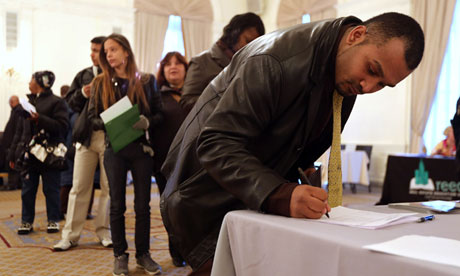
  • Unemployment at 4-Year-Low as U.S. Hiring Gains Steam


    Spencer Platt/Getty Images

    Job applicants waited to speak to employer representatives at a Jewish community center in New York this week.


    Unemployment at 4-Year-Low as U.S. Hiring Gains Steam


    By NELSON D. SCHWARTZ
     
    March 8, 2013


March 7, 2013

  • US unemployment rate falls to four-year low as economy adds 236,000 jobs

    Unemployment figures, US

    February was the 29th month in a row that the US economy had added jobs. Photograph: John Moore/Getty Images.


    The US added 236,000 new jobs in February as the unemployment rate edged down to 7.7%, its lowest level since December 2008. The figures easily beat economists' predictions that the US would add 160,000 jobs in February and look set to drive US stock markets to new record highs.

    This is 29th month in a row that the US has added jobs. On average, 183,000 jobs were added each month in all of 2012. In past three months, that pace has picked up to an average of about 195,000 a month.

    The Bureau of Labor Statistics said the job gains were made in professional and business services, construction, and healthcare. In a sign of the improving housing market, the construction industry added 48,000 in February. Since September, construction employment has risen by 151,000.

    There are still major issues in the job market, however. The number of long-term unemployed – those jobless for 27 weeks or more – was unchanged in February at 4.8m. These individuals accounted for 40.2% of the unemployed. The unemployment rates for teenagers (25.1%), black people (13.8%), and Hispanics (9.6%) remained high and showed little or no change.

    The number of people not in the labour force rose to 90.1m in February, up from 89.9m in January and 88.3 million in February 2012.

    The news comes after payroll giant ADP's latest poll concluded that the private sector added 198,000 jobs in February, higher than the 175,000 forecast by economists. The firm also revised its January number up to 215,000, 22,000 higher than its initial estimate.

    Mark Zandi, chief economist of Moody's Analytics, which compiles the report with ADP, said: "The job market remains sturdy in the face of significant fiscal headwinds. Businesses are adding to payrolls more strongly at the start of 2013 with gains across all industries and business sizes. Tax increases and government spending cuts don't appear to be affecting the job market."


    The jobs figures and better than expected figures from the service sector helped drive US stock markets to all time highs this week. On Tuesday, the Dow Jones Industrial Average passed levels unseen since before the start of the recession.

    Dow futures contracts, a shaky indication of the direction the stock market is likely to take, were rising before the New York Stock Exchange opened, suggesting the index could hit new highs Friday.


  • OSCAR PISTORIUS, HIS GIRLFRIEND, AND HIS GUN

    February 14, 2013

    OSCAR PISTORIUS, HIS GIRLFRIEND, AND HIS GUN

    Posted by 

    pistorius-close-read.jpg

    Oscar Pistorius, who ran in the Olympics on carbon-fibre blades, has been arrested and charged with the murder of his girlfriend, who was shot dead at his home in Pretoria. Her name was Reeva Steenkamp and she was twenty-nine years old. There has been talk in the press that he mistook her for an intruder, and maybe he did—the investigation is in its first stages. Brigadier Denise Beukes said, though, that “we are not sure where this report came from; it definitely didn’t come from the South African police service.” Beukes, who did not use Steenkamp’s name, pending her family’s identification of the body (though it was widely reported), added that there was no other suspect involved. There were witnesses—“we’re talking about neighbors and people that heard things”—but “the only two persons on the premises were the resident and the deceased.”

    What the police do know is that they have been to the home before. “I can confirm that there has previously been incidents at the home of Oscar Pistorius.” Pressed, she said that they had involved “allegations of domestic nature.” Beukes said that Steenkamp had been shot four times: “It’s a 9-mm pistol. It is a licensed firearm. It is licensed to Mr. Pistorius.”

    What exactly brought the police to Pistorius’s house those other days? And what persuaded them to walk away? Again, we don’t know yet, and maybe a comparison to all the visits that the police made to the home of O. J. Simpson, leaving without doing much of anything, is too facile at this point. Or maybe it comes too late, in terms of Steenkamp’s life. A famous man—or any person—learns very quickly what protects him, and what leaves a person close to him vulnerable. Pistorius and Steenkamp were a well-known couple. She was a model and had been on reality shows, and also studied law at Nelson Mandela Metropolitan University. They were photographed at parties; she had tweeted about looking forward to Valentine’s Day. (She had also, in the past, tweeted and retweeted about the problem of rape and violence against women in South Africa.)

    “She was an amazing girl, a really intelligent person,” a former editor of the South African edition of the magazine FHM told the Guardian. “It’s a hammer blow…. I’ve been trying to process it. It’s a real tragedy that such a bright girl has gone.”

    Pistorius hasn’t spoken publicly yet. He was led from the police station with the hood of his sweatshirt over his head; he will be in court tomorrow. His father reportedly told the South African Broadcasting Company that his son was “sad at the moment,” adding, “I don’t know the facts.” According to the AP, his former coach, Andrea Giannini, “said he hopes it was ‘just a tragic accident.’” But even the scenarios that exculpate Pistorius raise practical questions about guns.

    We have heard a good deal from the N.R.A. in the last couple of months about how a gun defends a home. Wayne LaPierre, the group’s executive vice-president and increasingly unhinged public face, has been out talking about how everyone needs a gun to be prepared for a coming time of financial crisis and natural disaster. South Africa and the United States are distinct countries with different gun cultures, but people are not so different. The array of objects within arm’s reach can turn a moment of rage to something worse in any country. A gun in the house makes it more likely that domestic violence will lead to murder. (The Times has a story this morning about how living with guns has also been connected to dying by suicide.) Oscar Pistorius’s gun did not keep Reeva Steenkamp safe. Living in a house with many guns did not keep Kasandra Perkins safe when Jovan Belcher, the father of her child, shot her and then himself.

    There is much to admire in the confidence that made Pistorius believe that he could challenge world running federations, and make them let him run. There was a clarity there, and inspiration, and the right kind of pride. (This morning, someone reportedly took a Nike ad with the line “I am the bullet in the chamber” off of his Web site.) There will be plenty of talk, too, about what brings athletes to both the highest levels of sports and to a place of domestic tragedy—publicity, pressure, even the unsettling question of performance-enhancing drugs and their psychological effects. That discussion is worth having. But what matters even more is what can happen in any home, in any room, with a man and a woman and a gun.

    Photograph by Thembani Makhubele/Reuters.

    Read more: http://www.newyorker.com/online/blogs/closeread/2013/02/oscar-pistorius-his-girlfriend-and-his-gun.html#ixzz2MpkzGCgb

March 3, 2013

  • Google Glass’ Women Problems

    Google Glass’ Women Problems

    TAYLOR BULEY

    posted 1 hour ago
    14 Comments

    glass-model-logo-google-1

    If you build it, they will come. Perhaps. And only if you don’t chase them away.

    Recently Google co-founder Sergey Brin took to the stage at theTED “Ideas Worth Spreading” conference. His idea worth spreading? That cellphones are “emasculating.”

    This newsbyte, currently making the rounds, appears here and elsewhere out of context from a much longer pitch for Google Glass, a high-tech monocle that is Google’s eyebrow-raising vision for the next generation of wearable computing. But with reporters there to witness it live, readers appear to have since deemed Brin’s remark the most shareworthy headline of the event. (When asked about the remark’s larger context, Google didn’t immediately elaborate on record.)

    With one word Brin appears to have shot in the direction of both feet: both possibly alienating Google’s male Android smartphone customers and offputting women who might otherwise be in the market for Google Glass.

    This is a point made clear by close technology follower and Wharton business ethics professorAndrea Matwyshyn, who writes to TechCrunch:

    That is a missed commercial opportunity. Women make a large portion of household consumer purchasing decisions in the United States, and they tend to spend equal or greater numbers of hours using technology as do men according to some studies.

    In other words, a marketing strategy that positions Google Glass as a “man gadget” potentially alienates half of the consumer base who might have been keenly interested in purchasing the product in the future.

    A question going forward is whether women beyond technology insiders like Matwyshyn have even heard about the gaffe, let alone Google Glass altogether. In the meantime, from an armchair perspective, charts from Google Trends shows usage for the “emasculating” search term has skyrocketed, and thousands of references to the quote appear to smear across Google News.

    If the first rule of speaking is to know your audience, such a remark prompts questions about whether Brin, and by extension Google, knows theirs. What will Google Glass be used for? The answer seems to be literally anyone’s guess.

    In a recently ended contest, Google asked potential Google Glass customers — when “applying” to purchase the $1,500 developer device — to identify and define themselves via the use of a #ifihadglass hashtag on Google+ or Twitter. Thanks to public messages and public APIs, results from the #ifihadglass marketing campaign are in effect transparent.

    In order to guess at what Google is seeing in terms of gender breakdown amid this abundance of marketing information, TechCrunch collected close to 11,000 Google+ posts and 22,000 tweets tagged with #ifihadglass and looked at the likely gender of the authors’ first names. The results suggest that if Google isn’t yet worried about encouraging female adoption of Google Glass, perhaps it should be.

    Amateur analysis is fraught with guesswork — especially when dealing with gender-by-name, since names such as “Taylor” can be donned by both females and males. To attempt to compensate, a probably for each gender was assigned using census data on how frequently the name occurs by gender in the United States. Names like “Elizabeth” with greater than a 95 percent certainty of being a given gender were assigned to a gender group; mixed names like “Taylor” are compared across genders and become ‘likely-male’ or ‘likely-female’ and grouped together as ‘uncertain’; both never-before-seen and non-names like “JetBlue” get lumped into the ‘ambiguous’ group.

    To be taken with skepticism, here’s the breakdown of the TechCrunch analysis of the likely gender of authors of #ifihadglass postings on Google+:

    • For the 7,358 Google+ postings whose authors had first names assigned to a gender group, 86% were guessed to be posted by males and 14% by females.
    • Including 517 uncertain cases, the numbers water down to 80% male and 13% female.
    • Among the uncertain cases, 77% where thought to be ‘likely male’ and 23% ‘likely female’.
    • 27% of the overall 10,782 found Google+ postings tagged with #ifihadglass were authored by people’s whose names were deemed ambiguous.

    For Twitter:

    • For the 10,524 Twitter tweets whose authors had first names assigned to a gender group, 80% were guessed to be male and 20% female.
    • Including 807 uncertain cases, the numbers adjust to 74% male and 19% female.
    • Among the uncertain cases, 72% where thought to be ‘likely male’ and 28% ‘likely female’.
    • 48% of the overall 21,684 tweets found at the time were deemed as authored by someone whose first name was too ambiguous to gender.

    guessedgendergoogleguessedgendertwitter

    Google has a real name policy that makes its publicly findable data quality a little better than Twitter’s. The gender breakdown of Google+ users is uncertain and so a good baseline of over-/under-representation by gender cannot be established across both Twitter and Google+.

    Any uncontrolled or publicly sourced data are suspect and the underlying dataset here is not an exception. Another possible problem is that kind of hashtag analysis also embraces the “no press is bad press” mentality and includes those freeriding with their own marketing efforts and and those just having some fun.

    Despite all the caveats, the numbers present a strong argument why Brin might be tempted to play up the “masculinity” angle for Google Glass: among early customers talking about “#ifihadglass,” about four out of five appear to be men.

    The other edge to this truth is that while it might be tempting to preach to the male demographic choir, in fact Google should perhaps be doing the opposite: encouraging early adoption among women. Without a representative customer base selling the first generation of this technology to their peers, Google could end up with the next Segway.

    An informal mining of the many different uses suggested by these prospective customers — among them, health and recreation (traveling, coaching, workout, biofeedback, biking, baby care), health and emergency services (emergency care, diagnosis, surgery), reference (instructional material, study aids/practice, translation, search, research, image recognition), location (GPS/maps, directions, traffic), communication (reading, sharing, teaching, training, tours), productivity (note taking, tasks) and cooking — none but the very visually- or manually-intensive applications scream for the immediate abandonment of the ubiquitous and “emasculating” smartphone. In this case, as in others, data seem to back common sense that it’s not a great marketing strategy to alienate a critical and already-trailing customer segment.


     © 2013 AOL Inc. All rights reserved.
     

February 24, 2013

  • Pompom Girl for Feminism

    Fred R. Conrad/The New York Times


    Go to Columnist Page February 23, Pompom Girl for Feminism


    By MAUREEN DOWD


    SHERYL SANDBERG is not one to settle for being the It Girl of Silicon Valley.

    Nor is the chief operating officer of Facebook willing to write a book that people might merely read.

    One of her friends from her Harvard days told Vogue that the brainy, beautiful, charming, stylish, happily married 43-year-old mother of two, one of the world’s richest self-made women, has an “infectious insistence.” (She would have to, having founded Harvard’s aerobics program in the ’80s, wearing blue eye shadow and leg warmers.)

    Now that she has domesticated the Facebook frat house, Sandberg wants to be “the pompom girl for feminism,” as she calls it. She has a grandiose plan to become the PowerPoint Pied Piper in Prada ankle boots reigniting the women’s revolution — Betty Friedan for the digital age. She wants women to stop limiting and sabotaging themselves.

    The petite corporate star is larger than life, and a normal book tour for “Lean In,” which she describes as “sort of a feminist manifesto” mixed with career advice, just won’t do.

    “I always thought I would run a social movement,” she said in “Makers,” an AOL/PBS documentary on feminist history.

    Sandberg may have caught the fever to change the world from Mark Zuckerberg, or come by it genetically. She writes that her mother, at age 11, responded to a rabbi’s sermon on tikkun olam, the Jewish concept of repairing the world, by “grabbing a tin can and knocking on doors to support civil rights workers in the South.”

    The charmed Sandberg is no Queen Bee. Unlike some other women who reach the top, she does not pull up the ladder, or jungle gym, as she prefers to think of it, behind her. Many women found it inspiring when she said in “Makers” that she left work at 5:30 to go home to her kids, even while they acknowledged that you might have to be Sheryl Sandberg to get away with that.

    Sandberg, who worked at the Treasury Department for her mentor, Larry Summers, and at Google before going to Facebook, started a group called the Women of Silicon Valley to listen to celebrity speakers and swap stories.

    She knows there is slow evolution or even erosion in women’s progress in some areas, and that many younger women don’t want to be called feminists. Professional women often take their husbands’ last names these days without a thought.

    Her book is chockablock with good tips and insights, if a bit discouraging at times. She urges women in salary negotiations to smile frequently and use the word “we” instead of “I.” And she encourages employers and women to talk upfront about plans for children, which employers may fear is lawsuit fodder.

    She seems to think she can remedy social paradigms with a new kind of club — a combo gabfest, Oprah session and corporate pep talk. (Where’s the yoga?)

    Sandberg has been recruiting corporations to join her Lean In Foundation, which will create the Lean In Community and Lean In Circles, which are, as The Times’s Jodi Kantor wrote, like “consciousness-raising groups of yore.” The circles will entail 8 to 12 peers who will meet monthly and use “education modules” to learn the skills to pursue equality. (Like how Rosa Parks used bus modules.) The debut assignment is a video on how to command more authority by altering how you speak and sit.

    Women are encouraged to send in stories about leaning in, but no sad sacks allowed: “Share a positive ending about what you learned from the experience,” says the instructional material for Lean In Circles. And no truants: “Don’t invite flakes.”

    That leaves me leaning out.

    Sandberg has already gotten some flak from women who think that her attitude is too elitist and that she is too prone to blame women for failing to get ahead. (Not everyone has Larry Page and Sergey Brin volunteering to baby-sit, and Zuckerberg offering a shoulder to cry on.) Noting that her Facebook page for “Lean In” looks more like an ego wall with “deep thoughts,” critics argue that her unique perch as a mogul with the world’s best husband to boot makes her tone-deaf to the problems average women face as they struggle to make ends meet in a rough economy, while taking care of kids, aging parents and housework.

    Sandberg describes taking her kids to a business conference last year and realizing en route that her daughter had head lice. But the good news was that she was on the private eBay jet.

    Sandberg may mean well, and she may be setting up a run for national office. But she doesn’t understand the difference between a social movement and a social network marketing campaign. Just because digital technology makes connecting possible doesn’t mean you’re actually reaching people.

    People come to a social movement from the bottom up, not the top down. Sandberg has co-opted the vocabulary and romance of a social movement not to sell a cause, but herself.

    She says she’s using marketing for the purpose of social idealism. But she’s actually using social idealism for the purpose of marketing.


    Copyright. 2013. The New York Times Company. All Rights Reserved


  • Barcelona beckons as testing gets serious 18 Feb 2013

    Barcelona beckons as testing gets serious 18 Feb 2013

    Fernando Alonso (ESP) Ferrari. Formula One World Championship, Rd20 Brazilian Grand Prix, Qualifying, Sao Paulo, Brazil, 24 November 2012Valtteri Bottas (FIN) Williams FW34. Formula One Testing, Day 4, Jerez, Spain, Friday, 8 February 2013Adrian Sutil (GER) Sahara Force India Formula One Team VJM04. Formula One World Championship, Rd 19, Brazilian Grand Prix, Practice Day, Interlagos, Sao Paulo, Brazil, Friday, 25 November 2011Sergio Perez (MEX) McLaren MP4-28. Formula One Testing, Day 4, Jerez, Spain, Friday, 8 February 2013Pirelli tyres. Formula One Testing, Day 2, Jerez, Spain, Wednesday, 6 February 2013Esteban Gutierrez (MEX) Sauber C32 kicks up the gravel. Formula One Testing, Day 4, Jerez, Spain, Friday, 8 February 2013Sebastian Vettel (GER) Red Bull Racing RB9. Formula One Testing, Day 4, Jerez, Spain, Friday, 8 February 2013

    The Formula One paddock heads back to Spain this week for the second of 2013’s three pre-season tests. The venue is Barcelona’s Circuit de Catalunya, a popular testing location due to its mild temperatures and technical layout that challenges every aspect of car and tyre performance. 

    The theory goes that if a car can be quick here, it can be quick almost anywhere and this is what all the teams will be trying hard to establish over the next four days. In the spotlight will be Fernando Alonso, driving the Ferrari F138 for the first time, and the new Williams FW35, which will make its debut on Tuesday.

    The Spanish fans will no doubt be out in force for Alonso, who saw team mate Felipe Massa post the fastest time of the recent opening Jerez test. The former champion sat out that session to concentrate on physical preparations for his 2013 campaign, but this week will spend three days in the car before handing over to Massa for the final day.

    Williams were the only team not to launch their 2013 car ahead of the first test, and this week should give some indication of whether that extra off-track development effort was time well spent. 2012 Spanish Grand Prix winner Pastor Maldonado will debut the FW35 on Tuesday, before new team mate Valtteri Bottas gets his first drive on Wednesday.

    Force India are also likely to find themselves the subject of intense media scrutiny in Spain - they are the only squad yet to finalise their 2013 line-up. Following a seat fitting for former driver Adrian Sutil last week, the German will make his F1 return as he takes to the track alongside Paul di Resta and team tester Jules Bianchi.

    Most pundits agreed it was all but impossible to draw any firm conclusions from the Jerez test, especially as the low temperatures and abrasive track surface meant it was hard to get the best from Pirelli’s 2013 tyres, though it was McLaren’s MP4-28 that many tipped as arguably the strongest of the new machines.

    Tyres will again be a primary focus in Barcelona this week - the minimal rule changes for 2013 mean most teams have come up with evolutionary (rather than revolutionary) car designs, so all are eager to get a handle on Pirelli’s revised rubber and the huge performance gains that it could bring them.

    “Barcelona is a circuit that the teams have plenty of data on already, which is useful for comparison purposes,” says Pirelli motorsport director Paul Hembery. “So it should be possible for them to carry out plenty of productive work to help understand how their new cars interact with our latest generation of tyres, which are generally softer and faster than last year with deliberately increased degradation.

    “The limiting factor at the opening test in Jerez earlier this month was the abrasiveness of the track, so hopefully conditions will be more representative this time. There is always the potential for low ambient temperatures though: last year, we actually saw some ice on the track in the morning…”

    And while the teams themselves also agreed that the time spent in Jerez was useful, they too expect the Circuit de Catalunya to provide a more realistic test of how their new cars perform, with aerodynamics - the key to modern F1 performance - playing a more important role here.

    It all means that by the end of this week, we might - just might - have a clearer idea of who will head to Australia next month as pre-season favourites for the 2013 FIA Formula One World Championship.

    As usual, Formula1.com will be bringing you images and reports from every day of the Barcelona test, so check back throughout the week for the latest news.

    For tickets and travel to 2013 FORMULA 1 races, click here.
    For FORMULA 1 and F1 team merchandise, click here.


    © 2003-2013 Formula One World Championship Limited. All Rights Reserved

February 23, 2013

  • Antigua’s Legal “Pirate Site” Authorized by the World Trade Organization

    Antigua’s Legal “Pirate Site” Authorized by the World Trade Organization

    During a meeting in Geneva today the World Trade organization (WTO) authorized Antigua’s request to suspend U.S. copyrights. The decision confirmed the preliminary authorization the Caribbean island received in 2007, and means that the local authorities can move forward with their plan to start a download portal which offers movies, music and software without compensating the American companies that make them.

    warez-agLast week we broke the newsthat the island nation Antigua and Barbuda wants to start a Government run “pirate” site.

    Today, this plan came a step closer to reality when the Caribbean country received authorization from the WTO to suspend U.S. copyrights during a meeting in Geneva.

    This decision affirms the preliminary approval that was granted to Antigua in 2007 after the country won a gambling related trade dispute against the United States.

    At the moment it’s still unclear what Antigua’s exact plans are but TorrentFreak is informed that the media portal will offer movies, TV-shows, music as well as software to customers worldwide.

    Antigua’s Finance Minister Harold Lovell said in a comment that the U.S. left his Government no other option than to respond in this manner. Antigua’s gambling industry was devastated by the unfair practices of the U.S. and years of negotiations have offered no compromise.

    “These aggressive efforts to shut down the remote gaming industry in Antigua has resulted in the loss of thousands of good paying jobs and seizure by the Americans of billions of dollars belonging to gaming operators and their customers in financial institutions across the world,” Lowell says.

    “If the same type of actions, by another nation, caused the people and the economy of the United States to be so significantly impacted, Antigua would without hesitation support their pursuit of justice,” the Finance minister adds.

    The Government has not given a time-frame for the release of the site, which has been in the works for a few months already. Ideally, Antigua hopes to settle the dispute before opening up their free media portal but there are no signs that the U.S. is going to comply with the WTO rulings.

    Thus far, the U.S. has only warned Antigua that “Government-authorized piracy” would harm the ongoing settlement discussions.

    “Government-authorized piracy would undermine chances for a settlement that would provide real benefits to Antigua. It also would serve as a major impediment to foreign investment in the Antiguan economy, particularly in high-tech industries,” U.S. officials said earlier.

    However, these comments haven’t changed Antigua’s course. Emanuel McChesney, Chairman of the Antigua and Barbuda Investment Authority, is not impressed by this apparent scare tactic.

    “We assume this is just rhetoric for public consumption, and we look forward to the United States putting aside these tactics and focusing their future efforts on thoughtful negotiation rather than on hyperbole and intimidation,” McChesney.

    The Antiguan government further reiterated today that the term “piracy” doesn’t apply in this situation, as they are fully authorized to suspend U.S. copyrights. It is a legal remedy that was approved by all WTO members, including the United States.

    If Antigua does indeed pull through, it will be rather interesting to see how the U.S. responds. It might add a whole new dimension to the ongoing “war on piracy.”