MADRID — For decades, the members of Spain’s royal family were treated with profound deference by the public, politicians and the media. Their private lives generally went uninvestigated, their whereabouts unreported, and the sources of King Juan Carlos’s vast personal wealth were not discussed, even though he came to the throne with almost no money in 1975, after the death of Gen. Francisco Franco.
But times have changed, both for the king and the country. Spain is in the midst of an economic and identity crisis, having tied its fortunes to the now-troubled European Monetary Union. The 75-year-old king is increasingly unpopular, and polls suggest that far from attracting sympathy, his declininghealth has intensified calls for him to abdicate in favor of Crown Prince Felipe, his 45-year-old son.
Politicians and journalists are starting to dig deeper now, and the taboos are falling away. Almost every week, the royal family seems to be confronted with fresh embarrassments and accusations, some leveled at the king himself, and nearly every aspect of the family’s personal and financial life has become fair game.
“The protective shield of the royal family has simply disappeared,” said Carmen Enríquez, who has written several books about the royal family and who served as the royal correspondent for Spain’s national television network for almost two decades. “We are in a serious crisis, where suffering citizens feel they should know where every cent of public money is being spent, including by the monarchy.”
Thousands of people demonstrated against the monarchy in central Madrid on Sunday, the 82nd anniversary of the establishment of Spain’s last Republican government, which was supplanted by the Franco dictatorship after a civil war. Several demonstrators held posters calling for Spain to replace Juan Carlos with an elected head of state.
Earlier this month, the main Socialist opposition party took steps in Parliament that, for the first time, formally requested information about the king’s personal finances. The request followed a report in the newspaper El Mundo asserting that Juan Carlos had stashed money in secret Swiss bank accounts he inherited from his father. The royal household said it would look into the allegations before issuing any response.
Last week, a book that makes several embarrassing claims about the personal history of Princess Letizia, the wife of Felipe, was published. It sold out almost immediately. The book was written by David Rocasolano, a cousin of the princess whom she once employed as a lawyer.
The book drew immediate scorn from royal supporters, who said it was inaccurate and amounted to an act of treason. Whatever its accuracy, the publication underlined the breadth and intensity of the criticism being leveled against the royal family.
The wedge that has exposed the family to deep scrutiny is probably the corruption investigation centered on Iñaki Urdangarin, the king’s son-in-law. The matter touched on the king himself last week, when the royal household was confronted with claims that Juan Carlos had personally intervened to secure the appointment of Mr. Urdangarin, a former Olympic handball player, as assistant coach of the national team of Qatar. The palace said that while the king had telephoned Sheik Hamad bin Khalifa al-Thani of Qatar several times, their conversations were related to a Spanish shipbuilding contract and not to Mr. Urdangarin’s sporting ambitions.
That the news media raised the issue at all was surprising. Calling on influential friends has long been the king’s way of conducting business for the family, according to royal watchers. That pattern is also seen in e-mail messages that have been leaked in the investigation of Mr. Urdangarin, which concerns lucrative contracts he was given by Spanish regional governments to organize sports events.
The judge in the case also recently subpoenaed Mr. Urdangarin’s wife, Princess Cristina — an unprecedented step by Spain’s courts that further tarnished the royal image.
The royals are not the only ones coming under greater scrutiny: almost no political party in Spain has been spared an inquiry. Arguably, the most damaging landed on the doorstep of Prime Minister Mariano Rajoy and his governing Popular Party, which is accused of operating a slush fund. Nearly every institution of power in the country has been touched by corruption and popular disillusionment.
Still, the royal family’s fall from popular grace is probably the most striking example. It seemed to start in earnest last April when the king was forced to make a highly unusual apology after returning from a lavish elephant hunting excursion to Botswana, which came to public attention only because he fell and broke his hip on the trip.
Since then, the king has undergone more surgical procedures, prompting even some supporters of the monarchy to suggest that he abdicate, including the prominent political columnist José Antonio Zarzalejos, a former editor in chief of the conservative newspaper ABC.
“The king is clearly not in perfect health, and has made many errors, so he doesn’t have the capacity to lead that his son does,” said Mr. Zarzalejos, who describes himself as “an absolute monarchist.”
He said that during his tenure as ABC’s editor, he was not subject to formal censorship from the royal household, but voluntarily restrained coverage of the monarchy, as other mainstream publications did.
“The media consented not to publish some things,” Mr. Zarzalejos said. “That wasn’t driven by fear, but instead by respect and gratefulness” for the role the king played in anchoring Spain’s return to democracy after decades of dictatorship under Franco.
A spokesman for the royal household said it was well aware of the fall in popularity of the monarchy and the king himself, but also said the monarchy remained more popular than many other institutions in the country. The spokesman underlined efforts to make the royal household more transparent, including greater disclosure about its financial assets, which would be required under a broader law that Mr. Rajoy’s government is pushing through Parliament.
But Ms. Enríquez, the former television correspondent, said that in today’s Spain, the family may have had little choice: “The royal household itself has come to understand that it could not stay out of such a transparency law without provoking a genuine public clamor.”
Copyright. 2013. The New York Times Company.All Rights Reserved
It’s such a silly question. Of course Hillary is running. I’ve never met a man who was told he could be president who didn’t want to be president. So naturally, a woman who’s told she can be the first commandress in chief wants to be.
“Running for president is like sex,” James Carville told me. “No one ever did it once and forgot about it.”
Joe Biden wants the job. He’s human (very). But he’s a realist. He knows the Democratic Party has a messianic urge to finish what it started so spectacularly with the election of Barack Obama — busting up the world’s most exclusive white-bread old-boys’ club. And he knows that women, both Democratic and Republican, want to see one of their own in the White House and became even more militant while listening to the G.O.P.’s retrogressive talk about contraception and vaginal probes last year.
Also, Joe genuinely likes Hillary. These two have no appetite for tearing each other apart.
As long as there are no more health scares — the thick glasses are gone — Hillary’s age won’t stop her. The Clinton scandals and dysfunction are in the rearview mirror at the moment, and the sluggish economy casts a halcyon glow on the Clinton era. Hillary is a symbol and a survivor, running on sainthood. Ronald Reagan, elected at 69, was seen as an “ancient king” gliding through life, as an aide put it. Hillary, who would be elected at 69, would be seen as an ancient queen striding through life.
She was supposed to go off to a spa, rest and get back in shape after her grueling laps around the world. But instead she’s a tornado of activity, speaking at global women’s conferences in D.C. and New York; starting to buck-rake on the speaking circuit; putting out a video flipping her position to support gay marriage; and signing a lucrative deal for a memoir on world affairs — all as PACs spring up around her, Bill Clinton and Carville begin to foment, and Chelsea lands on the cover of this week’s Parade, talking about how “unapologetically and unabashedly” biased she is about her mother’s future.
“I can’t see her taking it easy and sitting on the couch eating a bowl of popcorn,” said Randall Johnston, a 25-year-old New York University Law School student who helped pass out “Ready for Hillary” signs on Friday outside Lincoln Center, while her icon was inside enthralling the crowd at Tina Brown’s “Women in the World” conference.
Hillary jokes that people regard her hair as totemic, and just so, her new haircut sends a signal of shimmering intention: she has ditched the skinned-back bun that gave her the air of a K.G.B. villainess in a Bond movie and has a sleek new layered cut that looks modern and glamorous.
In a hot pink jacket and black slacks, she leaned in for a 2016 manifesto, telling the blissed-out crowd of women that America cannot truly lead in the world until women here at home are full partners with equal pay and benefits, careers in math and science, and “no limit” on how big girls can dream.
“This truly is the unfinished business of the 21st century,” she said. But everyone knew the truly “unfinished business” Hillary was referring to: herself.
“She’s gone to hell and back trying to be president,” Carville said. “She’s paid her dues, to say the least. The old cliché is that Democrats fall in love and Republicans fall in line. But now Republicans want a lot of people to run and they want to fall in love. And Democrats don’t want to fight; they just want to get behind Hillary and go on from there.”
The real question is not whether but whither. Does Hillary have learning software? Did she learn, from her debacle with health care, to be more transparent and less my-way-or-the-highway? Did she learn, after voting to support W.’s nonsensical invasion of Iraq without even reading the intelligence estimate, that she doesn’t need to overcompensate to show she’s tough? (No one, even Fox News, thinks she’s a Wellesley hippie anymore.)
Did she learn, from her viper’s nest and money pit of a campaign in 2008, how to manage an enterprise rather than be swamped by rampant dysfunction? Did she learn, when she wrapped herself in an off-putting and opaque mantle of entitlement in the primary, that she’s perfectly capable of charming reporters and voters if she wants to, without the obnoxious undertone of “I’m owed this”?
Even top Democrats who plan to support Hillary worry about her two sides. One side is the idealistic public servant who wants to make the world a better place. The other side is darker, stemming from old insecurities; this is the side that causes her to make decisions from a place of fear and to second-guess herself. It dulls her sense of ethics and leads to ends-justify-the-means wayward ways. This is the side that compels her to do anything to win, like hiring the scummy strategists Dick Morris and Mark Penn, and greedily grab for what she feels she deserves.
If Obama is the kid who studies only on the night before and gets an A, Hillary is the kid who studies all the time, stays up all night and does extra credit work to get the A. She doesn’t know how not to drive herself into the ground.
As Carl Bernstein wrote in his Hillary biography, “A Woman in Charge,” her insecurities grew from her herculean effort to win paternal praise: “When Hillary came home with all A’s except for one B on her report card, her father suggested that perhaps her school was too easy, and wondered half-seriously why she hadn’t gotten straight A’s. Hillary tried mightily to extract some unequivocal declaration of approval from her father, but he had tremendous difficulty in expressing pride or affection.”
Hillary was an indefatigable secretary of state — she logged 956,733 diplomatic frequent-flier miles — and a star ambassador, especially on women’s issues. But many experts feel, as John Cassidy wrote in The New Yorker, that, compared with the work of more geopolitical secretaries, her “signature achievements look like small beer.”
Still, the job allowed her to get out of her husband’s codependent shadow and develop a more authentic aura of inevitability. President Obama allowed his former rival to take Hillaryland into the State Department and then build it out, burnishing her own feminist brand around the world.
The idea of Hillary is winning, a grand historical gender bender: first lady upgrading to president. But is the reality winning? The Clintons have a rare talent for finding puddles to step in. Out of public life, can she adapt and make the leaps needed, in a world changing at a dizzying tempo, to keep herself on top?
Her challenge is to get into the future and stay there, adding fresh people and perspectives and leaving the Clinton mishegoss and cheesiness in the past.
The real question about Hillary is this: When people take a new look at her in the coming years, will they see the past or the future — Mrs. Clinton or Madam President?
Copyright. 2013. The New York Times Company. All Rights Reserved
putthison Copyright 2013. putthison@tumblr.com All Rights Reserved
The OCBD Shirt Series, Part II: The "Golden Era" Oxfords
“They’re such beautiful shirts,” she sobbed, her voice muffled in the thick folds. “It makes me sad because I’ve never seen such – such beautiful shirts before.” -The Great Gatsby
My original interest in doing this series was to track down “Golden Era” Brooks Brothers OCBDs and see how one of the most classic American clothing designs has evolved over the last hundred years or so. Finding old Brooks shirts hasn’t been easy, however. Brooks Brothers, at least to my knowledge, doesn’t have a clothing archive like Levis or Gant, so I’ve had to track down deadstocks and vintage pieces owned by collectors and enthusiasts. I found mine through Ethan at O’Connell’s, Mariano at Typhoid Jones, and Giuseppe atAn Affordable Wardrobe. What they sent me collectively represents about 75 years of Brooks’ OCBD history, which has rarely been seen together before.
To understand why the OCBD became popular, you only need to know what men used to wear before it was invented. Here we see one of Brooks Brothers’ detachable collar shirts and accompanying collars from the early 20thcentury. The shirt is made from cotton, but the collar is made from linen, cardboard, and various composite materials. It’s difficult to tell from a photograph, but the collar is very, very stiff (you can kind of infer this from the fact that it’s standing up so straight on my table). In the hand, it feels something like thick, heavy cardstock.
In the 19thand early 20thcenturies, men wore detachable collar shirts because clothing was still handmade and very expensive, so they wanted to preserve their shirts for as long as possible. Since most men wore undershirts, the parts of the dress shirt that would get worn down the most were the parts that came in contact with the skin – that is, the collars and cuffs. Having these detachable not only meant they could be more easily laundered and ironed, but also that they could be replaced without having to buy an entirely new shirt. Sometimes women of a household would make these collars, but you can tell this one was store bought because of the stamping inside.
The high, stiff collar, however, was very uncomfortable, as you can imagine. So when Brooks introduced a ready-made, soft collar shirt, it was instantly popular. The earliest versions were something like a long-sleeved pullover shirt, as you see here.
These were, after all, originally meant to be sport shirts, so they were more casual in nature. Eventually however, Brooks introduced a five button “coat style” shirt, and then later replaced it with a six-button. A “coat style” is what we’re most familiar with today – the full front of the body opens up like a coat, and then is secured again with buttons.
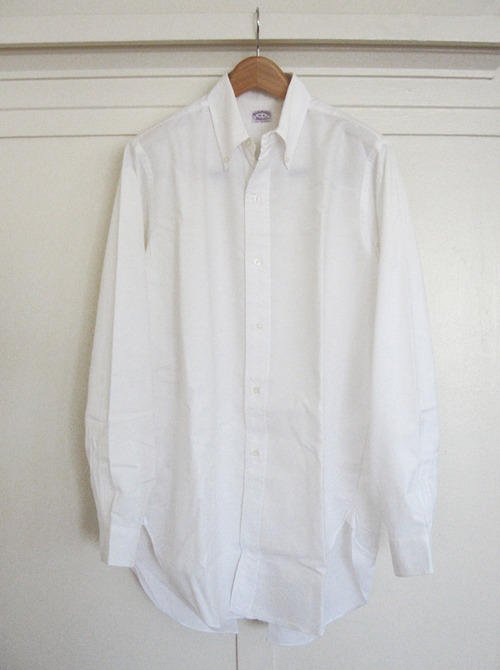
This is an example of a six button coat-style OCBD, which dates back to 1949. Two things to note: the absence of a chest pocket and the presence of a side gusset at the hem. All of the early versions of Brooks’ shirts – OCBD or not – seem to be like this, but as we’ll soon see, a pocket was later added and the gusset was taken out.
Next is a pink candy-striped OCBD from the 1960s. This piece arrived to me in near tatters. The right side seam, for example, is busted and frayed, and the collar is so worn down that the back is falling apart. On the upside, because of how the collar has broken down, you can see that there’s no interlining inside. If you were to cut open almost any OCBD today, you’d see a strip of fabric inside the collar used to make more “behaved.” Brooks does this nowadays as well, but the originals were unlined and incredibly soft. The lack of interlining also meant a “messier” looking collar. Terrible for the modern man who wants control in every aspect of life, but great for people who understand why mid-century OCBDs looked so charming and carefree.
On this 1960s specimen we also see the introduction of a curved chest pocket, which remained on future OCBD designs from this period on forward. The hem is also uniquely curved, though that seems to vacillate with time.
A yellow candy-striped OCBD from the 1980s is nearly identical, save for the more angled curve at the hem.
Finally, we arrive at the 1990s, when an additional button was added, to help keep the front from gaping when the collar naturally shrunk over time. This is design has more or less remained the same till today.
From photos alone, it would seem that the original OCBD has largely remained unchanged, save maybe for the transformation of the pullover to a coat-style shirt, the addition of a chest pocket, and the slow addition of buttons from five to six and then eventually to seven.
This is partly true, as many things that have been retained. Obviously, there’s still the iconic button down collar, with two buttons to secure the collar tips, which originated when polo players needed some way of keeping collar points from flapping into their faces. Just below the short of the yoke (which always seemed to measure about one and a half inches on a 15.5 size shirt), there’s always the beginning of a box pleat (with no locker loop) that ran down the middle of the back. This would go all the way to the waist, where the pleat would then expand into the fullness of the shirt tail. There’s also always a fold over placket at the front, to help keep the button line straight, pleated sleeves (as opposed to shirred) with no gauntlet buttons, and a uniquely off-centered cuff button (though this style seems to be slightly mitigated on later shirts).
>
The off-center cuff button is a stylistic holdover from when men who would write with quill pens. Since they didn’t want to get ink on their shirts, they’d fold back the cuff of their Brooks Brothers sleeves just a bit, which a slightly higher, off-center button design allowed.
However, a lot has also changed. At the heart of it, sometimes either in the 1990s or shortly after, Brooks added an unfused interlining to their collar. This made them slightly heavier and more “behaved.” The collar leafs didn’t wrinkle as much or change with the wearer’s position, and the collar towards the back didn’t rumple from the bulk of the tie underneath. The cut of the collar itself has also been modified over the years. In a February 1926 issue of Men’s Wear, one author described a sized 15.5 Brooks OCBD as having:
“[C]ollar points measure three and one-half inches in length, buttons placed three quarters of an inch from the tips and three and one quarter inches apart. At the top of the collar is a half inch space to permit the high set of a cravat knot. […] For the neckband, there is simply an additional inner and outer strip of the fabric. This band measures one and one-half inches in back and one inch in front, although the double thickness of the collar extends up another quarter of an inch all around.”
This may seem like absurd accounting, but the author was trying to, in his words, give “some measurements and features that make this shirt more than just a shirt.” Undoubtedly, it was talking about how the collar rolled and looked when buttoned down.
These measurements have largely remained the same, except with some minor adjustments. In the 1940s through the 80s, for example, the collar tip buttons were set about a half inch further apart. And today, we have them set back to their original 1929 style, but the collar tips have shrunk about a quarter of an inch. These all don’t sound like much, but when the total measurements themselves are one to three inches, such changes really affect how the collar looks.
Not to be wistful about days gone by, but there is something uniquely special about these “Golden Era” oxfords. Their particular proportions and collar constructions seemed to give them an enviable roll – something like two angel wings - when the collar points were secured. They had a very particular comfortable and carefree look, while still affording the wearer to look educated, well-mannered, and professional. It’s a bit hard to tell that just from photographs of shirts hung on hangers, but it’s rather evident whenever you see a photograph of someone wearing a Brooks button down during the early- to mid-century.
Brooks Brothers’ oxfords cloth button downs were, and continue to be, a hallmark of classic American style. When they were introduced, they revolutionized how men dressed. Not only because of their uniquely soft and comfortable collars, but also because they were the first ready-made, attached collar shirts. They also signaled the beginning of a uniquely casual American style of dress, one that Brooks would pioneer for the next seventy-five to eighty years. In the history of men’s clothing, there’s perhaps never been a shirt that’s been so beloved by so many for so long.
* Special thanks to Ethan, Mariano, and Giuseppe for their kindness in lending me these shirts for so long, and to Kelly Brooks Brothers for helping me date them.
Jay Directo/Agence France-Presse — Getty Images
Weighing gold nuggets in the Philippines.
April 10, 2013
Falling Fortunes The price of gold has had an extraordinary run up in the last 10 years, creating wealth for investors. But its price has fallen in the last two years.
Justin Lane/European Pressphoto Agency
Traders at the New York Mercantile Exchange when the gold prices hit a nominal high in 201
Narendra Shrestha/European Pressphoto Agency
A jeweler in Katmandu, Nepal. A French bank says the price of gold could fall for years to come.
Matt York/Associated Press
A 1-ounce gold coin. Some investors expecting high inflation are sticking with gold, but it lost $28 an ounce on Wednesday.
Below the streets of Lower Manhattan, in the vault of the Federal Reserve Bank of New York, the world’s largest trove of gold — half a million bars — has lost about $75 billion of its value. In Fort Knox, Ky., at the United States Bullion Depository, the damage totals $50 billion.
Falling Fortunes The price of gold has had an extraordinary run up in the last 10 years, creating wealth for investors. But its price has fallen in the last two years.
A 1-ounce gold coin. Some investors expecting high inflation are sticking with gold, but it lost $28 an ounce on Wednesday.
And in Pocatello, Idaho, the tiny golden treasure of Jon Norstog has dwindled, too. A $29,000 investment that Mr. Norstog made in 2011 is now worth about $17,000, a loss of 42 percent.
“I thought if worst came to worst and the government brought down the world economy, I would still have something that was worth something,” Mr. Norstog, 67, says of his foray into gold.
Gold, pride of Croesus and store of wealth since time immemorial, has turned out to be a very bad investment of late. A mere two years after its price raced to a nominal high, gold is sinking — fast. Its price has fallen 17 percent since late 2011. Wednesday was another bad day for gold: the price of bullion dropped $28 to $1,558 an ounce.
It is a remarkable turnabout for an investment that many have long regarded as one of the safest of all. The decline has been so swift that some Wall Street analysts are declaring the end of a golden age of gold. The stakes are high: the last time the metal went through a patch like this, in the 1980s, its price took 30 years to recover.
What went wrong? The answer, in part, lies in what went right. Analysts say gold is losing its allure after an astonishing 650 percent rally from August 1999 to August 2011. Fast-money hedge fund managers and ordinary savers alike flocked to gold, that haven of havens, when the world economy teetered on the brink in 2009. Now, the worst of the Great Recession has passed. Things are looking up for the economy and, as a result, down for gold. On top of that, concern that the loose monetary policy at Federal Reserve might set off inflation — a prospect that drove investors to gold — have so far proved to be unfounded.
And so Wall Street is growing increasingly bearish on gold, an investment that banks and others had deftly marketed to the masses only a few years ago. On Wednesday, Goldman Sachs became the latest big bank to predict further declines, forecasting that the price of gold would sink to $1,390 within a year, down 11 percent from where it traded on Wednesday. Société Générale of France last week issued a report titled, “The End of the Gold Era,” which said the price should fall to $1,375 by the end of the year and could keep falling for years.
Granted, gold has gone through booms and busts before, including at least two from its peak in 1980, when it traded at $835, to its high in 2011. And anyone who bought gold in 1999 and held on has done far better than the average stock market investor. Even after the recent decline, gold is still up 515 percent.
But for a generation of investors, the golden decade created the illusion that the metal would keep rising forever. The financial industry seized on such hopes to market a growing range of gold investments, making the current downturn in gold felt more widely than previous ones. That triumph of marketing gold was apparent in an April 2011 poll by Gallup, which found that 34 percent of Americans thought that gold was the best long-term investment, more than another other investment category, including real estate andmutual funds.
It is hard to know just how much money ordinary Americans plowed into gold, given the array of investment vehicles, including government-minted coins, publicly traded commodity funds, mining company stocks and physical bullion. But $5 billion that flowed into gold-focused mutual funds in 2009 and 2010, according to Morningstar, helped the funds reach a peak value of $26.3 billion. Since hitting a peak in April 2011, those funds have lost half of their value.
“Gold is very much a psychological market,” said William O’Neill, a co-founder of the research firm Logic Advisors, which told its investors to get out of all gold positions in December after recommending the investment for years. “Unless there is some unforeseen development, I think the market is going lower.”
Gold’s abrupt reversal has also been painful for companies that were cashing in on the gold craze. In the last year, two gold-focused mutual funds were liquidated after years of new fund openings, Morningstar data shows. Perhaps the most famous company to come out of the 2011 gold rush, the retail trading company Goldline, has drastically cut back its advertising on cable television, lowering spending to $3.7 million from $17.8 million in 2010, according to Kantar Media.
Goldline agreed to pay $4.5 million last year to settle charges brought by the city attorney of Santa Monica, Calif., accusing the company of running a bait-and-switch operation. Goldline did not respond to requests for comment for this article.
But the worst news for gold is probably good news for the broader economy, which, though still struggling to grow, has recovered from its lows.
“As the economy improves, the demand for gold as a financial hedge declines more than the fundamental demand for gold jewelry increases,” said Daniel J. Arbess, a partner at Perella Weinberg Partners, who sold off his fund’s large stake in gold in the fourth quarter of 2012.
Investment professionals, who have focused many of their bets on gold exchange-traded funds, or E.T.F.’s, have been faster than retail investors to catch wind of gold’s changing fortune. The outflow at the most popular E.T.F., the SPDR Gold Shares, was the biggest of any E.T.F. in the first quarter of this year as hedge funds and traders pulled out $6.6 billion, according to the data firm IndexUniverse. Two prominent hedge fund managers who had taken big positions in gold E.T.F.’s, George Soros and Louis M. Bacon, sold in the last quarter of 2012, according to recent regulatory filings.
“Gold was destroyed as a safe haven, proved to be unsafe,” Mr. Soros said in an interview last week with The South China Morning Post of Hong Kong. “Because of the disappointment, most people are reducing their holdings of gold.”
Gold’s most vocal bulls say gold doubters are losing faith too easily. Peter Schiff, the chief executive of the investment firm Euro Pacific Capital, said that he still expected gold to hit $5,000 an ounce within a few years because, he said, the world is headed for a period of dangerous hyperinflation.
“People believe the U.S. economy is recovering. It’s not,” said Mr. Schiff.
The most famous investor who is standing by gold is John Paulson, the hedge fund manager who made a fortune betting against the American housing market. His $900 million gold fund reportedly dropped 26 percent in the first two months of this year.
Mr. Paulson’s losses were particularly severe because he bet heavily on gold mining companies, which have fallen more sharply than gold itself.
Mr. Norstog, in Pocatello, made a similar mistake. He put his money in a gold fund that was focused on mining company stocks.
“If I had to do it all over again, I would have just bought the gold,” Mr. Norstog said. “At least that way I could have run my fingers through the glittering coins.”
Copyright. 2013. The New York Times Company. All Rights Reserved
A version of this article appeared in print on April 11, 2013, on page B1 of the New York edition with the headline: A Sure Bet Loses Its Luster.
The container port in Pusan, South Korea. Citigroup cut a deal with Blackstone, which insured the bank against some losses on a roughly $1 billion pool of shipping loans.
APRIL 10, 2013, 7:39 PM
Seeking Relief, Banks Shift Risk to Murkier Corners
Banks have been shedding risky assets to show regulators that they are not as vulnerable as they were during the financial crisis. In some cases, however, the assets don’t actually move — the bank just shifts the risk to another institution.
This trading sleight of hand has been around Wall Street for a while. But as regulators press for banks to be safer, demand for these maneuvers — known as capital relief trades or regulatory capital trades — has been growing, especially in Europe.
Citigroup, Credit Suisse and UBS have recently completed such trades. Rather than selling the assets, potentially at a loss, the banks transfer a slice of the risk associated with the assets, usually loans. The buyers are typically hedge funds, whose investors are often pensions that manage the life savings of schoolteachers and city workers. The buyers agree to cover a percentage of losses on these assets for a fee, sometimes 15 percent a year or more.
The loans then look less worrisome — at least to the bank and its regulator. As a result, the bank does not need to hold as much capital, potentially improving profitability.
“I think we are going to see more of these type of trades in the U.S. given the demands by regulators to hold more capital,” said Kevin White, a former executive at Lehman Brothers who founded Spring Hill Capital Partners, which is working with banks to structure regulatory capital trades.
Citigroup, Credit Suisse and UBS declined to comment on their trades. Privately, however, bankers acknowledge that while these trades may be pushing risk into a less regulated corner of Wall Street, they also point out that the risk is being moved into a less systemic part of the financial industry than the big banks.
The rule-writing going on as part of the Dodd-Frank financial regulatory overhaul may prevent some of these trades, but bankers say this will simply force them to structure the trades differently.
Some regulators say they are concerned that in some instances these transactions are not actually taking risk off bank balance sheets. For instance, a financial institution may end up lending money to clients so they can invest in one of these trades, a move that could leave a bank with even more risk on its books.
Critics point to other reasons to worry. Most of these trades are structured as credit-default swaps, a derivative that resembles insurance. These kinds of swaps pushed the insurance giant American International Group to the brink of collapse in September 2008. Another red flag is that banks often use special-purpose vehicles located abroad, frequently in the Cayman Islands, to structure these trades.
“These trades allow the banks to go to regulators and say the risk is gone,” said Anat R. Admati, a professor of finance at Stanford University. “But it’s not gone at all; it’s just been pushed into a murky corner of the market.”
The trades can take many forms, but typically a bank will buy a credit-default swap on some of its loans from a special-purpose vehicle, which is financed by outside investors. If all goes well, the investors receive an annual fee for taking on this risk. But in the worst case, where the loans in the portfolio default, the insurance that the bank has bought kicks in and covers its losses. The investors on the other side are wiped out.
A number of American investment firms like Spring Hill Capital Partners have been trying to find investors for these deals. Glenn Blasius, another Lehman alumni, said he was raising money for the Ovid Regulatory Capital Relief Fund, which will invest in these trades.
The Orchard Global Capital Group has raised a fund to invest in regulatory capital trades, and the New Mexico Educational Retirement Board is among its investors.
In December 2011, Allan Martin, a representative with an investment consultant firm that advises pension funds, met with the New Mexican pension fund over investing through Orchard in a regulatory capital trade, according to the minutes of a board meeting.
Mr. Martin explained to the retirement board that these transactions had been created to allow the banks “to continue to hold the assets on their balance sheet” while selling some of the risk.
At the meeting, Jan Goodwin, executive director of the New Mexico Educational Retirement Board, asked about the use of credit-default swaps, which got A.I.G. into trouble. Mr. Martin admitted that the Orchard deal “has a little flavor of that” but said Orchard had done “a great deal” of due diligence on the underlying collateral, something he said A.I.G. often didn’t do.
In an interview, Mr. Martin said that “a lot of clients ask how this is different than A.I.G.,” and he said it was because Orchard had a better understanding of the risks involved in the assets it was dealing with.
An executive with Orchard did not respond to requests for comment.
Many major banks have structured these trades. In March, Credit Suisse completed a transaction named Lucerne, after the Swiss lake, in which it bought insurance on a 5 billion Swiss franc portfolio of small and medium-size Swiss business loans, according to people who were briefed on the matter but not authorized to speak on the record because they had signed confidentiality agreements.
Credit Suisse agreed to take a small percentage of the losses, and it lined up American and European investors willing, for an annual fee of roughly 10 percent, to assume the rest of the risk, these people say.
Citigroup cut a deal at the end of last year with the private equity firm Blackstone Group, which insured the big bank against a portion of the losses on a roughly $1 billion pool of shipping loans. The bank used a special-purpose vehicle in Ireland called Cloverie to facilitate the trade, according to people briefed on the matter but not authorized to speak on the record.
For its part, Blackstone put up about $100 million, or 12 percent of the value of the shipping portfolio, to cover any possible losses. If things go well, Blackstone will receive a return of about 15 percent, these people say. If the shipping loans go sour, Citigroup gets Blackstone’s money and the private equity firm loses its cash.
Credit Suisse received capital relief on the Lucerne deal, although the exact amount is not known. Citigroup was able to reduce by roughly 90 percent the amount of capital it needed to set aside to cover losses on the shipping portfolio.
One Citigroup executive with knowledge of this trade but not authorized to speak on the record said it was structured to reduce Citigroup’s exposure to shipping loans. The fact that it reduced the amount of capital the bank had to hold was “an added bonus.”
UBS also recently completed a regulatory capital trade, selling a piece of the risk on a portfolio of roughly 100 corporate loans, according to people who reviewed the transaction but who declined to speak publicly because they had signed confidentiality agreements.
And Citigroup is marketing a second risk capital trade involving shipping loans, according to people briefed on the matter.
“These trades are a good thing,” said Richard Robb, a New York money manager whose firm, Christofferson, Robb & Company, has been structuring regulatory capital trades for more than a decade. “The best way to protect the banks against this risk is to move it outside the banking system to wealthy institutions. No one will be coming to bail out our company or our investors if these trades backfire.”
Copyright. 2013 The New York Times Company. All Rights Reserved
British Prime Minister Margaret Thatcher in 1980, during her first term. She died of a stroke on Monday at the age of 87
Whatever you thought of Margaret Thatcher — and during an unbroken stretch in office from 1979 to 1990 the former Prime Minister, who died on April 8 after a stroke, aged 87, attracted both passionate support and deep loathing — you never doubted her force of will. The Iron Lady showed her mettle again and again, wrenching Britain, often brutally, out of a malaise and sense of all-encompassing failure that had blighted it for much of the era after the end of World War II. This meant not only facing down opponents but also critics in her own party, who ran scared as the strong economic medicine she prescribed sickened swathes of voters. “To those waiting with bated breath for that favorite media catchphrase, the U-turn, I have only one thing to say,” she declared at the 1980 Conservative party conference. “You turn if you want to. The lady’s not for turning.”
Britain keeps state papers secret for 30 years. A trove released at the end of 2011 revealed a leader who may have been more sensitive to public opinion, and counterarguments, than legend suggests. In July 1981 she authorized secret contacts with Irish republicans to try to halt the hunger strike by IRA prisoners that would see 10 of their number starve themselves to death. During the same month she fended off hardliners in her Cabinet who proposed consigning the riot-torn city of Liverpool to “managed decline.” But these stirrings — of conscience or pragmatism — also prove that she was prepared to override resistance from those closest to her. Indeed, her peremptory manner with her own colleagues attracted the attention of Britain’s inspired satirical TV puppetry show, Spitting Image. In one sketch Thatcher and her Cabinet are seated in a restaurant. She orders raw steak. “And what about the vegetables?” the waiter inquires. “Oh, they’ll have the same as me,” Thatcher replies.
A Boadicea, she led her nation into battle in the Falkland Islands and fought off attempts to draw the U.K. into a closer political embrace with Europe. “She has the eyes of Caligula and the mouth of Marilyn Monroe,” observed the French President François Mitterrand, revealing the queasy mixture of antipathy and attraction she stirred in many of her male associates.
Ronald Reagan’s feelings for his helmet-haired, be-handbagged friend in Westminster wereclearer cut. She was his ideological soulmate and theirs was a truly special relationship. Together they reinvigorated political conservatism, and by refusing to believe that history moved in only one direction, led a challenge to Soviet communism that in the end saw its fall.
As the first female premier not only of Britain but of any leading industrial democracy, she forged a template by which women anywhere might measure their ambitions. At the time, many of us in the U.K. found it impossible to savor her achievements. Most brands of feminism held that women were (at least) as capable as men of governing, but there was also an anticipation that we would bring different qualities to the job, not least empathy for the underdog, a consensual approach and a determination to do right by the sisterhood. Thatcher appeared to glory in her utter lack of these instincts, stigmatizing the poor as work-shy, decrying consensus politics as “the process of abandoning all beliefs, principles, values and policies” and averring “I owe nothing to women’s lib.” In 2009, I mentioned to a friend, who had also lived through Thatcher’s polarizing reign, that I had just encountered our old bête noire at a party. More than a quarter of a century had elapsed since we had marched down a street chanting “Maggie, Maggie Maggie! Out, out out!,” but my friend reacted with undiminished hostility. “Why didn’t you punch the old bag?” she snarled.
In truth I had long since revised my views of “Maggie.” You can argue that her economic reforms ought to have been introduced with greater care for their social impact, but not about whether most of them were necessary. The history of Thatcherism is also a history of the failure of the left to articulate any viable alternative. This analysis was shared by Tony Blair, who was able to build on Thatcher’s economic legacy after remodeling the Labour Party lnto an electable force.
But even if I still harbored resentments, the frail woman I encountered at the U.S. ambassador to London’s Christmas drinks evoked quite different emotions. A year previously, her daughter had publicly confirmed that her mother was suffering from dementia; the initial symptoms appeared in 2000. I first saw the evidence of this deterioration at a photoshoot for TIME in 2006. A devoted assistant and a brace of security officers ushered a woman with disheveled hair and a crumpled face into the studio. As the hairdresser and makeup artist plied their skills, so the familiar, imposing figure emerged and with this transformation came renewed clarity and a graciousness that endeared her to the team working on the shoot. The only residual sign of her decline was her unshakeable conviction that Mikhail Gorbachev would shortly join us, no matter how many times I assured her he would not.
This was not simply the dementia talking. There had never been a plan to photograph the former leaders together, but TIME had photographed Gorbachev the day before, for an issue of the magazine featuring the Europeans who had done most to shape the world in the 20th century. Even before President Reagan, Thatcher spotted in Gorbachev, who became General-Secretary of the Soviet Communist Party in 1985, “a man we can do business with.” She helped persuade a skeptical Washington that glasnost and perestroika were for real, and that some at least in Moscow had understood that their bankrupt society could not continue in the ways that it had done before. When the Berlin Wall fell in 1989, Europe’s annus mirabilis, she had her vindication.
Yet in a curious sense, the end of the Cold War was also her political undoing. She would not accept, as her contemporaries Mitterrand and Helmut Kohl did, that a new, post-Soviet architecture was needed in Europe. As the U.S. gratefully looked at Europe as “job done” and turned its attention to other matters in the world — the dysfunction and violence of the Middle East, the rise of China — she stood obdurate against the impulse towards closer political and economic integration of the European nations, helping to foster divisions in her own party that would eventually lead to her ouster and are once again widening the Channel between Britain and the rest of Europe. In November 1990, she lost the Conservative leadership and was driven from Downing Street with tears glistening in her eyes.
It was a rare defeat for someone who had beaten Britain’s class system and dusty attitudes to women in the workplace to rise to the summit of public life. Margaret Hilda Roberts was born in 1925, the daughter of a small-town storekeeper in Lincolnshire, a featureless county in the east of England. Devoted to her father — who served as an alderman and mayor in their town — she took a degree in chemistry at Oxford, where she first dabbled in Conservative Party politics. She married Denis Thatcher, a successful businessman, 10 years her senior, in 1951, and two years later gave birth to twins, Mark and Carol. After an arduous battle to convince her own party and voters that she had the right stuff to be a politician, she won a seat in Parliament for Finchley, a constituency in North London, in the 1959 election, and was quickly recognized for her intelligence and energy. From 1964 to 1970, the Labour Party governed Britain, but when the Tories, against the odds, won the 1970 election, Edward Heath, the new Prime Minister, made her Secretary of State for Education and Science. After Heath lost power in 1974, she ran against him as party leader in 1975 and, to the astonishment of Britain’s famous chattering classes, was successful. In 1979, as the minority Labour government of James Callaghan floundered and Britain’s antediluvian labor unions visited their grievances on long-suffering voters, her party won a decisive victory. She secured two more terms of office, in 1983 and 1987, extending her majority in the House of Commons on both occasions, at the time an unprecedented feat in modern British political history.
As Prime Minister, Thatcher was motivated by a few simple principles. Government regulation — and confiscatory taxation — neutered the animal spirits of capitalism; the world was a dangerous place, in which it paid to be on one’s guard; Britain was not finished; communism was an evil which threatened the world and stunted the life-chances of those who had to live under its heel. But beyond that, she understood what it was that a significant strand of ordinary people wanted from political leaders: not necessarily ringing phrases and great speechifying (though she could certainly do that) but a sense that decent lives, decently lived, were worthwhile; that growing prosperity was not a sign of capitalism’s rapaciousness but the mechanism by which families could live a little better each year.
In the first few years of her first term in office, she squeezed inflation out of the British economy and made plain that those enterprises that could not compete in the modern world would not be rescued, as had been the case under her predecessors. Britain, the world’s first industrial nation, saw its smoke-blackened heartlands rendered into rustheaps. As unemployment climbed and riots broke out in the cities her position appeared precarious. But by 1982, the economy was beginning to show the first signs of life. That spring, she refused to accept that the Argentine invasion of the Falkland Islands was a done deal, and dispatched her armed forces across the Atlantic to fight a fierce little war. Triumphant, she won re-election in 1983, and then took on the coal miners — the vanguard of the old left-wing English working class — crushing them in a year-long strike. Like many of her victories, the casualty toll was high, with communities blighted and families plunged into grinding poverty with no means of escape.
She had arrived in Downing Street in 1979 improbably quoting St Francis of Assisi. “Where there is discord,” she intoned, “may we bring harmony; where there is error, may we bring truth; where there is doubt, may we bring faith; and where there is despair, may we bring hope.” She failed in the first objective at least, and the human costs of Thatcherism—and the unequal distribution of hope—mean she may prove almost as divisive in death as in life, as Britons squabble over her legacy. At her own request she will not be granted a state funeral, though many believe she deserves one.
There are those, like my friend, who feel a more appropriate response would be to dance on her grave. I cannot share that view, and not only because I believe Thatcher left Britain, on balance, in better shape than she found it. Politicians have forfeited public trust in recent years, relying too heavily on spin and connecting too little with voters. Thatcher’s greatest flaws — a strength of conviction that brooked few moderating influences, a strength of character that rendered her viscerally incapable of understanding human vulnerabilities — were also her greatest assets. There was little difference between the public figure and private one. She was motivated by her belief in what she could deliver to public office, not by what public office could deliver to her.
So when she clutched my arm at that Christmas drinks party, I wasn’t tempted to recoil. She seemed disoriented and a little anxious. Now even the teased hair and mask of make-up couldn’t disguise that she had become the sort of person she once least understood: someone incapable of looking after herself. A colleague attempted to engage her in conversation about world affairs but she stared at him, blankly. I commented instead on her clothing. In recent years she had taken to wearing shades of deep rose and magenta instead of her signature blue. “I do think pink is such a friendly color,” she said.
The 2011 biopic The Iron Lady focused on the poignancy of Thatcher’s declining years. While Meryl Streep’s performance in the title role was uncannily accurate, the film’s depiction of Thatcher’s legacy was far less so. That she overcame obstacles of class and sex to rise to power tempered her resolve but it isn’t the reason she will be remembered as one of the most significant leaders of the 20th century.
By standing shoulder to shoulder with Reagan and calling Soviet communism for what it was — a cruel sham, an economic failure — she helped liberate those Russians and east Europeans who had spent generations with their dreams on hold. Many of her own countrymen will never accept that she performed a similar function for Britons. She was not an empathetic person, not one to suffer fools gladly (or at all), not one who could appreciate that men, women and families could imagine different ways to a satisfying life from the one that she thought best. She was hard-headed, perhaps hard-hearted. She was that most polarizing of beings: a conviction politician. In our current age of weak leaders transfixed by oncoming global crises like rabbits in the headlights, it’s sobering to realize that the Lady’s not for returning.
In 2008, when I was a college junior, I went home to New Jersey one weekend to visit my family—and almost immediately regretted it. My mother seemed more interested in my romantic life than my academic life: "Have you found a boyfriend yet?"
I rolled my eyes and said no. With a healthy dose of young-adult arrogance, I explained that I was too busy studying, working on the college review, and helping out at my sorority. No time for men. My mother nodded, acknowledging that there was a lot going on.
Then she said calmly but forcefully: "You're in college. You're at Dartmouth. There will never be a better time to meet someone. I'm sure there are many interesting boys around. If you don't find one before you graduate, you might not find one at all—so start looking."
Related Video
Best of the Web Today columnist James Taranto on why Princeton alumna Susan Patton was right to suggest that smart women should try to seek out husbands in college. Photos: AP
Fast forward to today. A woman named Susan Patton is being pilloried online and elsewhere for giving young women the same advice that my mother gave to me. Late last week, she wrote a letter to the Daily Princetonian newspaper advising the school's female students: "You will never again have this concentration of men who are worthy of you. . . . Find a husband on campus before you graduate."
Feminist attacks on Ms. Patton began immediately—the paper's website was swamped with complaints, the Twitter crowd was livid, and writers lit into her at Slate, New York magazine and beyond.
To call Ms. Patton anti-feminist is misguided at best. She was the first woman in her family to attend college. In fact, she was in one of the first classes of women to graduate from Princeton after the school went coed in 1969, and she had to fight her parents to go. Her parents, who were Holocaust survivors, thought a woman's place was in the home. Ms. Patton has spent the years since her 1977 graduation carving out a successful career in corporate America.
Getty Images
My mother, too, has blazed her own trails as a woman. Born in Iran to a middle-class family, she worked so hard in high school that she was one of only a handful of women admitted to the country's most prestigious engineering university. After the 1979 Islamic Revolution, which drastically changed Iranian life, especially for women, she packed her bags and headed west—first to the United States, then to Canada, where one of her early jobs was flipping burgers.
She eventually started working as a chemical engineer and has, like Ms. Patton, enjoyed a successful career. My mom benefited enormously from the freedom and opportunities that feminism gave her—opportunities she would have been denied in Iran.
So have I. For my entire life, my parents have pushed me to work hard and be independent, to be capable of supporting myself emotionally and financially.
That is precisely why my mother's advice five years ago stopped me in my tracks. If she, a strong, career-oriented feminist—who, with my dad, sacrificed a great deal for me to go to college—was telling me to pay more attention to my romantic life, then what did she know that I didn't?
A lot. She knew what few, if any, feminists would tell young women today: There is far more to happiness than career success.
Before Susan Patton wrote the letter that went viral, she had attended a Princeton conference about women and leadership. In one of the conference sessions, Ms. Patton and her best friend since freshman year of college met with undergraduate women ostensibly to talk about their careers. As she explained in the letter, though, the undergrads were less interested in discussing jobs than relationships and other personal matters.
Ms. Patton wrote that one of the young women asked how she and her friend had sustained a friendship for 40 years: "You asked if we were ever jealous of each other. You asked about the value of our friendship, about our husbands and children. Clearly, you don't want any more career advice. . . . You know that there are other things that you need that nobody is addressing. A lifelong friend is one of them. Finding the right man to marry is another."
In a boardroom somewhere, Sheryl "Lean In" Sandberg's heart is sinking.
Career success and relationships are both undoubtedly important to women's happiness, but many young and ambitious women value their personal lives more than their career aspirations. And that feeling intensifies over time.
In a 2009 study in the Journal of Personality and Social Psychology, David Lubinski and his team at Vanderbilt found that in a sample of academically gifted young adults, women became less career-oriented than men over time. As they approached middle age, women also placed more value than men on spending time with family, community and friends. These differences became more pronounced with parenthood.
My mother's advice—Susan Patton's advice—may not be right for every woman, but it was right for me. In the fall of my senior year, I started dating a brilliant man and we're still together. If I were unattached today, I'm not sure what I would do. The post-college dating scene can be rough: Getting to know someone often means shouting across a noisy bar or scrolling through Internet dating profiles. Finding a partner in college is easier.
Mom was right.
Ms. Smith is an associate editor of The New Criterion and editor of the blog Acculturated.
A version of this article appeared April 5, 2013, on page A15 in the U.S. edition of The Wall Street Journal, with the headline: Find a Man Today, Graduate Tomorrow.
Copyright 2012 Dow Jones & Company, Inc. All Rights Reserved
For Op-Ed, follow@nytopinion and to hear from the editorial page editor, Andrew Rosenthal, follow@andyrNYT.
FOR most of my teenage years, I made a hobby of hacking into some of the world’s largest government and corporate computer systems. I was “lucky” enough to be raided by theF.B.I.when I was 17 years old. After that wake-up call, I eventually started a software security company and now find myself helping to plug security holes, not exploit them.
The nature of hacking has changed, too, since I left it in the late 1990s — from a game of curiosity and occasional activism into a central tool in cybercrime and nation-state attacks.
Alongside that shift has come a loud and often misguided conversation about what to do to stop this new breed of hacking. Too much of the debate begins and ends with the perpetrators and the victims of cyber attacks, and not enough is focused on the real problem: the insecure software or technology that allows such attacks to succeed. Instead of focusing solely on employees who accidentally open e-mails, we should also be pressuring software makers to make significant investments in their products’ security.
When you read headlines about the latest cyber attack, you typically do not hear about how attackers were able to put a virus or other malware on a system in the first place. In many cases, it begins with attackers exploiting a software vulnerability or weakness in order to install their malware.
The unspoken truth is that for the most part, large software companies are not motivated to make software secure. It’s a question of investment priorities: they care more about staying competitive with their products, and that means developing the latest features and functions that consumers and businesses are looking to buy. Security issues are often treated more as a marketing challenge than an engineering one.
A result is an open door to hackers inside some of the world’s most popular software systems. Perhaps most famously, during the early to middle parts of the last decade, hackers discovered a significant number of glaring security weaknesses in Microsoft products (some of which were discovered by my company). Several of these weaknesses were exploited in high-profile computer virus and worm attacks.
To be fair, securing software is not a trivial task. Often it means building in multiple barriers to entry and keeping those defenses current with the latest developments in hacker techniques. Security has to be a central and significant investment in any software development project.
Still, given the heightened impact of recent attacks on both corporate and government operations, we must begin to hold software companies accountable for such vulnerabilities.
Fortunately, there is a lot a company can do to secure its code, should it choose to. After Microsoft’s software vulnerabilities drew significant negative attention — one of the few times the public has correctly affixed blame to a software company — Bill Gates himself addressed the issue in 2002 in his now famous “Trustworthy Computing” memo.
In that memo, sent to all Microsoft employees, Mr. Gates made it clear that the company’s future depended on building software and a platform that could be reliably secure. It was more than talk: in the decade or so since, Microsoft fundamentally changed its software development process to make security a core part of the program.
Too many other companies, though, seem to have missed the memo.
Take Oracle, and specifically the security challenges surrounding its Java software, which the company inherited through its 2010 acquisition of Sun Microsystems. Java, one of the most ubiquitous pieces of software in the world, is so full of security holes — including multiple avenues for hackers to take control of a computer remotely — that the Department of Homeland Security recommends that its users completely disable the software in their browsers.
Oracle is not alone. Adobe, which makes the popular Adobe Reader and Flash applications, has seen a significant number of security weaknesses over the years and also a sharp increase in its software’s being a gateway for cyberattacks. The risks associated with Flash were one reason Apple decided not to allow it on iPhones.
Like Microsoft, Adobe has made strides to increase the security of its technology over the last couple of years, and more recently some of those security improvements seem to be paying off. But it still has work to do.
In his 2002 memo, Mr. Gates cast the security challenge as not just a Microsoft problem, but one for the overall industry. A computer or a network is only as secure as its weakest link — no matter how secure one program might be, a poorly protected bit of software could compromise everything.
That means that on top of investing in their own security, companies have to make efforts to coordinate with other developers to present a united front. Adobe and Microsoft have worked together in recent years to identify and close off mutual vulnerabilities, and other companies should follow suit.
A lot of the talk around cybersecurity has centered on the role of government. But investing in software security and cooperating across the software industry shouldn’t take an act of Congress. It will, however, take a new mind-set on the part of developers. They should no longer see security as an add-on feature, nor should they regard holes in their competitors’ security efforts as merely a competitive advantage. As the world comes to depend more and more on their products, it should demand nothing less.
Marc Maiffret is the chief technology officer of BeyondTrust, an enterprise security management company.
Copyright. 2013. The New York Times Company. All Rights Reserved
In a front-page article in The New York Times on Thursday, I wrote that Web search is at its biggest crossroad since its invention, as users demand more from search and Google faces a broader array of rivals than ever.
Google, in response, is widening the scope of its ambition to include things that today’s Internet users might never even think to ask the search engine. Might Google someday help you, for instance, figure out how to get the $200 you need by next week, force your cat and your girlfriend’s dog to get along or tell you whether your husband is picking up the children from school?
Those are three of the types of information needs that currently go unmet online, Google discovered in a study the company did. Thirty-six percent of people’s information needs are unmet, Google found, and most are things people need to get through the day. The rest of the time, when people do find what they need, 59 percent do it using Google, the study found.
But Google wants to be the place people go to satisfy all their information needs.
“Our goal here really is to satisfy as many information needs as possible,” said Patrick Riley, a search analysis engineer at Google. “There are always things we’re not able to do, but there are a lot of possibilities, with the type of data that people are willing to share, that we can really use to make people’s lives better.”
To do the study, Google asked 150 volunteers to download a mobile app that pinged their phones at various times during the day to ask about their information needs at that moment, where they looked for the answer and whether they found it.
Their answers broke down into four categories. The first two Google already does well — answering simple questions (“when is Columbus Day?”) and more exploratory ones (“biography of Yves St. Laurent.”) The other two are more challenging — tasks to complete (“does my local library have this book available for checkout?”) and complex issues that often do not have a single answer or an answer findable on the Web (“best path to deal with borderline personality disorder” or “is my wife picking the kids up from school?”)
Even though cold, hard data is sacred at Google, the study shows why its engineers also have to rely on human interaction and intuition, Mr. Riley said.
And the results show that search is far from a solved problem, said Amit Singhal, Google’s senior vice president for search.
“Search is by no means perfect,” Mr. Singhal said. “If anything, it’s really, really imperfect, far away from the dream we want to build.”
He envisions the company climbing a pyramid, he said, with data at the bottom, then information, then knowledge and finally wisdom.
What would the ancient philosophers think of finding wisdom in a search engine?
This post has been revised to reflect the following correction:
Correction: April 4, 2013
Copyright 2013. The New York Times Company. All Rights Reserved
Because of an editing error, a picture caption with an earlier version of this post misspelled the surname of Google's senior vice president for search. He is Amit Singhal, not Senghal.






Recent Comments