April 21, 2010

  • The Week of April 11-17

    The Week of April 11-17

    Eruption

    Jon Gustafsson/Associated Press

    BOOM

    THE EYJAFJALLAJOKULL VOLCANO, Iceland’s largest, had slept for nearly 200 years before awakening on the night of March 20. The first visible sign was a red cloud glowing above the vast glacier that covers it.

    Over the next few days, fire fountains began spewing hot magma as high as 300 feet into sky; lava flowed in molten rivers 60 feet thick. The mountain then seemed to return to its slumber before a spectacular explosion on Wednesday sent a plume of ash more than 30,000 feet into the atmosphere.

    Picked up by the jet stream, the ash spread across northern and central Europe.

    GROUNDED

    AIR TRAFFIC OFFICIALS grounded aircraft, fearing the silica-rich ash would cause engines to fail.

    Thousands of flights were canceled, stranding passengers in airports from North America to Asia. On Friday, almost two-thirds of Europe’s flights were canceled. The airline industry said it was losing $200 million a day.

    Polish officials worried that world leaders might not be able to attend Sunday’s funeral for its president.

    The weekend was a question mark; restrictions were lifted, imposed or extended as the ash moved across the continent. British Airways canceled all flights to and from London for Saturday.

    CHAOS

    AIRLINE PASSENGERS across Europe scrambled to find alternate transportation; the hopeful waited at the airport, while others flooded hotels. “I’ve never seen such chaos,” said one traveler who was stranded in the Frankfurt airport, where hundreds stood in line to buy train tickets and nearby, people slept on cots. In Paris, travelers trying to reach Britain converged at the Gare du Nord, hoping to buy tickets on the trans-Channel Eurostar high-speed line.

    People who live near London’s Heathrow Airport enjoyed the disruption. “In three decades of living in London,” said one, “it has never been like this. Two days of real peace and quiet.”

    FALLING ASH

    ASH COATED THE GROUND in Iceland and dusted parts of Scotland, England, Norway and the Faroe Islands.

    The World Health Organization warned that ash could cause breathing problems and urged those with respiratory ailments to stay indoors. “We’re very concerned about it,” a spokesman, Daniel Epstein, told The Associated Press. “These particles when inhaled can reach the peripheral regions of ...the lungs and can cause problems.”

    Other experts said inhaling the ash posed no long-term risks. Organ transplants were disrupted, with organs redistributed to those within driving distance.

    WHAT’S NEXT?

    HOW LONG will the eruption last? In 1821, the last time Eyjafjallajokull erupted, it continued off and on for two years. “This may have been it,” said Colin Macpherson of the University of Durham in England. “Alternatively it may be that were seeing the beginning of prolonged activity.”

    Michael Rampino, a volcanologist at New York University told The A.P. “It’s very difficult to predict the size, predict the behavior of a volcano.”

    Another expert, Bill McGuire of University College London, told Reuters “if the eruption continues — and continues to produce ash — we could see repeated disruption over six months or so.”


    writePost();

  • A Home Library’s Educational Edge

    DESCRIPTIONAndrew Councill for The New York Times

    Learning environment?

    April 20, 2010, 6:28 am

    A Home Library’s Educational Edge

    Today’s idea: Home libraries, and the fostering of learning they represent, correlate with extra years of educational attainment and better odds of finishing college, a study says.

    Education | Now they tell you, just when you’ve sold the old Harvard Classics on eBay, hauled the Britannicas down to the dump and signed up Junior for online SAT prep. Tom Jacobs reports for Miller-McCune:

    Andrew Councill for The New York Times Learning environment?

    After examining statistics from 27 nations, a group of researchers found the presence of book-lined shelves in the home — and the intellectual environment those volumes reflect — gives children an enormous advantage in school.

    “Home library size has a very substantial effect on educational attainment, even adjusting for parents’ education, father’s occupational status and other family background characteristics,” reports the study, recently published in the journal Research in Social Stratification and Mobility. “Growing up in a home with 500 books would propel a child 3.2 years further in education, on average, than would growing up in a similar home with few or no books.

    “This is a large effect, both absolutely and in comparison with other influences on education,” adds the research team, led by University of Nevada sociologist M.D.R. Evans. “A child from a family rich in books is 19 percentage points more likely to complete university than a comparable child growing up without a home library.”

    Of course, ours is a society where even local libraries are scrapping books en masse. Then again, maybe that’s where you go to stock up cheap.
    [Miller-McCune]

    More Recommended Reading:

    Copyright. New York Times Co. 2010. All Rights Reserved

  • Cyberattack on Google

    April 19, 2010

    Cyberattack on Google Said to Hit Password System

    Ever since Google disclosed in January that Internet intruders had stolen information from its computers, the exact nature and extent of the theft has been a closely guarded company secret. But a person with direct knowledge of the investigation now says that the losses included one of Google’s crown jewels, a password system that controls access by millions of users worldwide to almost all of the company’s Web services, including e-mail and business applications.

    The program, code named Gaia for the Greek goddess of the earth, was attacked in a lightning raid taking less than two days last December, the person said. Described publicly only once at a technical conference four years ago, the software is intended to enable users and employees to sign in with their password just once to operate a range of services.

    The intruders do not appear to have stolen passwords of Gmail users, and the company quickly started making significant changes to the security of its networks after the intrusions. But the theft leaves open the possibility, however faint, that the intruders may find weaknesses that Google might not even be aware of, independent computer experts said.

    The new details seem likely to increase the debate about the security and privacy of vast computing systems such as Google’s that now centralize the personal information of millions of individuals and businesses. Because vast amounts of digital information are stored in a cluster of computers, popularly referred to as “cloud” computing, a single breach can lead to disastrous losses.

    The theft began with an instant message sent to a Google employee in China who was using Microsoft’s Messenger program, according to the person with knowledge of the internal inquiry, who spoke on the condition that he not be identified.

    By clicking on a link and connecting to a “poisoned” Web site, the employee inadvertently permitted the intruders to gain access to his (or her) personal computer and then to the computers of a critical group of software developers at Google’s headquarters in Mountain View, Calif. Ultimately, the intruders were able to gain control of a software repository used by the development team.

    The details surrounding the theft of the software have been a closely guarded secret by the company. Google first publicly disclosed the theft in a Jan. 12 posting on the company’s Web site, which stated that the company was changing its policy toward China in the wake of the theft of unidentified “intellectual property” and the apparent compromise of the e-mail accounts of two human rights advocates in China.

    The accusations became a significant source of tension between the United States and China, leading Secretary of State Hillary Rodham Clinton to urge China to conduct a “transparent” inquiry into the attack. In March, after difficult discussions with the Chinese government, Google said it would move its mainland Chinese-language Web site and begin rerouting search queries to its Hong Kong-based site.

    Company executives on Monday declined to comment about the new details of the case, saying they had dealt with the security issues raised by the theft of the company’s intellectual property in their initial statement in January.

    Google executives have also said privately that the company had been far more transparent about the intrusions than any of the more than two dozen other companies that were compromised, the vast majority of which have not acknowledged the attacks.

    Google continues to use the Gaia system, now known as Single Sign-On. Hours after announcing the intrusions, Google said it would activate a new layer of encryption for Gmail service. The company also tightened the security of its data centers and further secured the communications links between its services and the computers of its users.

    Several technical experts said that because Google had quickly learned of the theft of the software, it was unclear what the consequences of the theft had been. One of the most alarming possibilities is that the attackers might have intended to insert a Trojan horse — a secret back door — into the Gaia program and install it in dozens of Google’s global data centers to establish clandestine entry points. But the independent security specialists emphasized that such an undertaking would have been remarkably difficult, particularly because Google’s security specialists had been alerted to the theft of the program.

    However, having access to the original programmer’s instructions, or source code, could also provide technically skilled hackers with knowledge about subtle security vulnerabilities in the Gaia code that may have eluded Google’s engineers.

    “If you can get to the software repository where the bugs are housed before they are patched, that’s the pot of gold at the end of the rainbow,” said George Kurtz, chief technology officer for McAfee Inc., a software security company that was one of the companies that analyzed the illicit software used in the intrusions at Google and at other companies last year.

    Rodney Joffe, a vice president at Neustar, a developer of Internet infrastructure services, said, “It’s obviously a real issue if you can understand how the system works.” Understanding the algorithms on which the software is based might be of great value to an attacker looking for weak points in the system, he said.

    When Google first announced the thefts, the company said it had evidence that the intrusions had come from China. The attacks have been traced to computers at two campuses in China, but investigators acknowledge that the true origin may have been concealed, a quintessential problem of cyberattacks.

    Several people involved in the investigation of break-ins at more than two dozen other technology firms said that while there were similarities between the attacks on the companies, there were also significant differences, like the use of different types of software in intrusions. At one high-profile Silicon Valley company, investigators found evidence of intrusions going back more than two years, according to the person involved in Google’s inquiry.

    In Google’s case, the intruders seemed to have precise intelligence about the names of the Gaia software developers, and they first tried to access their work computers and then used a set of sophisticated techniques to gain access to the repositories where the source code for the program was stored.

    They then transferred the stolen software to computers owned by Rackspace, a Texas company that offers Web-hosting services, which had no knowledge of the transaction. It is not known where the software was sent from there. The intruders had access to an internal Google corporate directory known as Moma, which holds information about the work activities of each Google employee, and they may have used it to find specific employees.


    Copyright. 2010. New York Times Company. All Rights Reserved

  • Obesity and Your Brain

    April 20, 2010, 9:00 pm

    Brain Damage


    Being fat is bad for your brain.

    That, at least, is the gloomy conclusion of several recent studies. For example, one long-term study of more than 6,500 people in northern California found that those who were fat around the middle at age 40 were more likely to succumb to dementia in their 70s. A long-term study in Sweden found that, compared to thinner people, those who were overweight in their 40s experienced a more rapid, and more pronounced, decline in brain function over the next several decades.

    Consistent with this, the brains of obese people often show signs of damage. One study of 60 healthy young adults (in their 20s and 30s) found that the fatter members of the group had significantly lower gray-matter densities in several brain regions, including those involved in the perception of taste and the regulation of eating behavior. A study of 114 middle-aged people (aged between 40 and 66) found that the obese tended to have smaller, more atrophied brains than thinner people; other studies have found similar results.

    Brains usually atrophy with age, but being obese appears to accelerate the process. This is bad news: pronounced brain atrophy is a feature of dementia.

    Why fatness should affect the brain in this way is not clear, although a host of culprits have been suggested. A paper published this week in the early edition of Proceedings of the National Academy of Sciences has identified a gene that seems to be involved. FTO, as the gene is known, appears to play a role in both body weight and brain function. This gene comes in different versions; one version — let’s call it “troublesome”— appears to predispose people to obesity. Individuals with two copies of the troublesome version tend to be fatter than those with only one copy of it, who in turn tend to be fatter than those with two copies of the “regular” version. Now, the troublesome form has been linked to atrophy in several regions of the brain, including the frontal lobes, though how and why it has this effect remains unknown.

    But genes are not the only guilty parties. Obesity exacerbates problems like sleep apnea, which can result in the brain being starved of oxygen; this can lead to brain damage. Obesity often goes along with high blood pressure, heart disease and diabetes, all of which are bad for the brain in their own right. Indeed, one study has shown that if, in middle age, you are obese and have high blood pressure, the two problems gang up on you, increasing the chances of your getting dementia in old age more than either one would do on its own.

    Fat tissue itself may be a problem. Fat cells secrete hormones like leptin; leptin acts on the brain in a variety of ways, and is thought to play a role in the development of Alzheimer’s. Obesity may thus disrupt the normal production of leptin, with dangerous results. Fat cells also secrete substances that cause inflammation; chronic inflammation of the brain, which is often found in the obese, impairs learning and memory and is also a feature of Alzheimer’s.

    Diet may play a role, too. Studies in mice have shown that eating a very-high-fat diet increases brain inflammation and disrupts brain function. And the onset of brain decay may itself play a part. Since the regions of the brain most affected by obesity appear to be those involved in self-control and the regulation of appetite, erosion of these abilities may lead to greater obesity, which may lead to more rapid brain erosion, in a downward spiral.

    Whatever the causes, the implications are grave. In the United States today, around one-third of adults are obese. At the same time, dementia is already one of the most costly and devastating health problems of old age. The possibility that obesity today will lead to higher rates of dementia in the future is, therefore, deeply alarming.

    The obvious question is: can obesity-associated brain damage be reversed? No one knows the answer, but I am hopeful that it can. Those two old friends, a healthful diet and plenty of exercise, have repeatedly been shown to protect the brain. Foods like oily fishes and blueberries have been shown to stimulate the growth of new neurons, for example. Moreover, one study found that dieting reversed some of the changes to brain structure found among the obese. Which suggests an interesting study. The most effective — and radical — treatment for obesity is bariatric surgery, whereby the stomach is made much smaller or bypassed altogether. Do people who have taken this option show a reversal, or at least a slowing, of brain atrophy?

    But whether you are fat or thin, young or old, the best hope you have of guarding your brain is to eat well and exercise. Anyone seen my running shoes?


    Notes:

    For fatness increasing dementia risk in Northern California, see Whitmer, R. A. et al. 2008. “Central obesity and increased risk of dementia more than three decades later.” Neurology 71: 1057-1064. For fatness and cognitive decline in Sweden, see Dahl, A. et al. 2009. “Being overweight in midlife is associated with lower cognitive ability and steeper cognitive decline in late life.” Journal of Gerontology 65A: 57-62.

    For obesity and the effects on gray matter in young adults, including the impact on areas involved in eating and taste, see Pannacciulli, N. et al. 2006. “Brain abnormalities in human obesity: a voxel-based morphometric study.” NeuroImage 31: 1419-1425. For atrophy in the brains of fat middle-aged adults, see Ward, M. A. et al. 2005. “The effect of body mass index on global brain volume in middle-aged adults: a cross sectional study.” BMC Neurology 5:23. For “other studies with similar results”, see Gunstad, J. et al. 2008. “Relationship between body mass index and brain volume in healthy adults.” International Journal of Neuroscience 118: 1582-1593; and Raji, C. A. et al. 2010. “Brain structure and obesity.” Human Brain Mapping 31: 353-364. (This last paper considered 94 older adults, and found that obese people had pronounced atrophy in particular brain regions rather than a general reduction in brain volume.)

    For FTO and brain atrophy, see Ho, A. J. et al. 2010. “A commonly carried allele of the obesity-related FTO gene is associated with reduced brain volume in the healthy elderly.” Proceedings of the National Academy of Sciences USA, published online ahead of print 19 April 2010. doi/10.1073/pnas.0910878107.

    For sleep apnea and brain injury, see Lim, D. C. and Veasey, S. C. 2010. “Neural injury in sleep apnea.” Current Neurology and Neuroscience Reports 10: 47-52. For high blood pressure and obesity ganging up to increase your risk of dementia, see Kivipelto, M. et al. 2005. “Obesity and vascular risk factors at midlife and the risk of dementia and Alzheimer disease.” Archives of Neurology 62: 1556-1560.

    For a general overview of how obesity can impact the brain, including a discussion of the possible role of leptin, see Bruce-Keller, A. J., Keller, J. N. and Morrison, C. D. 2009. “Obesity and vulnerability of the CNS.” Biochimica et Biophysica Acta 1792: 395-400. For fat cells producing factors that cause inflammation, see Lumeng, C. N., Maillard, I., and Saltiel, A. R. 2009. “T-ing up inflammation in fat.” Nature Medicine 15: 846-847. For inflammation, impaired cognition, and Alzheimer’s, see Wilson, C. J., Finch, C. E., and Cohen, H. J. 2002. “Cytokines and cognition — the case for a head-to-toe inflammatory paradigm.” Journal of the American Geriatrics Society 50: 2041-2056. For mice eating a very-high-fat diet and having brain inflammation and cognitive impairment as a result, see Pistell, P. J. et al. 2010. “Cognitive impairment following high fat diet consumption is associated with brain inflammation.” Journal of Neuroimmunology 219: 25-32.

    For current levels of obesity in the United States, see Flegal, K. M. et al. 2010. “Prevalence and trends in obesity among US adults, 1999-2008.” Journal of the American Medical Association 303: 235-241. For the devastating impact of dementia, see Ferri, C. P. et al. 2005. “Global prevalence of dementia: a Delphi consensus study.” Lancet 366: 2112-2117.

    For foods that stimulate the growth of neurons (including blueberries and oily fishes) see, for example, Stangl, D. and Thuret, S. 2009. “Impact of diet on adult hippocampal neurogenesis.” Genes and Nutrition 4: 271-282. See also Spencer, J. P. E. 2009. “Nutrients and brain health: an overview.” Genes and Nutrition 4: 225-226. A wealth of studies have found that exercise protects the brain. See, for example, the review by van Praag, H. 2009. “Exercise and the brain: something to chew on.” Trends in Neurosciences 32: 283-290. (This paper also discusses the synergistic effects of exercise and a healthful diet.)

    For dieting reversing some of the changes seen in the brains of the obese, see Haltia, L. T. et al. 2007. “Brain white matter expansion in human obesity and the recovering effect of dieting.” Journal of Clinical Endocrinology and Metabolism 92: 3278-3284. As far as I know, no one has investigated bariatric surgery and its impact on brain structure.

    Many thanks to Jonathan Swire for insights, comments and suggestions.

    New  York Times Co. Copyright. 2010 All Rights Reserved

  • Stomping Onto Broadway With a Punk Temper Tantrum

    Sara Krulwich/The New York Times

    “American Idiot”: John Gallagher Jr., left, as Johnny, and Tony Vincent as St. Jimmy in the musical “American Idiot,” which opened on Tuesday at the St. James Theater.


    April 21, 2010
    THEATER REVIEW | 'AMERICAN IDIOT'

    Stomping Onto Broadway With a Punk Temper Tantrum

    Rage and love, those consuming emotions felt with a particularly acute pang in youth, all but burn up the stage in “American Idiot,” the thrillingly raucous and gorgeously wrought Broadway musical adapted from the blockbuster pop-punk album by Green Day.

    Pop on Broadway, sure. But punk? Yes, indeed, and served straight up, with each sneering lyric and snarling riff in place. A stately old pile steps from the tourist-clogged Times Square might seem a strange place for the music of Green Day, and for theater this blunt, bold and aggressive in its attitude. Not to mention loud. But from the moment the curtain rises on a panorama of baleful youngsters at the venerable St. James Theater, where the show opened on Tuesday night, it’s clear that these kids are going to make themselves at home, even if it means tearing up the place in the process.

    Which they do, figuratively speaking. “American Idiot,” directed by Michael Mayer and performed with galvanizing intensity by a terrific cast, detonates a fierce aesthetic charge in this ho-hum Broadway season. A pulsating portrait of wasted youth that invokes all the standard genre conventions — bring on the sex, drugs and rock ’n’ roll, please! — only to transcend them through the power of its music and the artistry of its execution, the show is as invigorating and ultimately as moving as anything I’ve seen on Broadway this season. Or maybe for a few seasons past.

    Burning with rage and love, and knowing how and when to express them, are two different things, of course. The young men we meet in the first minutes of “American Idiot” are too callow and sullen and restless — too young, basically — to channel their emotions constructively. The show opens with a glorious 20-minute temper tantrum kicked off by the title song.

    “Don’t want to be an American idiot!” shouts one of the gang. The song’s signature electric guitar riff slashes through the air, echoing the testy challenge of the cry. A sharp eight-piece band, led by the conductor Carmel Dean, is arrayed around the stage, providing a sonic frame for the action. The simple but spectacular set, designed by Christine Jones, suggests an epically scaled dive club, its looming walls papered in punk posters and pimpled by television screens, on which frenzied video collages flicker throughout the show. (They’re the witty work of Darrel Maloney.)

    Who’s the American idiot being referred to? Well, as that curtain slowly rose, we heard the familiar voice of George W. Bush break through a haze of television chatter: “Either you are with us, or with the terrorists.” That kind of talk could bring out the heedless rebel in any kid, particularly one who is already feeling itchy at the lack of prospects in his dreary suburban burg.

    But while “American Idiot” is nominally a portrait of youthful malaise of a particular era — the album dates from 2004, the midpoint of the Bush years, and the show is set in “the recent past” — its depiction of the crisis of post-adolescence is essentially timeless. Teenagers eager for their lives to begin, desperate to slough off their old selves and escape boredom through pure sensation, will probably always be making the same kinds of mistakes, taking the same wrong turns on the road to self-discovery.

    “American Idiot” is a true rock opera, almost exclusively using the music of Green Day and the lyrics of its kohl-eyed frontman, Billie Joe Armstrong, to tell its story. (The score comprises the whole of the title album as well as several songs from the band’s most recent release, “21st Century Breakdown.”) The book, by Mr. Armstrong and Mr. Mayer, consists only of a series of brief, snarky dispatches sent home by the central character, Johnny, played with squirmy intensity by the immensely gifted John Gallagher Jr. (“Spring Awakening,” “Rabbit Hole”).

    “I held up my local convenience store to get a bus ticket,” Johnny says with a smirk as he and a pal head out of town.

    “Actually I stole the money from my mom’s dresser.”

    Beat.

    “Actually she lent me the cash.”

    Such is the sheepish fate of a would-be rebel today. But at least Johnny and his buddy Tunny (Stark Sands) do manage to escape deadly suburbia for the lively city, bringing along just their guitars and the anomie and apathy that are the bread and butter of teenage attitudinizing the world over. (“I don’t care if you don’t care,” a telling lyric, could be their motto.)

    The friend they meant to bring along, Will (Michael Esper), was forced to stay home when he discovered that his girlfriend (Mary Faber) was pregnant. Lost and lonely, and far from ready for the responsibilities of fatherhood, he sinks into the couch, beer in one hand and bong in the other, as his friends set off for adventure.

    Beneath the swagger of indifference, of course, are anxiety, fear and insecurity, which Mr. Gallagher, Mr. Esper and Mr. Sands transmit with aching clarity in the show’s more reflective songs, like the hit “Boulevard of Broken Dreams” or the lilting anthem “Are We the Waiting.” The city turns out to be just a bigger version of the place Johnny and Tunny left behind, a “land of make believe that don’t believe in me.” The boys discover that while a fractious 21st-century America may not offer any easy paths to fulfillment, the deeper problem is that they don’t know how to believe in themselves.

    Johnny strolls the lonely streets with his guitar, vaguely yearning for love and achievement. He eventually hooks up with a girl (a vivid Rebecca Naomi Jones) but falls more powerfully under the spell of an androgynous goth drug pusher, St. Jimmy, played with mesmerizing vitality and piercing vocalism by Tony Vincent. Tunny mostly stays in bed, clicker affixed to his right hand, dangerously susceptible to a pageant of propaganda about military heroism on the tube, set to the song “Favorite Son.” By the time the song’s over, he’s enlisted and off to Iraq.

    In both plotting and its emotional palette, “American Idiot” is drawn in brash, primary-colored strokes, maybe too crudely for those looking for specifics of character rather than cultural archetypes. But operas — rock or classical — often trade in archetypes, and the actors flesh out their characters’ journeys through their heartfelt interpretations of the songs, with the help of Mr. Mayer’s poetic direction and the restless, convulsive choreography of Steven Hoggett (“Black Watch”), which exults in both the grace and the awkwardness of energy-generating young metabolisms.

    Line by line, a skeptic could fault Mr. Armstrong’s lyrics for their occasional glibness or grandiosity. That’s to be expected, too: rock music exploits heightened emotion and truisms that can fit neatly into a memorable chorus. The songs are precisely as articulate — and inarticulate — as the characters are, reflecting the moment in youth when many of us feel that pop music has more to say about us than we have to say for ourselves. (And, really, have you ever worked your way through a canonical Italian opera libretto, line by line?)

    In any case the music is thrilling: charged with urgency, rich in memorable melody and propulsive rhythms that sometimes evolve midsong. The orchestrations by Tom Kitt (the composer of “Next to Normal”) move from lean and mean to lush, befitting the tone of each number. Even if you are unfamiliar with Green Day’s music, you are more likely to emerge from this show humming one of the guitar riffs than you are to find a tune from “The Addams Family” tickling your memory.

    But the emotion charge that the show generates is as memorable as the music. “American Idiot” jolts you right back to the dizzying roller coaster of young adulthood, that turbulent time when ecstasy and misery almost seem interchangeable states, flip sides of the coin of exaltation. It captures with a piercing intensity that moment in life when everything seems possible, and nothing seems worth doing, or maybe it’s the other way around.

    AMERICAN IDIOT

    Music by Green Day; lyrics by Billie Joe Armstrong; book by Mr. Armstrong and Michael Mayer; directed by Mr. Mayer; choreography by Steven Hoggett; musical supervision, arrangements and orchestrations by Tom Kitt; sets by Christine Jones; costumes by Andrea Lauer; lighting by Kevin Adams; sound by Brian Ronan; video and projections by Darrel Maloney; technical supervision by Hudson Theatrical Associates; music coordinator, Michael Keller; music director, Carmel Dean; associate choreographer, Lorin Latarro; associate director, Johanna McKean. Presented by Tom Hulce and Ira Pittelman, Ruth and Stephen Hendel, Vivek J. Tiwary and Gary Kaplan, Aged in Wood and Burnt Umber, Scott M. Delman, Latitude Link, HOP Theatricals and Jeffrey Finn, Larry Welk, Bensinger Filerman and Maellenberg Taylor, Allan S. Gordon and Élan V. McAllister and Berkeley Repertory Theater, in association with Awaken Entertainment and John Pinckard and John Domo. At the St. James Theater, 246 West 44th Street, Manhattan; (212) 239-6200. Running time: 1 hour 30 minutes.

    WITH: John Gallagher Jr. (Johnny), Stark Sands (Tunny), Michael Esper (Will), Rebecca Naomi Jones (Whatshername), Christina Sajous (the Extraordinary Girl), Mary Faber (Heather) and Tony Vincent (St. Jimmy).


  • As British Airports Open, Huge Backlog Remains

    Suzanne Plunkett/Reuters

    At Heathrow Airport near London, Richard Young greeted his wife, Sarah, who had been stranded in Vancouver, British Columbia, for five days, but made it back on Tuesday, her birthday.


    April 21, 2010

    As British Airports Open, Huge Backlog Remains

    Britain’s sudden lifting of a six-day ban on air traffic allowed stranded travelers to begin making their way home on Wednesday, as airlines around the world began to confront a huge backlog of passengers seeking to travel, a situation that could take weeks to resolve.

    With nearly 100,000 flights having been canceled due to the vast cloud of volcanic ash over Europe, carriers in Asia began resuming some European service on Wednesday. But things were far from back to normal even though most European airports were operating.

    Qantas, the Australian carrier, said it would take “approximately two to three weeks to clear the current backlog.” Cathay Pacific, based in Hong Kong, said it was not taking any new bookings on flights to Europe until after May 10.

    “We have to be realistic,” Cathay said in a statement. “When services resume, all airlines around the world will be competing for landing slots at airports, and airspace and airports are going to be horribly congested.”

    The chaos has already lasted twice as long as the three-day closing of American airspace after the attacks of Sept. 11, 2001, which devastated many airlines financially. The opening of British airports late Tuesday night — including Heathrow near London, Europe’s busiest — came as the broader European crisis had begun to unwind with the gradual resumption of flights in some of Europe’s busiest flight paths above France and Germany.

    British Airways, Air France and Lufthansa said they would run a full schedule of long-haul flights on Wednesday, while most Asian and American carriers planned limited service to and from Europe.

    Eurocontrol, the agency that coordinates regional air-traffic management, said that roughly 75 percent of the airspace over Europe was open — northern Europe was still being affected — and that all airspace was open above 20,000 feet, enabling intercontinental overflight traffic to resume.

    Britain had seemed the last major holdout, with aviation authorities citing an unexpected new cloud of ash closing on its airspace.

    Then, in late evening, the whine of jet engines was heard for the first time in almost a week as trans-Atlantic flights began to land at Heathrow. The first one to land was a British Airways flight from Vancouver.

    The British air traffic control agency, or NATS, said late Tuesday only a small area over northwest Scotland remained closed and “continues to be affected by a dense concentration of volcanic ash.”

    The reopening of European airspace was certain to be accompanied by a potentially acrimonious debate about the indecision of governments in handling the crisis.

    The Civil Aviation Authority said the “major barrier to resuming flights had been understanding tolerance levels of aircraft to ash,” suggesting that the authorities had been especially cautious in assessing the danger from the volcanic ash’s ability to clog jet engines, forcing planes to stall in midflight with potentially catastrophic consequences.

    But, with every day of closings, the cost and disruption mounted and airlines pressured governments to reconsider their assessment of the risks. Eurocontrol said that by the end of the day Tuesday, 95,000 flights would have been canceled as a result of the ash cloud.

    The British transport secretary, Andrew Adonis, said safety had been the “paramount concern” but after talking to airplane manufacturers, airlines and scientific specialists, the authorities had reached a better understanding of “how different concentrations of ash affect aircraft engines.”

    Willie Walsh, the chief executive of British Airways, said the airline was “delighted the authorities have paid heed to the arguments we and the industry have put forward.” But, like others, he said he did not believe it had been necessary to impose a “blanket ban.”

    With hundreds of airplanes idle on airport aprons, aviation authorities and airlines warned that the restoration of full schedules would take time. The Civil Aviation Authority said there would be a “phased reintroduction” of access to airspace, but restricted areas would be “very much smaller” than in recent days.

    The cancellations have cost the United States economy some $650 million, the United States Travel Association reported Tuesday, as businesses lost out on an estimated $450,000 spent by every flight of international travelers arriving in the United States.

    The closings also caused major financial strains for Asian airlines. Andrew Herdman, director general of the Association of Asia Pacific Airlines in Kuala Lumpur, Malaysia, said Tuesday in a statement that flights to and from Europe accounted for about 15 percent of total passenger revenues for the region’s main carriers, worth some $40 million a day.

    Mark McDonald reported from Hong Kong, Alan Cowell from London, and Nicola Clark from Paris. Reporting was contributed by James Kanter from Brussels, Raphael Minder from Madrid, Bettina Wassener from Hong Kong, and Brian Knowlton from Washington.


    Copyright. New York Times Company. All Rights Reserved

April 19, 2010

  • Campaign contributions and impunity from Safety Laws.

    In West Virginia, coal miner's slaughter

    Upper Big Branch's owners bought themselves virtual impunity with campaign contributions. The result was tragedy

    The high cost of energy in America was paid in human lives this week, with the deaths of more than two dozen miners in a massive explosion at the Upper Big Branch coal mine in West Virginia. It's the worst mine disaster in a quarter of a century.

    Upper Big Branch is owned by Massey Energy Co., which operates 47 mines in central Appalachia. According to the Los Angeles Times, it employs nearly 6,000 and in 2009 reported revenues of $2.3 billion, with a net income of $104.4 million. At the center of this week's catastrophe is Massey's president and CEO Don Blankenship, a man so reviled nowadays he had to be escorted away by police when he and other company officials tried to address a group of distraught family and friends outside the Upper Big Branch mine in the early morning hours after the explosion. The crowd hurled invective -- and a chair.

    Blankenship hates unions (Upper Big Branch is a non-union mine), thinks global warming is a figment of our imaginations and that those who do believe in climate change are crazy; supports destructive, mountaintop-removal mining; serves on the board of the conservative, free market U.S. Chamber of Commerce and now, lucky us, shares his pearls of right-wing wisdom via Twitter. "America doesn't need Green jobs," he tweeted pithily last month, "but Red, White, & Blue ones." David Roberts of the environmental magazine Grist described him as "the scariest polluter in the U.S. ...The guy is evil and I don't use that word lightly."

    Just one example of Massey Energy's earlier history of environmental malfeasance was described in a May 2003 issue of Forbes Magazine:

    "In October 2000 the floor of a 72-acre wastewater reservoir built above an abandoned mine in Kentucky collapsed, sending black sludge through the mine and out into a tributary of the Big Sandy River. The sludge killed fish and plants for 36 miles downstream. Water supplies were shut down in several towns for a month. In total, 230 million gallons spilled out, 20 times the volume of the crude oil from the Exxon Valdez. Lawns nearby were covered in as much as 7 feet of muck...

    "... The reservoir had shown signs of leaking right before the accident and Massey failed to report that fact to regulators as required, according to the U.S. Mine Safety & Health Administration. The cleanup has cost $58 million so far."

    This week's Upper Big Branch mine disaster is the latest in a string of environmental and safety-related calamities linked to Massey and Blankenship. In 2008, the company paid a $20 million fine to the Environmental Protection Agency, and that same year, a Massey subsidiary, the Aracoma Coal Co., pled guilty to safety violations and agreed to $4.2 million in civil penalties and criminal fines connected to the 2006 deaths of two miners in a fire. According to the New York Times, "After the fire broke out, the two miners found themselves unable to escape, partly because the company had removed some ventilation controls inside the mine. The workers died of suffocation. Federal prosecutors at the time called it the largest such settlement in the history of the coal industry."

    The Upper Big Branch mine has a long history of violations. Last month alone it was cited by the U.S. Mine Safety and Health Administration for 53 safety violations, many of them for inadequate venting of dust and methane and improperly maintained escape passages. Last year, the Times reports, "the number of citations against the mine more than doubled, to over 500, from 2008, and the penalties proposed against the mine more than tripled, to $897,325." So far, only $168,393 of those fines have been paid. Blankenship's response? "Violations are unfortunately a normal part of the mining process," he told a radio interviewer.

    West Virginia and federal laws were toughened after the Sago mine disaster in 2006 that killed 12 men. But as the number of safety citations has increased, so, too, has the number of appeals by the mining companies, and while that long bureaucratic process unfolds, it's business as usual.

    Blankenship and Massey Energy play our political system like a country fiddle, a system corrupted by money and influence. A certified public accountant (he's actually in the national CPA hall of fame -- I'm not kidding), Blankenship apparently sees the world as one big balance sheet, with human life an expendable commodity and -- especially if they're judges or other officials -- something to be bought and sold. The nonpartisan Center for Responsive Politics says that since 1990, those associated with Massey and its political action committee have given more than $300,000 in campaign contributions to federal candidates. And in 2006, according to the National Institute on Money in State Politics, Blankenship spent more than $100,000 trying to elect pro-business candidates to the West Virginia state Legislature.

    But it's in the courthouse that Blankenship has really tried to spread the wealth. In 2008, photos were published of him wining and dining West Virginia Supreme Court Justice "Spike" Maynard along the Riviera. They were popping corks in Monaco as Massey Energy was before the court appealing a $50 million judgment that had been won by smaller mining companies charging Massey with fraud. Subsequently, Maynard recused himself from the case and was defeated for reelection. Now he's running for Congress.

    Blankenship had better luck when he went on the offensive against West Virginia Supreme Court of Appeals Justice Warren McGraw, creating a PAC called "And for the Sake of the Kids." He contributed $3 million and created campaign ads described by USA Today as "venomous." They made particular hay with a case in which Justice McGraw was part of a majority that voted to free a mentally disturbed child molester, who got a job as a school janitor. McGraw was defeated by Blankenship's candidate, Brent Benjamin.

    When the appeal of the $50 million came before the court, ABC News reports," Justice Benjamin refused to recuse himself from the case and twice provided the deciding vote in Massey's favor. The jury verdict against Massey was overturned." So egregious were Benjamin's actions that even the current United States Supreme Court, so heavily pro-business in its recent decision-making, was appalled. It ruled that the judge and Blankenship were out of line. Even so -- and even with Benjamin finally recusing himself -- on a third vote, Massey again won its appeal. When you can't beat 'em, buy 'em.

    Meanwhile, miners working for Massey Energy and Blankenship continue to risk their lives deep below the earth, digging out the fuel that helps keep our lights burning at the price of never knowing if the tiniest of sparks will ignite the next fatal explosion.

     Michael Winship is senior writer of the weekly public affairs program "Bill Moyers Journal," which airs Friday night on PBS. Check local airtimes or comment at The Moyers Blog.

  • Defending World Champion wins Chinese Grand Prix

    Button leads McLaren 1-2 in action-packed China

    Racing series   
    Date 2010-04-18

    By Mark Gero - Motorsport.com


    After Team Red Bull showed everyone that they were the team to beat in qualifying, McLaren Mercedes drivers Jenson Button and Lewis Hamilton proved that race day makes all the difference as the duo finished 1-2 respectively in the Grand Prix of China Sunday at the Shanghai International Speedway. Nico Rosberg took third for Mercedes.

    See large picture
    Jenson Button, McLaren Mercedes. Photo by xpb.cc.

    For Button, it is his second win of 2010 after the defending Formula One World Champion triumphed earlier in the season in Australia.

    "For me, it is my best victory," he said. "Every one you win becomes your best victory but this was pretty tough conditions. It wasn't just the call of weather, it was good pace. At the end we were two seconds a lap quicker than other people. We still don't know where we are in the dry, but we will forget about it at the moment."

    Showers were expected at race time, but when the flag fell, the showers themselves were late in coming, and it worried the two Red Bull cars as the race began with Fernando Alonso shooting out in front at the first corner, ahead of both Sebastian Vettel and Mark Webber.

    But the Spaniard's effort was short lived as in the back of the pack, Vitantonio Liuzzi collided with Sauber driver Kamui Kobayashi and Sebastian Buemi, bringing out the safety car for the next three laps. Liuzzi afterwards claimed that he was just an innocent bystander.

    "I was just a passenger; I didn't see much." Said the Italian. "When I went into corner five, the brake locked and I slid off."

    As the pace slowed while the track crews picked up debris, both Alonso and Webber dived into the pits for intermediates. Vettel and the rest of the front-runners pitted as well, and by the time the safety car pulled off the track on lap four, Rosberg took over the lead as he and Button remained on the track with slick tires.

    But the decision of many of the drivers to change to intermediates was a good one, as all the racers who pitted early, now moved quickly through the field. On lap five, Alonso was given a go-stop penalty after the two-time world champion jump starts the grid on lap one.

    Rosberg had increased his lead by lap six, and the other drivers began to realize that the track was beginning to dry. And many came in to change for slicks. Sauber continued to experience a slump in their Grand Prix performances, and after Kobayashi already exited the race on the first lap, his teammate Pedro De La Rosa retired from the race on lap nine with an expiring Ferrari engine.

    By lap 19, Rosberg still led Button by four seconds, and Robert Kubica trailed in third by 11. The other top rivals kept moving up on the grid, despite the new threats of rain that might come down at any time. But only a lap later, Rosberg showed signs of extreme tire wear, and spun his Mercedes into turn 11, losing his huge lead, and returning back to the pits for intermediates.

    With the rain threatening to return, most of the drivers came back to the pits for intermediates on lap 20 and only two laps later, the safety car returned back to the track when Jaime Algusuari brought his Toro Rosso car into the pits with a broken nosecone, leaving loose parts all over the track.

    Button now led the race, with Rosberg -- despite his spin -- still only four seconds behind the Englishman, and Kubica remaining in third, closing up six seconds behind.

    But the safety car stayed out longer then expected and this was the turning point of the race, as many of the drivers who trailed behind, now caught up with the top three. When the race went green again by lap 25, Hamilton quickly took advantage of this opportunity, passing Kubica for third.

    By lap 40, Button continued to lead the race, with a gap of 2.6 seconds to Hamilton now in second, and improving his lap times. But by lap 48, Hamilton realized that his tires were beginning to get bald, giving the Englishman no choice but to hold his position for second. Alonso, following all the problems he encountered during the race, finally ran into some good luck, and moved up to fourth and with only ten laps to go, began to challenge Rosberg, who was so far having an impressive race.

    "I took the advice from the team and my engineer and eventually decided to give it a go and stay out and it turned out to be really good." Stated Rosberg. "Out there you want it to stop raining, it was so on edge. "That went really well and it was nice to be leading the race for a long time from there. I got a little more tyre degradation than Jenson. I made a mistake so he came by, but in general I am really, really happy it is a good step in the right direction."

    But as the final lap came around, Button still held a slight lead of 2.6 seconds over Hamilton, giving the McLaren Mercedes team their first 1-2 of the season, while Rosberg managed to hold off Alonso for third. Kubica continued his improvement for Renault, as the Pole took fifth ahead of Vettel. His teammate, Russian Vitaly Petrov, who was under pressure to perform by his team, finally came through by taking sixth, ahead of Mark Webber. Felipe Massa and Michael Schumacher took the last two point positions.

    In comparison to his earlier victory in Melbourne, which came down to an early tire change in poor conditions, Button really could not say too much on how he won in this race.

    "It's not luck we came out on top today," he said. "We chose correctly in the conditions. The start was the right call, definitely, but it was slippery and we knew how quickly the soft tyres would be working.""If we didn't have the safety car later in the race we'd have been a long way up. The safety car definitely helped the situation for those who stopped for inters [but] ataying on dries was the right thing. You wouldn't think it was, but they were good, you just had to be a bit careful."

    With the Pacific races now over until the end of September, the F1 circus now returns to Europe where the next race will be in Barcelona, Spain on May 8th. However, with the recent travel problems on the continent due to volcanic ash, their travel plans are certain to be complicated.

    Copyright. Motorsport Magazine 2010. All Rights Reserved

  • Paddock Life - Shanghai edition


    AUTOSPORT brings you its regular column of life inside the paddock. This week: Shanghai

    It's not very often that events outside of the Formula 1 world take a precedent over what is taking place on the track or in the paddock, but there is little doubt that China 2010 will be remembered purely for the volcano.

    Chinese GP paddockWhile a normal F1 paddock talks about fluctuating car form, prospects for the race, driver market gossip or the latest technical innovation, the only topic of conversation in Shanghai last weekend was about how people were getting home.
    Once it became clear that the ash cloud that had caused a bit of a minor inconvenience in the build-up to the weekend was not going away, and that flights booked to get people home weren't going to happen, the F1 paddock set about worrying more about its travels than the racing. The grand prix itself was almost an inconvenience for people trying to sort their travel plans!

    For some, the prospect of a fortnight wait for the next available plane home was not too much of a bother - even if the Chinese authorities made life fairly difficult for those needing to extend visas by demanding they sacrifice their passports for a few days.

    It was a Catch 22. Hand the passport in for a longer visa and risk your scheduled flight home actually being on and you not being able to get on it; or don't hand it in and risk the wrath the authorities and a potential ban from being let back in the country. Genius!

    With the flights back to Europe all grounded, and the extent of the problem clear, it was left to the ever ingenious members of the F1 paddock to try and work out how best to get home.

    At the time of writing, your correspondent's plan is to go to Athens, train/coach to Patras, get a ferry across to Italy and then head up to Paris or Calais depending where there is less chaos. The prospect of returning to British port on the back of Ark Royal does sound quite intriguing though...

    While others tried to book themselves onto the Trans-Siberian Railway from Beijing to Moscow, there were numerous plans being hatched over the weekend by journalists and team members – the best of which will certainly come out by the time F1 resumes in Spain in three weeks.

    The F1 teams started putting on charter planes to get their personnel back to Europe once the ash cloud lifts. Lotus boss Tony Fernandes commandeered one of his AirAsia planes to be on standby ready to get to Stansted as soon as a window opened in the clouds, while McLaren was looking at getting its crew into Spain as early as Wednesday this week.

    Some journalists felt the gamble of waiting in Asia for flights to get back on was too much, so started concocting ingenious routes home. AUTOSPORT's Mark Hughes and MOTORSPORT NEWS's Simon Arron went east from the Far East – around to New York, where they planned to get a plane to Porto in Portugal before driving up to Santander for the ferry home.

    The best story though is from long-time AUTOSPORT friend Luis Vasconcelos, who wanted to get back home to Portugal as quickly as possible. His plan to Shanghai-Kuala Lumpur for an overnight stop; Kuala Lumpur to Bahrain, Bahrain to Cairo for an overnight stop, Cairo to Casablanca and then Casablanca to Porto.

    It may sound long winded, but it has put him on pole position to be one of the first men back home from an unforgettable Chinese Grand Prix.

    For an incredibly complicated technical sport, F1 does sometimes like keeping things simple – especially when it comes to naming things.

    It often means that once something is christened then its name sticks – which is why we all know what 'shark fin' engine covers, 'zero keel' noses, and 'F-Ducts' are.

    That latter device, the concept pioneered by McLaren to help stall the rear wing through a driver closing off a vent in the cockpit, has been the subject of intense debate in the paddock about where it had got its name from for several race.

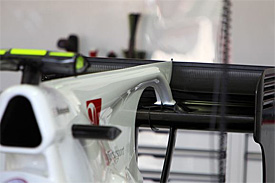
    Sauber f-ductAUTOSPORT first revealed that the 'F-Duct' was the name that the design had been given internally by engineers during its development – although no explanation of why it got that moniker ever surfaced.
    There were suggestions that it could have been the sixth-iteration of the design (with the A-Duct, B-Duct, C-Duct, D-Duct and E-Duct having been consigned to the rubbish skip), and someone even reckoned it could have been because the 'F' was where Vodafone stickers should be.

    The matter got even more complicated over the weekend when it was claimed the whole wing idea was called the RW80 – a far less catchy name but one that had been used in an email sent out by McLaren's engineering director Paddy Lowe.

    AUTOSPORT thought it was time to go and check out with a senior figure at the team exactly what the truth was behind the 'F-Duct' and what it was called actually at Woking.

    It was explained that McLaren policy is for whenever a new innovation is being designed and developed, it is given a totally random name so the opposition don't have a clue about its existence, or what it could be – even if they overhear conversations in the paddock.

    That was why the famous J-Damper that McLaren pioneered got its name – not because the J stood for something but just because that is the random name for the inerter that the team decided to settle on.

    And so it was for the F-Duct. It means nothing other than that was the name the team came up with.

    The RW80 information that swirled around over the weekend was simply the configuration name of the rear wing being used at the first four races – so 'Rear Wing' 80. For Barcelona, a track with higher downforce, it will be RW90.

    Red Bull Racing may well still call it the F-ing Duct though!

    Formula 1 supremo Bernie Ecclestone always has a watching eye over all that happens in the sport, but the Chinese took things a bit too literally when they made some statues of him and race-winning drivers to be shown off at the Shanghai track.

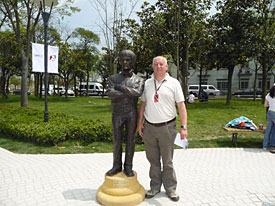
    Bernie Ecclestone statue, with Dieter RenckenThe organisers created a chess set display – with the pieces crowned by the heads of former winners of the Chinese Grand Prix. Standing there with them is a certain Mr. Ecclestone – no doubt as The King.
    However, whoever created the statues got their proportions slightly out – although not quite to the scale of Stonehenge in Spinal Tap.

    For while the racing drivers were all mounted to be quite short, it is Ecclestone who appears to have been given a bit of a height boost – as he towers over the on-track gladiators.

    AUTOSPORT writer Dieter Rencken popped down on race morning to capture himself with the larger than life Ecclestone...

    All Rights Reserved. Autosport. 2010

April 17, 2010

  • The stage has been set in Shanghai for the 2010 running of the Chinese

    . These races in Asia keep you a little confused as to what is happening when, cause the time difference is such as they finish their day before yours really gets started. Is ok. They know when to start, and start they will, for the fourth race of the 2010 Grand Prix World Championship 2010.

    Wishing everyone a safe and competitive drive.

    Felipe Massa and Fernando Alonso pilot my favorite Team Ferrari. Alonso in great qualifying performance. P-3 takes you to the front off the jump, and dey be in your mirrors all day. Alonso and Massa . Ferrari 2 spots on the podium tomorrow.

    Awesome Fernando, you did not win two World Championships not knowing how to drive.

    Get them off start. Drive man! good luck 


    Sebastian Vettel Takes Yet Another Pole in China 2010

    Patrick Allen by Analyst Written on April 17, 2010
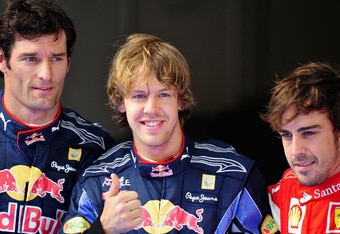
    SHANGHAI, CHINA - APRIL 17:  Pole sitter Sebastian Vettel (C) of Germany and Red Bull Racing celebrates in parc ferme alongside second placed Mark Webber (L) of Australia and Red Bull Racing and third placed Fernando Alonso (R) of Spain and Ferrari following qualifying for the Chinese Formula One Grand Prix at the Shanghai International Circuit on April 17, 2010 in Shanghai, China.  (Photo by Clive Mason/Getty Images) Clive Mason/Getty Images

    Well, despite Jonathan Legard doing his best to make the dying seconds of qualifying sound close, I think we all knew in the back of our minds who was going to finish in pole.


    Qualifying 1

    Kovalainen’s Lotus opened proceedings, but a spin from the Fin at turn six meant that the first time of the day was set by his team mate, Trulli (1:40:533).

    The Italian was quickly toppled by Massa and Alonso though. McLaren had looked extremely strong all weekend despite suffering with gear troubles. Button radioed his team to complain of "forced neutral" but still managed to get to P2 on his first run. Meanwhile his team mate, (also suffering with the dreaded unwanted neutral gear), sped around the track to get P1.

    Around the halfway point the positions were as follows:

    Hamilton, Alonso, Button, Webber, Rosberg, Kubica, Massa, Sutil, Schumacher, Hulkenberg, Barrichello, Buemi, Kobayashi, Liuzi, Alguersurai, de la Rossa, Trulli, Kovalainen, Glock, di Grassi, Senna, Chandhok, Vettel, Petrov

    Now you probably see the Vettel was in the drop out stage at this point. However, practically the second I finished copying down the positions, the German popped up into P6 after his first run.

    With just a few minutes left, Petrov took to the track for the first time after his mechanics had tirelessly worked on the Renault due to a crash in Practice Three. The Russian clawed his way out of danger and into P11.

    With all of the new teams now occupying the bottom slots the question now became, who would join them for the embarrassing P18 position?

    Well, that "honor" fell to Liuzi, who later complained of traffic holding him up.


    Q1 top three

    Hamilton

    Rosberg

    Webber


    Out

    Liuzi, Glock, Trulli, Kovalainen, di Grassi, Senna, Candhok


    Qualifying Two

    This time Petrov left the pits first and set the opening time of 1:36:311. However, his time on top was short as Hamilton yet again lit up the time sheets. The McLaren man sped around the track beautifully to pick up where he left off in Q1.

    The early stages of the session brought no real shocks. No doubt Rosberg would have been pleased to see Schumacher in P7 as he crossed the line to take P2 though!

    Eight minutes in, here were the positions:

    Hamilton, Rosberg, Alonso, Massa, Webber, Button, Vettel, Kubica, Schumacher, Sutil, Barrachello, Alguersurai, Petrov, Buemi, Kobayashi, Hulkenberg, de la Rossa.

    Yet, again Hamilton struggled with gear issues, but the Brit felt comfortable enough, not to have to go out again in the last five minutes of the session.

    The positions didn’t really change much though. Perhaps the closest action was the scare that Schumacher was getting slipping down the rankings and eventually scrapping through in just P10.


    Q2 top three

    Hamilton

    Webber

    Rosberg


    Out

    Barrichello, Alguersuari, Buemi, Petrov, Kobayashi, Hulkenberg, de la Rossa


    Qualifying Three

    Now by this stage you would arguably have put your money on Hamilton for pole. As I said earlier, the McLarens had been fast all weekend and throughout qualifying. However, really strangely, and not for the first time, cars one and two just seemed to fade away in the final session.

    The first time came from Alonso who set a nice 1:35:065, but he was quickly toppled by Vettel.

    After all the drivers had completed their first runs the positions were as follows:

    Vettel, Alonso, Webber, Rosberg, Hamilton, Massa, Button, Schumacher, Kubica, Sutil.

    I think Hamilton was a bit heavy for his first run because he only took on new tyres for his final attempt (as opposed to other drivers who needed to get back into the garage to re-fuel).

    Nevertheless, the McLaren man didn’t find enough speed and despite getting up to P2, quickly dropped down the standings after fast times from Button, Webber, Alonso, and Rosberg.

    As I said at the top of the article, the commentators tried their best to spice up the action but those Red Bulls were simply too fast. By the time Webber had sped into provisional pole, Vettel was "fastest of any man in the final sector." Sure enough the German made it four Red Bull poles out of four and ended a rather slow session with a predictable result.

    Now I’m not moaning specifically because of the Red Bull one two, far from it. The whole session seemed a bit lacking to me. Of course these positions don’t settle the race and having Hamilton behind Button and Alonso behind the Bulls will hopefully give us a great start.

    And hey! They predict rain for tomorrow! Hear's hoping we get a good one on Sunday!

    1 Sebastian Vettel RBR-Renault 1:36.317

    2 Mark Webber RBR-Renault 1:35.978

    3 Fernando Alonso Ferrari 1:35.987

    4 Nico Rosberg Mercedes GP 1:35.952

    5 Jenson Button McLaren-Mercedes 1:36.122

    6 Lewis Hamilton McLaren-Mercedes 1:35.641

    7 Felipe Massa Ferrari 1:36.076

    8 Robert Kubica Renault 1:36.348

    9 Michael Schumacher Mercedes GP 1:36.484

    10 Adrian Sutil Force India-Mercedes 1:36.671

    11 Rubens Barrichello Williams-Cosworth 1:36.664 1

    12 Jaime Alguersuari STR-Ferrari 1:36.618

    13 Sebastien Buemi STR-Ferrari 1:36.793

    14 Vitaly Petrov Renault 1:37.031

    15 Kamui Kobayashi BMW Sauber-Ferrari 1:37.044

    16 Nico Hulkenberg Williams-Cosworth 1:37.049

    17 Pedro de la Rosa BMW Sauber-Ferrari 1:37.050

    18 Vitantonio Liuzzi Force India-Mercedes 1:37.161

    19 Timo Glock Virgin-Cosworth 1:39.278

    20 Jarno Trulli Lotus-Cosworth 1:39.399

    21 Heikki Kovalainen Lotus-Cosworth 1:39.520

    22 Lucas di Grassi Virgin-Cosworth 1:39.783

    23 Bruno Senna HRT-Cosworth 1:40.469

    24 Karun Chandhok HRT-Cosworth 1:40.578