Month: October 2012

  • What Is Love

    What Is Love ???

    What is love? It is one of the most difficult questions for the mankind. Centuries have passed by, relationships have bloomed and so has love. But no one can give the proper definition of love. To some Love is friendship set on fire for others Maybe love is like luck. You have to go all the way to find it. No matter how you define it or feel it, love is the eternal truth in the history of mankind. 

    Love is patient, love is kind. It has no envy, nor it boasts itself and it is never proud. It rejoices over the evil and is the truth seeker. Love protects; preserves and hopes for the positive aspect of life. Always stand steadfast in love, not fall into it. It is like the dream of your matter of affection coming true. heart: what is loveLove can occur between two or more individuals. It bonds them and connects them in a unified link of trust, intimacy and interdependence. It enhances the relationship and comforts the soul. Love should be experienced and not just felt. The depth of love can not be measured. Look at the relationship between a mother and a child. The mother loves the child unconditionally and it can not be measured at all. A different dimension can be attained between any relationships with the magic of love. Love can be created. You just need to focus on the goodness of the other person. If this can be done easily, then you can also love easily. And remember we all have some positive aspect in us, no matter how bad our deeds maybe.

    And as God said Love all Depending on context, love can be of different varieties. Romantic love is a deep, intense and unending. It shared on a very intimate and interpersonal and sexual relationship. The term Platonic love, familial love and religious love are also matter of great affection. It is more of desire, preference and feelings. The meaning of love will change with each different relationship and depends more on its concept of depth, versatility, and complexity. But at times the very existence of love is questioned. Some say it is false and meaningless. It says that it never exist, because there has been many instances of hatred and brutality in relationships. The history of our world has witnessed many such events. There has been hatred between brothers, parents and children, sibling rivalry and spouses have failed each other. Friends have betrayed each other; the son has killed his parents for the throne, the count is endless. Even the modern generation is also facing with such dilemmas everyday. But love is not responsible for that. It is us, the people, who have forgotten the meaning of love and have undertaken such gruesome apathy.

    In the past the study of philosophy and religion has done many speculations on the phenomenon of love. But love has always ruled, in music, poetry, paintings, sculptor and literature. Psychology has also done lot of dissection to the essence of love, just like what biology, anthropology and neuroscience has also done to it. Psychology portrays love as a cognitive phenomenon with a social cause. It is said to have three components in the book of psychology: Intimacy, Commitment, and Passion. Also, in an ancient proverb love is defined as a high form of tolerance. And this view has been accepted and advocated by both philosophers and scholars. Love also includes compatibility. But it is more of journey to the unknown when the concept of compatibility comes into picture. Maybe the person whom we see in front of us, may be least compatible than the person who is miles away. We might talk to each other and portray that we love each other, but practically we do not end up into any relationship. Also in compatibility, the key is to think about the long term successful relationship, not a short journey. We need to understand each other and must always remember that no body is perfect. Be together, share your joy and sorrow, understand each other, provide space to each other, but always be there for each others need. And surely love will blossom to strengthen your relationship with your matter of affection.

  • One Last Trip for the Endeavour

    One Last Trip for the Endeavour

    by  | September 28, 2012


    NASA Crawler-Transporter vs. Toyota Tundra CrewMax (©2012 HowStuffWorks)

    Have you ever seen one of those “strongman” competitions where someone pulls train cars or maybe a few city busses with a huge rope wrapped around his waist? There’s no arguing that it’s an impressive show of power. And, at least for me anyway, it’s always a little bit comical to see someone so (relatively) small moving such a large object. It’s like watching a tiny ant carrying a huge leaf. It’s visually absurd.

    About two weeks from now there’s going to be another amazing show of strength (and I’m sure a fair amount of that visual absurdity, too) as a stock 2012 Toyota Tundra CrewMax half-ton pickup tows the massive, retired space shuttle Endeavour to its new home.

    It’s well-known that NASA’s space shuttle program has flown its final mission. And if you’ve been paying attention to the news lately, then you also know that the retired space shuttle Endeavour has made its way across the USA to Los Angeles International Airport (LAX). Not under its own power, but by riding on the back of NASA’s Boeing 747 shuttle carrier. (That’s another strange sight, incidentally.) But the craziest part of the journey still lies ahead. On October 13th, the Endeavour — all 300,000 pounds of it — will be towed (via a special dolly built by the Sarens Group, a heavy lifting and engineered transport company), on a 12-mile trip through the streets of Los Angeles to the California Science Center where it will remain on display for the public. Heavy-duty industrial equipment will haul the shuttle most of the way, but then a Toyota Tundra pickup truck — with a 10,000-pound towing capacity — will take over the towing duty for the final quarter mile.

    A 300,000-pound load towed by a vehicle with a 10,000-pound towing capacity? That doesn’t add up, does it? How does the (relatively diminutive) Toyota Tundra accomplish what the (massive, purpose-built) NASA Crawler-Transporter normally does? (You can read the specs on the two terrestrial shuttle movers in the illustration above.)

    As Irwin ‘Fletch’ Fletcher once said, “It’s all ball bearings, nowadays.”

    So true, Fletch. So true. And if you take a look at the way the tow-dolly has been set up — you can see that the Tundra isn’t actually supporting the weight of the shuttle. In fact, the truck won’t be supporting any additional weight. And that’s good because, let’s be honest, the weight of shuttle would crush the Tundra like a bug. So the Tundra isn’t actually carrying the weight, but it will have to pull it. And it’ll do that by simply overcoming the entire rig’s rolling resistance. Good trailer wheel bearings (well, better make that great trailer wheel bearings), lots of grease, fully inflated tires and a nice flat surface to tow across should make this an achievable task for a pickup truck with lots of low-end torque and enough horsepower to keep it moving. If the Tundra were pulling Endeavour fast — like, say, on the freeway and at typical freeway speeds — then it would have to overcome the shuttle’s air resistance (aka air-drag), too. But it won’t have to in this case. If anything, keeping the engine and transmission cool is going to be the biggest test the Tundra will have to face during this quarter-mile pull.

    So let’s review: Trailer tongue weight? Almost none. Just the weight of the tow bar itself. Air resistance? Again, almost none (if any). Rolling resistance? Sure, there’ll be a good deal of that to overcome initially, but nothing a strong V-8 in low-gear should have any trouble with. Engine and transmission cooling? Better watch those gauges. Fun to watch a half-ton truck pull a 300,000-pound load? Absolutely!

    Don’t forget that you can keep up with CarStuff on our Facebook page and on our Twitter feed, too. Let us know what you think!


    Tags: 


    Copyright. 2012. ©1998-2010 HowStuffWorks, Inc. All Rights Reserved

  • F1 and Speed channel splitting after this season

    F1 and Speed channel splitting after this season

    By JENNA FRYER, AP Auto Racing Writer – 39 minutes ago  

    CHARLOTTE, N.C. (AP) — The cable sports channel Speed will no longer air Formula One races after this season, ending a 17- year partnership.

    Fox Sports Media Group, which owns Speed, confirmed Friday that the partnership will end after this season. The network indicated it was outbid for the U.S. broadcast rights.

    “It’s disappointing to learn that F1 has elected to move forward with a different media partner,” Fox Sports Media Group said in a statement to The Associated Press.

    F1 was in talks with NBC Sports Group for U.S. broadcast rights, according to two people familiar with the negotiations who spoke to the AP on condition of anonymity because there was no official announcement.

    NBC Sports spokesman Chris McCloskey declined comment, as did F1′s governing body, FIA, which noted that TV deals are handled by Formula One Management. The series is in South Korea this week for the Korean Grand Prix.

    “Speed has been the U.S. voice of F1 since the mid ’90s, and it is a passion for many people at the network,” the Fox Sports statement said. “Fox Sports Media Group made what we believed to be a fiscally responsible bid based on the sport’s current viewership levels, but F1 has elected to go in another direction. We wish them well.”

    It’s not clear what NBC Sports would do with F1.

    NBC Sports Network currently broadcasts the bulk of the U.S-based IndyCar Series, and announced last month a deal with Robby Gordon to televise the inaugural season of his Stadium Super Trucks. Gordon inked a deal that gets 12 races televised — seven of them on NBC. The television contract for IndyCar is split between ABC, which owns the network broadcast rights, and NBCSN, which only has the rights to air races on cable.

    The departure of F1 comes as Fox Sports moves closer to rebranding its motorsports network into a broad-based national sports network. Fox has not commented on the rebranded channel, expected to be called Fox Sports 1, but it is expected to be heavily utilized in the eight-year television contract announced earlier this month with Major League Baseball.

    Speed partnered with F1 in 1996 in the network’s first full season on the air. Speed moved to live coverage in 1997, and has expanded to live coverage of qualifying and practice sessions of the most popular motorsports series in the world.

    Broadcasting from a studio in Charlotte, the booth of Bob Varsha, Steve Matchett and David Hobbs is considered by many fans to be the best in motorsports. The excitable trio breathes excitement into often single-file racing, and closely follows storylines and strategy despite being halfway around the world from most of the tracks.

    AP Sports Writer Jerome Pugmire contributed to this report.


  • Novel Neighborhoods. Writers in New York

    TOWNIES October 11, 2012, 12:00 PM 26 Comments

    Novel Neighborhoods

    By CATHERINE CHUNG
    Townies

    Townies is a series about life in New York, and occasionally other cities.


    Two years ago, when a magazine named me one of five Brooklyn writers to look out for, I was thrilled and gratified, but troubled by just one thing: I didn’t live in Brooklyn, and never had.

    These days if you are a writer, especially a youngish writer, people generally assume you live in one of four or five Brooklyn neighborhoods. And I did spend a lot of time in the borough, visiting friends and co-hosting a reading series in Park Slope. But I had never meant to mislead anyone! I wondered how quickly I could move out of Manhattan before anyone learned the truth.

    I told a friend about my predicament, and he laughed, pointing out what a reversal it was from the contempt Manhattanites used to have for the unfortunates who lived elsewhere. I was new to all this interborough politicking, having learned only recently that some people didn’t consider the outer boroughs part of “the city,” that they’d once looked down their noses at Brooklyn, and still turned them up at Queens. I was new to these conversations because I was new to New York. I’d moved here the year before to be a writer, in that dazed way that I imagine aspiring actors and actresses go to Hollywood — without a plan or an idea of what exactly I was looking for. James Baldwin and Edna St. Vincent Millay had lived here, and I would live here, too, walk the same streets, and hope some of the magic would rub off on me. And if it didn’t, well — at least I’d be among like-minded people.

    Except I’d miscalculated: I’d taken a sublet uptown in Morningside Heights, and even before I’d finished unpacking, well-meaning New Yorkers began telling me I’d established myself in the wrong place.

    I’d arrived in Manhattan too many blocks north, and decades too late. I’d missed the heyday of the literati — had missed the West Village, the Upper West Side, the East Village, the Lower East Side. I’d missed the dirty ’80s, and the glamorous ’90s — the yachts, the salons, the outlaw parties. “Manhattan,” a friend declared, “is dead.” All the writers had long since left the island for Brooklyn, in search of cheaper rents. The longer I lived here — listening to New Yorkers tell me about New York — the more I began to understand.

    Yann Kebbi

    Nearly every reading, book party or gallery opening I attended happened in Brooklyn. So it makes sense that my first big New York break came to me in Brooklyn, too — in Williamsburg, at a reading I gave to a group of 20-somethings in an overheated gallery after hours. In the audience was a sweet stranger who e-mailed me the next day asking for the story, and who later sneaked a copy of it onto the desk of a magazine editor who worked in his building. The editor published the story, and then someone else — who would soon become the editor of my first novel — wrote to me, asking if I had anything in the works. That’s the kind of story that can happen only in New York — the kind of story I moved here to find.

    It was rumored that Park Slope had the highest number of writers per capita of anywhere else in the country, and inevitably, I became one of them. After moving to the neighborhood, I found the perfect cafe, and worked there nearly every day, surrounded by other writers. One day I wandered down the street and into the Community Bookstore, and found the bookshop of my dreams. In the evenings I sat on my stoop, eating frozen yogurt. I got to know the babies in our building. I got to know the dogs. I signed a lease. I was finally throwing down roots.

    And then I moved again. Even before my lease was up, I was back in Manhattan, on the border of the West Village and Chelsea. I hadn’t planned it, wasn’t looking, but when a rent-stabilized one-bedroom apartment came up, I pounced. I agonized a little, but ultimately I made the decision New Yorkers have always had to make, the reason Brooklyn has become what it is: I chose the place I could both live in and afford, that could fit my books, that could make my life as a writer in New York sustainable.

    RELATED
    More From Townies

    Read previous contributions to this series.


    So in another comic reversal, I found myself explaining to my horrified Brooklyn friends — who couldn’t understand how I could ever choose to move away from the action — that I actually loved Manhattan. There were plenty of bookstores, a lot of great food, and it would take me less time to get to many parts of Brooklyn than when I actually lived in the borough.

    Finally, I reminded them of what the editor of the “five Brooklyn writers” article said back in 2010, when I sent word that while I loved being included, the truth was I lived in Manhattan. He responded that it was all right, that my “corporeal presence” when running the reading series in Park Slope was enough. Besides, he knew I’d live in Brooklyn one day soon. He was right then, and who knows — someday I may prove him right, again. But in the meantime, I’m happy where I am. Besides, I heard a rumor last week that all the fancy young writers are now moving to a new neighborhood: Morningside Heights.

    Townies welcomes submissions at townies@nytimes.com.


    Copyright. 2012. The New York Times Company. All Rights Reserved


    Catherine Chung is the author of the novel “Forgotten Country.”

  • Fernando Alonso and the Crash of His Ferrari in 2012 Formula 1 Grand Prix of Japanf

    costly mistake as defence turns in to attack

    Chris MedlandOctober 9, 2012


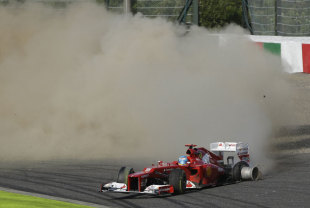
    Fernando Alonso failed to clear turn one for the second time in four races © Press Association
    Enlarge


    Related Links
     

    Fernando Alonso’s Japanese Grand Prix lasted around 700 metres, while Sebastian Vettel had to cover a full 307.771km, with the end result of Alonso’s championship lead being all but erased and his hopes hugely dented too.

    Though there are five races still to go, Alonso is now a clear second favourite for the championship despite holding a four point lead. It’s a sign of his brilliance this season that he’s even in such a position driving what has been on average the fourth quickest car on the grid, but on Sunday he made his first race day mistake of the season.

    Alonso was starting from sixth place on the dirty side of the grid, and in Suzuka the even-numbered positions have a genuine disadvantage; just look at Kamui Kobayashi’s start to jump Mark Webber. Alonso got a slightly poor start, with both Kimi Raikkonen and Jenson Button getting away better than him from the row behind.

    Having raced at Suzuka on eight occasions previously, Alonso knew he’d be slower away on the inside and soon cut across towards the outside, where Raikkonen was gaining. With Button easing up on the right, Alonso twice tried to intimidate Raikkonen in to backing out ahead of turn one, but it didn’t work.

    On the first occasion, Raikkonen was forced on the grass with the sort of move which had Alonso screaming “all the time you must leave a space” in Bahrain. Even allowing for the fact that it was at the race start, Alonso was being over-aggressive, continually moving across towards Raikkonen in a similar manner to Romain Grosjean at Spa. Then, with Button fully alongside, Alonso wanted the widest turn-in point for turn one, and again edged left.


    Fernando Alonso was left to watch as Sebastian Vettel took 25 points out of his lead © Getty Images
    Enlarge


    The last move was the costly one. Raikkonen’s off-track moment had seen him lose some momentum but he still had part of his car alongside the Ferrari and his front wing sliced Alonso’s left rear. The championship leader went spinning out, and Vettel smiled inside his 52nd helmet design.

    The most significant point is not Alonso’s error however, it’s his mindset.

    Alonso’s consistency has been remarkable, and he’s picked his fights to ensure he leaves each race with a good haul of points. Previously, he has been talking about defending his lead and beating the driver second in the standings – whoever it may be – in each race. Holding a significant points lead but a significantly slower car meant he was taking a very defensive approach to the championship.

    That all changed at Suzuka.

    Quoting Miyamoto Musashi – a 17th century Japanese Samurai – after the race, Alonso tweeted: “If the enemy thinks in the mountains, attack by sea. If they think in the sea, attack by the mountains.”

    The focus has switched from defence to attack, and it had clearly already done so before the race. Vettel was his biggest threat and had proven he had the quickest car. Having already put his car on pole, Vettel blocked Alonso in Q3 and cost him around 0.1s. But that 0.1s was the difference between sixth on the grid and fifth; ahead of Sergio Perez and on the clean side.

    With Vettel only having been reprimanded, Alonso’s frustration will have grown. Then came the poor start, which left him facing the prospect of exiting turn two in eighth place while his nearest challenger disappeared in to the distance, and Alonso fought hard. A little too hard.

    Despite the calm and confident exterior that he has exuded all season, Alonso’s been feeling the pressure as his championship lead has been reduced. At Suzuka, it finally showed.

    Chris Medland is assistant editor at ESPNF1

    © ESPN EMEA Ltd.

  • Japanese GP: Sebastian Vettel wins as Fernando Alonso retires

    7 October 2012Last updated at 07:36 GMT

    Japanese GP: Sebastian Vettel wins as Fernando Alonso retires

    By Andrew BensonChief F1 writer

    Red Bull’s Sebastian Vettel took a dominant victory in the Japanese Grand Prix to put himself in a strong position to win the world title.

    Championship leader Fernando Alonso of Ferrari retired on the first lap and had to watch as Vettel cut his lead to four points.

    Alonso suffered a puncture when he was hit from behind by Lotus’s Kimi Raikkonen.

    Japanese Grand Prix Top 10

    1. Sebastian Vettel – Red Bull 1:28.56

    2. Felipe Massa – Ferrari +00:20.64

    3. Kamui Kobayashi – Sauber +00:24.54

    4. Jenson Button – McLaren +00:25.54

    5. Lewis Hamilton – McLaren +00:46.49

    6. Kimi Raikkonen – Lotus +00:50.42

    7. Nico Hulkenberg – Force India +00:51.16

    8. Pastor Maldonado – Williams +00:52.36

    9. Mark Webber – Red Bull +00:55.68

    10. Daniel Ricciardo – Toro Rosso +01:07.92

    Ferrari’s Felipe Massa took second ahead of Sauber’s Kamui Kobayashi.

    “I knew behind me there was a crash and I saw a Ferrari was out but wasn’t sure which,” said Vettel. “Halfway through I was looking to see the others and I saw there [Ferrari] car still racing Felipe, I didn’t know what happened to Fernando.

    “The atmosphere has been unbelievable all weekend. There has been so much support, the stands have been full and that really makes our job feel very special.

    “When you’re dreaming at night, you dream one day about racing a car like that. The balance was so good and that’s why there was a gap to behind.”

    It was Massa’s first podium of the year and may well have secured his future at Ferrari, while Kobayashi held off a late charge from McLaren’s Jenson Button to take a maiden career podium.

    “I was clever on the first corner to manage to avoid the accident and the pace was really good,” said Massa.

    “I was quicker than Jenson [Button], then I was able to pass him and then Kamui [Kobayashi] so for sure it was a better race than what I expected.

    “Unfortunately Fernando isn’t here on the podium fighting for the championship but hopefully we can keep on pushing.”

    Play media
    Jenson Button
     

    ‘Strange’ car problems for McLaren duo at Japanese Grand Prix

    The second McLaren of Lewis Hamilton was fifth, ahead of Raikkonen, who was forced to fend off Force India’s Nico Hulkenberg and Williams’s Pastor Maldonado in the closing laps.

    Red Bull’s Mark Webber fought up from the back of the field after being hit from behind at the first corner to take ninth ahead of Daniel Ricciardo, who held off Michael Schumacher’s Mercedes in the last few laps.

    For Vettel, it was one the most comfortable victories of the year. He converted pole position into a lead at the first corner and streaked away into a race of his own.

    It was the first time a driver has taken back-to-back victories this season, and Vettel’s third win in four years in Japan. The 25-year-old now looks a strong bet to win his third consecutive world title.

    The Red Bull is a faster car than the Ferrari, in which Alonso has been fighting a rear-guard battle for some time.

    Thank you very much everyone. This is my first podium, and in Japan. Fantastic, unbelievable

    Kamui KobayashiSauber

    Alonso said of his retirement: “Kimi touched me a little bit in the rear and I had a puncture. It is a little sad but we need to concentrate and think about [the next race in Korea] next week.

    “We need to keep working well and not making mistakes. Nothing we can do. Thanks to this consistency we are leading the championship. The others make mistakes, we need to avoid this.”

    Raikkonen is in third place in the championship, 33 points behind Vettel and five points ahead of Hamilton.

    Red Bull’s Mark Webber, who finished ninth, is effectively out of contention, 60 points behind Alonso with a maximum of only 125 still available.

    Last 10 winners of Japanese GP

    • 2011 – Jenson Button, McLaren
    • 2010 – Sebastian Vettel, Red Bull
    • 2009 – Sebastian Vettel, Red Bull
    • 2008 – Fernando Alonso, Renault
    • 2007 – Lewis Hamilton, McLaren
    • 2006 – Fernando Alonso, Renault
    • 2005 – Kimi Raikkonen, McLaren
    • 2004 – Michael Schumacher, Ferrari
    • 2003 – Rubens Barrichello, Ferrari
    • 2002 – Michael Schumacher, Ferrari
    • 2001 – Michael Schumacher, Ferrari

    The turning point of the race and perhaps the entire championship came on the run to the first corner.

    Raikkonen ran slightly off the road and as he rejoined his front wing touched Alonso’s left rear tyre, which punctured and tipped the Spaniard into a spin as he turned into the first corner.

    Meanwhile, Lotus’s Romain Grosjean put Webber into a spin, and in a separate incident Williams’s Bruno Senna hit Nico Rosberg’s Mercedes.

    Rosberg was forced to retire, but Webber, Grosjean and Senna were all able to rejoin at the back of the field after pit stops, with Webber driving a quietly determined race to get back up into the points in ninth place.

    Grosjean was given a 10-second stop-and-go penalty for what was hisseventh first-lap incident in his 14 races this season. The Frenchmanwas banned from the Italian Grand Prix after causing a first-corner pile-up in Belgium last month.

    The safety car was sent out while the debris was cleared away, with Massa up into fourth place behind Vettel, Kobayashi and Button.

    Play media
    Kamui Kobayashi
     

    Kobayashi on “amazing” result

    Massa passed both his rivals by making his first pit stop later than they did, partly thanks to being able to start the race on new tyres while those who made it into the top 10 in qualifying had to start on the tyres that had used to set their grid time.

    The Ferrari initially made inroads into Vettel’s lead, but a couple of fastest laps from the Red Bull driver made it clear there was plenty of pace in reserve.

    Behind Massa, Kobayashi held off a determined challenge from Button, who was battling with a gearbox that was intermittently slipping into neutral in the first three laps after each of his two pit stops before righting itself.

    Button closed on Kobayashi before their final pit stops, but lost out by making his earlier than the Japanese.

    The McLaren closed in again in the final 10 laps but Kobayashi was able to hold him off.

    “Thank you very much everyone. This is my first podium, and in Japan. Fantastic, unbelievable,” said Kobayashi after the race.

    JAPANESE GRAND PRIX 2012, DAY THREE

    • Sunday, 7 October: Race highlights on BBC One 14:05 BST and online. Repeated Mon 8 Oct at 00:35 BST on BBC Two.

  • Cardinals beat Braves 6-3 in disputed wild card

    Cardinals beat Braves 6-3 in disputed wild card

    By PAUL NEWBERRY (AP Sports Writer) | The Associated Press – 1 hour 37 minutes ago


    RELATED CONTENT


    • From left to right, St. Louis Cardinals' Victor Marte, Jon Jay, Chris Carpenter and Carlos Beltran celebrate in the locker room after defeating the Atlanta Braves 6-3 in the National League wild card playoff baseball game on Friday, Oct. 5, 2012, in Atlanta. (AP Photo/John Bazemore)View Photo

      From left to right, St. Louis Cardinals’ Victor Marte, Jon Jay, Chris Carpenter and Carlos Beltran celebrate in the locker room after defeating the Atlanta …

    • St. Louis Cardinals' David Freese (23) hits a sacrifice fly, bringing in teammate Allen Craig, during the fourth inning of the National League wild card playoff baseball game against the Atlanta Braves, Friday, Oct. 5, 2012, in Atlanta. (AP Photo/Todd Kirkland)View Photo

      St. Louis Cardinals’ David Freese (23) hits a sacrifice fly, bringing in teammate Allen Craig, during the fourth inning of the National League wild card …


    ATLANTA (AP) — Talk about a wild card.

    This one was just plain wild.

    Chipper Jones played his final game. The Atlanta fans turned Turner Field into a trash heap after a disputed infield fly. And the St. Louis Cardinals did what they always seem to do in October.

    Celebrated another postseason triumph.

    Matt Holliday homered and the Cardinals rallied from an early deficit, taking advantage of three Atlanta throwing errors – the most crucial of them by the retiring Jones – to beat the Braves 6-3 in a winner-take-all wild-card playoff Friday.

    In the eighth inning, there was more crazy throwing, this time by an irate crowd that littered the field to protest an umpiring decision that went against the Braves. The Cardinals fled for cover, the Braves protested and the game was halted for 19 minutes while workers cleared up all the beer cups, popcorn holders and other debris.

    St. Louis manager Mike Matheny was asked if he’d ever seen anything like it.

    ”Not in the United States,” he said.

    Major League Baseball executive Joe Torre said the protest was denied. St. Louis advanced to face Washington in the best-of-five division round, beginning Sunday at Busch Stadium.

    The Braves are done for this season, the recipients of another heartbreaking loss in the playoffs.

    The 40-year-old Jones is all done, period. He managed an infield hit in his final at-bat but threw away a double play ball in the fourth, which led to a three-run inning that wiped out Atlanta’s 2-0 lead behind Kris Medlen.

    ”Ultimately, I feel I’m the one to blame,” Jones said.

    But this one-and-done game will be remembered for the eighth, when a disputed call on a fly ball that dropped in short left field cost the Braves a chance at extending Jones’ career.

    The Braves thought they had the bases loaded with one out after the ball fell between two fielders. But left-field umpire Sam Holbrook called Andrelton Simmons out under the infield fly rule – even though the ball landed at least 50 feet beyond the dirt. When the sellout crowd of 52,631 realized what had happened, and a second out go up on the scoreboard, they littered the field with whatever they could get their hands on.

    ”It was scary,” St. Louis catcher Yadier Molina said.

    Holbrook defended the call, even after he looked at the replay.

    ”Once that fielder established himself, he got ordinary effort,” he said, referring to shortstop Pete Kozma calling for the ball, then veering away at the last moment as left fielder Holliday drifted in. ”That’s when the call was made.”

    Braves president John Schuerholz apologized for the actions of the crowd, saying a ”small group of those fans acted in a manner that was uncharacteristic and unacceptable.” The barrage left Holbrook fearing for his safety.

    ”When cans are flying past your head, yeah, a little bit,” Holbrook said.

    The stoppage only delayed the inevitable. When play resumed, Brian McCann walked to load the bases but Michael Bourn struck out to end the threat. Dan Uggla grounded out with two aboard in the ninth to finish it, leading to one more wave of trash throwing as the umps scurried off the field – probably feeling a lot like those replacement NFL refs who caught so much grief.

    The infield fly is a complicated rule, designed to prevent infielders from intentionally dropping a popup with more than one runner on base and perhaps get an extra out.

    No one could ever remember it being applied like this. And, after past postseasons dotted by contested calls, this play will certainly lead to another slew of October cries for more instant replay.

    ”I was under it,” Kozma said. ”I should have made the play. I took my eyes off it. I was camped under it.”

    This is what some fans feared about a one-game playoff – a disputed call determining a team’s fate for an entire season, even with two extra umpires added for postseason games.

    Jones refused to pin this loss on the umps.

    ”That one play didn’t cost us the game. Three errors cost us the game,” he said. ”We just dug ourselves too big a hole.”

    Holliday homered in the sixth off Medlen, who had been baseball’s most dominant starter over the final two months. The Braves had not lost a start by the diminutive right-hander since 2010 – a streak of 23 games, the longest in modern baseball history.

    But this is the postseason.

    This is when the Cardinals shine.

    St. Louis stunningly made the playoffs a year ago at the Braves’ expense, ralllying from 10 1/2 games back in the wild-card race to pass Atlanta on the final day of the season. The Cardinals on capture the championship, winning four straight elimination games while upsetting Philadelphia, Milwaukee and, finally, Texas, with the most improbable victory over all in the World Series.

    St. Louis was expected to fade after slugger Albert Pujols signed with the Angels and longtime manager Tony La Russa retired. And, indeed, the Cardinals wouldn’t have made the playoffs without a change in the format, adding a second wild-card team in the each league. They finished six games behind the Braves during the regular season, only to hand them more misery in the postseason.

    The Braves haven’t won a playoff round since 2001. Since then, they’ve gone 0 for 7 – including six decisive losses at Turner Field.

    David Ross, starting in place of the slumping, ailing McCann, had the place rockin’ in the second when he launched a two-run homer into the left-field seats off 16-game winner Kyle Lohse. It looked as though Ross had struck out to end the inning, but he yelled for time just before Lohse delivered the pitch. Umpire Jeff Kellogg hopped out from behind the plate waving his arms while Ross swung and missed.

    That call worked out for the Braves. Ross homered on the next pitch.

    But the Cardinals have been in this position before.

    Carlos Beltran led off the fourth with the first hit of the game off Medlen, a bloop single to right. Holliday followed with a hard shot to third base, and Jones made a nice backhanded scoop. The crowd cheered, expecting a double play. That turned to gasps when Jones’ throw to second base sailed over the head of Uggla, winding up in right field. Instead of having no one on with two outs, Medlen and the Braves faced second and third and no outs.

    The Cardinals made Atlanta pay, as they always seem to do in October. Allen Craig, the replacement at first base for Pujols, lined a double off the left-field wall, cutting Atlanta’s lead to 2-1. Molina followed with a groundout that brought home another run and moved to Craig over to third. He trotted home on a sacrifice fly by David Freese, the hero of last year’s postseason.

    The Braves totally fell apart in the seventh, and Freese was right in the middle of things again. He led off with a routine grounder to Uggla, who bobbled it briefly, then unnecessarily rushed his throw to first. It wasn’t close, the ball sailing off behind home plate while Freese took second. Daniel Descalso bunted pinch-runner Adron Chambers over to third, and Chad Durbin replaced Medlen.

    Durbin got what he wanted from Kozma – a grounder to the drawn-in infield. But Simmons bobbled the ball and hurriedly threw it all the way to the backstop as Chambers slid across head first to make it 5-2. Kozma took second on the miscue, and he came all the way around to score on another ball that didn’t get out of the infield. Matt Carpenter’s bunt down the first-base line was fielded by the third pitcher of the inning, Jonny Venters, who missed a swipe tag and, with his back turned, failed to notice that Kozma kept right on running to make it 6-2.

    ”We played to win the game,” Molina said. ”They played to lose the game.”

    Lohse got the win, allowing six hits and two runs in 5 2-3 innings. Medlen, who went 10-1 during the regular season, surrendered just three hits and two earned runs in 6 1-3 innings. But he gave up five runs in all, most of it none of his doing.

    Jason Motte earned a save by getting the final four outs, taking over after the delay.

    NOTES: The Braves outhit the Cardinals 12-6 but left 10 runners on base. St. Louis stranded only two. … Lohse (16-3) and Medlen had a combined record of 26-4 during the regular season. The cumulative win percentage of .867 was the highest ever for opposing postseason starters, edging the .850 mark of California’s John Candelaria (10-2) and Boston’s Roger Clemens (24-4) in the 1986 AL championship series.


    Copyright © 2012 Yahoo! Inc. All rights reserved. | Yahoo! – ABC News Network

  • 2012 Japanese GP: Mark Webber fastest ahead of Lewis Hamilton

    Mark Webber
     

    5 October 2012Last updated at06:40 GMT


    Japanese GP: Mark Webber fastest ahead of Lewis Hamilton

    By Andrew BensonChief F1 writer

    Red Bull’s Mark Webber headed McLaren’s Lewis Hamilton as practice set up a mouth-watering Japanese Grand Prix.

    Michael Schumacher crashed out after losing control of his Mercedes at the Spoon curve, hitting a tyre barrier.

    Red Bull’s Sebastian Vettel and Ferrari’s Fernando Alonso were in third and fifth, split by the impressive Force India of Nico Hulkenberg.

    Lotus’s Romain Grosjean was sixth, ahead of McLaren’s Jenson Button.

    “It has been quite a smooth day,” said Hamilton. “I love this circuit, so it has been really great fun.”

    Force India’s Paul di Resta crashed after just five minutes in the most dramatic of several incidents in the second session, also at the troublesome Spoon curve.

    I just found myself with the right-hand wheels on the grass. Probably a bit of frustration with Kimi [Raikkonen's Lotus] getting in my way

    Paul Di Resta

    “I just found myself with the right-hand wheels on the grass,” Di Resta said, “probably a bit of frustration with Kimi [Raikkonen's Lotus] getting in my way but that’s no excuse.

    “I was 0.6secs up on my lap from first practice, so it’s annoying to go off. Hopefully it won’t cost me too much tomorrow.”

    Spoon, a tricky double-apex left-hander, caught out Schumacher late in the session.

    The German legend, who on Thursday announced he would retire for a second time at the end of the season, made exactly the same mistake as Di Resta. The only difference was that he hit the barriers backwards, while Di Resta went in forwards.

    It was the worst moment of a difficult day for Mercedes, whose other driver Nico Rosberg had stopped at the end of the first session with an engine problem.

    Sauber’s Sergio Perez, who will replace Hamilton at McLaren next season following the Englishman’s decision to move to Mercedes, narrowly avoided a similar incident when the Mexican also put two wheels on the grass on the entry to Spoon but managed to stay on the track.

    His team-mate Kamui Kobayashi also had a heart-stopping moment when he ran wide in the high-speed Dunlop corner but managed to rejoin.

    The litany of incidents underlined Suzuka’s well deserved reputation as one of Formula 1′s toughest tests, but there were no major incidents in the 90-minute session.

    Lotus’s Kimi Raikkonen, third in the championship behind Alonso and Vettel, lost most of the session after he was forced to stop after just 20 minutes because of a problem with his Kers power-boost system.

    “Why is the Kers not working?” Raikkonen asked his team over the radio.

    Japan GP Second Practice

    1. Mark Webber – Red Bull 1:32.193

    2. Lewis Hamilton – McLaren 1:32.707

    3. Sebastian Vettel – Red Bull 1:32.836

    4. Nico Hulkenberg – Force India 1:32.987

    5. Fernando Alonso – Ferrari 1:33.093

    6. Romain Grosjean – Lotus 1:33.107

    7. Jenson Button – McLaren 1:33.349

    8. Bruno Senna – Williams 1:32.499

    9. Felipe Massa – Ferrari 1:32.614

    10. Michael Schumacher – Mercedes 1:32.750

    His engineer replied: “We have a Kers problem, we have to treat the car as unsafe at the moment.”

    Raikkonen returned to the pits and was only able to get out on to the track with a little over five minutes remaining.

    Alonso arrived in Japan with a 29-point championship lead over Vettel, who is 16 points ahead of Raikkonen, with Hamilton a further seven adrift.

    The Spaniard’s Ferrari looked uncompetitive in the first session but he was much quicker in the second, setting the fastest time straight out of the pits, from Hamilton and Vettel.

    “We can be reasonably happy,” said Vettel. “The car seems to be improving. There are still some things we need to improve so we need to do another step overnight. Tomorrow it will be very close.

    “We had a good day. This morning the car was very nervous but this afternoon seemed to be quite a bit better. I was a lot happier, and both [tyre] compounds we seemed to perform reasonably well.”

    “It looks pretty competitive at the front,” said BBC F1 technical analyst Gary Anderson. “I’d like to pat Hulkenberg on the back – that’s a good effort by him.”

    Both Ferrari and Red Bull had problems with blistering of their rear tyres – where the surface of the rubber overheats and bubbles.

    Anderson said it looked like quite a serious problem on both cars.

    But Vettel said he was not concerned about it.

    Play media
    Jenson Button
     

    Button on top in Suzuka practice 1

    “Generally the track is quite hard for the tyres,” he said, “because there are a lot of high-speed corners one after the other so there is no time of the tyre to rest. We did a lot of laps, at some stage it is natural the tyres start to go off and you start to slide around. But I think overall we can be quite happy.”

    It was unclear immediately whether McLaren were suffering similar problems, as they would be expected to if their main rivals were in such trouble.

    Hamilton and Button were running different set-ups, with more downforce on Hamilton’s car.

    Button has a five-place grid penalty as a result of a gearbox change so extra straight-line speed will be valuable as he tries to make up places in the race.

    In the closing seconds, Vitaly Petrov spun at the first corner after his rear wing tore off on the pit straight.

    JAPANESE GRAND PRIX 2012, DAY TWO

    • Saturday, 6 October: Third practice 02:55 BST; 5 live Sports Extra and live text online. Qualifying 05:55 BST; 5 live Sports Extra and live text commentary online. Highlights on BBC One 13:00 BST.

    JAPANESE GRAND PRIX 2012, DAY THREE

    • Sunday, 7 October: Race: 06:55 BST, 5 live and live text commentary online. Highlights on BBC One 14:05 BST and Mon 8 Oct at 00:35 BST.

  • Frenemies: A Love Story. Tip O’Neill and Ronald Reagan

    October 5, 2012, 12:35 PM4 Comments

    Frenemies: A Love Story

    By THOMAS P. O’NEILL
    President Ronald Reagan talks with Democrat House Speaker Thomas "Tip"  O'Neill Jr. in the Oval Office of the White House in 1985.Scott Stewart/Associated PressPresident Ronald Reagan talks with Democrat House Speaker Thomas “Tip”  O’Neill Jr. in the Oval Office of the White House in 1985.

    Boston

    TO paraphrase a sometime-friend of my father: “There they go again.”

    Twice in their debate on Wednesday, President Obama and Mitt Romney brought up the names of my father, Tip O’Neill, and Ronald Reagan, the Republican icon, asserting that the relationship between Reagan and my father, a Democrat who was speaker of the House for most of Reagan’s presidency, should serve as a model for how political leaders can differ deeply on issues, and yet work together for the good of the country.

    It is not a new idea. As Washington has become increasingly partisan, and increasingly deadlocked, a misty aura has grown around the O’Neill and Reagan years. That mist obscures some hard truths — and harder words.

    Let’s not forget my father’s blunt descriptions of his ideological opposite as “Herbert Hoover with a smile” or “a cheerleader for selfishness.” He referred to the village of Reagan’s Irish forebears — Ballyporeen — as “the valley of the small potatoes.” Two phrases I often heard him use about Reagan: “Trust, but verify,” and “Love the sinner, hate the sin.” My father was not pleased to be compared by the president to the character in the video game Pac-Man — “a round thing that gobbles up money,” or to being the butt of G.O.P. political advertising.

    They were two men from humble Irish-American backgrounds who did not back down from a fight, and their worldviews were poles apart. As someone who watched the back-and-forth from a front-row seat, I know they each believed deeply in what they fought for — and that each had deep concern about where the other’s political views could take this country. My father was not simply tossing off a glib phrase when he said that Reagan wanted to rejigger this nation’s tax structure to throw “one big Christmas party for the rich.” Tip O’Neill detested Reagan-driven policies that left more money in the pockets of the wealthy — and cut the social programs for the elderly and the poor that he fought so hard to create.

    As speaker of the House, he was obliged to fight what he and his party believed were disastrous steps being taken by the Republicans. My father fought tirelessly to see that Reagan’s policies did not run roughshod over the disenfranchised. The president fought too, pushing back against spending he believed was out of control, and a social system he thought created dependency.

    On occasion, these dueling philosophies brought both men to the mat — to the point where neither would back down. My father stood firm against deep cuts and other proposed changes to Social Security, believing in his core that the elderly poor would bear too great a burden. “I haven’t been in public service all my life to watch anybody rip up everything I’ve stood for,” I remember him saying. The political battle that resulted, in 1982, was among the most bruising my father and Reagan ever had.

    In the fall of 1986, they waged war again over the renewal of the Clean Water Act. Just months before my father retired, after 34 years in the House, leaders in Congress hammered out a compromise agreement that seemed to satisfy all sides; the bill passed in the House by vote of 408 to zero, and in the Senate by 96 to none. When the president later vetoed the bill, my father didn’t relent — urging his former colleagues to override the veto from the sidelines. I remember some of what he said at the time. None of it is printable.

    But such unyielding standoffs were, in fact, rare. What both men deplored more than the other’s political philosophy was stalemate, and a country that was so polarized by ideology and party politics that it could not move forward. There were tough words and important disagreements over everything from taxation to Medicare and military spending. But there was yet a stronger commitment to getting things done.

    That commitment to put country ahead of personal belief and party loyalty is what Mr. Obama, Mr. Romney and millions of Americans miss so much right now. It allowed these two men to bend enough, even after their knockdown fight in 1982, to forge an agreement that helped save Social Security — something both men knew needed to be done. It meant that Reagan could support an increase in federal gas taxes, which would fund infrastructure improvements that both he and my father were convinced would put thousands of unemployed Americans back to work. My father hated to see the House cut social programs, even as he recognized that the president had been elected by millions of Americans and had earned the right to steer the country.

    Historic tax reforms, seven tax increases, a strong united front that brought down the Soviet Union — all came of a commitment to find common ground. While neither man embraced the other’s worldview, each respected the other’s right to hold it. Each respected the other as a man.

    President Reagan knew my father treasured Boston College, so he was the centerpiece of a dinner at the Washington Hilton Hotel that raised $1 million to build the O’Neill Library there. When Reagan was shot at that same hotel, my father went to his hospital room to pray by his bed.

    No, my father and Reagan weren’t close friends. Famously, after 6 p.m. on quite a few work days, they would sit down for drinks at the White House. But it wasn’t the drinks or the conversation that allowed American government to work. Instead, it was a stubborn refusal not to allow fund-raisers, activists, party platforms or ideological chasms to stand between them and actions — tempered and improved by compromise — that kept this country moving.

    I don’t blame Mr. Obama or Mr. Romney for getting nostalgic about that.

    Thomas P. O’Neill III, the lieutenant governor of Massachusetts from 1975 to 1983, is the founder and chief execuctive of the public affairs firm O’Neill and Associates.


    Copyright. 2012. The New York Times Company. All Rights Reserved

  • Photos of The Moment | Chanel

    Photos of The Moment | Chanel

    WOMEN’S FASHION 
    By SCHOHAJA

     OCTOBER 3, 2012, 2:15 PM


    Copyright. 2012. The New York Times Company. All Rights Reserved