Month: May 2011

  • A Q&A with Author Jaron Lanier

    Editorial Reviews

    Amazon.com Review

    Amazon Best Books of the Month, January 2010For the most part, Web 2.0–Internet technologies that encourage interactivity, customization, and participation–is hailed as an emerging Golden Age of information sharing and collaborative achievement, the strength of democratized wisdom. Jaron Lanier isn’t buying it. In You Are Not a Gadget, the longtime tech guru/visionary/dreadlocked genius (and progenitor of virtual reality) argues the opposite: that unfettered–and anonymous–ability to comment results in cynical mob behavior, the shouting-down of reasoned argument, and the devaluation of individual accomplishment. Lanier traces the roots of today’s Web 2.0 philosophies and architectures (e.g. he posits that Web anonymity is the result of ’60s paranoia), persuasively documents their shortcomings, and provides alternate paths to “locked-in” paradigms. Though its strongly-stated opinions run against the bias of popular assumptions, You Are Not a Gadgetis a manifesto, not a screed; Lanier seeks a useful, respectful dialogue about how we can shape technology to fit culture’s needs, rather than the way technology currently shapes us. 

    A Q&A with Author Jaron Lanier 

    Question: As one of the first visionaries in Silicon Valley, you saw the initial promise the internet held. Two decades later, how has the internet transformed our lives for the better?


    Jaron Lanier: The answer is different in different parts of the world. In the industrialized world, the rise of the Web has happily demonstrated that vast numbers of people are interested in being expressive to each other and the world at large. This is something that I and my colleagues used to boldly predict, but we were often shouted down, as the mainstream opinion during the age of television’s dominance was that people were mostly passive consumers who could not be expected to express themselves. In the developing world, the Internet, along with mobile phones, has had an even more dramatic effect, empowering vast classes of people in new ways by allowing them to coordinate with each other. That has been a very good thing for the most part, though it has also enabled militants and other bad actors.

    Question: You argue the web isn’t living up to its initial promise. How has the internet transformed our lives for the worse?

    Jaron Lanier: The problem is not inherent in the Internet or the Web. Deterioration only began around the turn of the century with the rise of so-called “Web 2.0″ designs. These designs valued the information content of the web over individuals. It became fashionable to aggregate the expressions of people into dehumanized data. There are so many things wrong with this that it takes a whole book to summarize them. Here’s just one problem: It screws the middle class. Only the aggregator (like Google, for instance) gets rich, while the actual producers of content get poor. This is why newspapers are dying. It might sound like it is only a problem for creative people, like musicians or writers, but eventually it will be a problem for everyone. When robots can repair roads someday, will people have jobs programming those robots, or will the human programmers be so aggregated that they essentially work for free, like today’s recording musicians? Web 2.0 is a formula to kill the middle class and undo centuries of social progress.

    Question: You say that we’ve devalued intellectual achievement. How?

    Jaron Lanier: On one level, the Internet has become anti-intellectual because Web 2.0 collectivism has killed the individual voice. It is increasingly disheartening to write about any topic in depth these days, because people will only read what the first link from a search engine directs them to, and that will typically be the collective expression of the Wikipedia. Or, if the issue is contentious, people will congregate into partisan online bubbles in which their views are reinforced. I don’t think a collective voice can be effective for many topics, such as history–and neither can a partisan mob. Collectives have a power to distort history in a way that damages minority viewpoints and calcifies the art of interpretation. Only the quirkiness of considered individual expression can cut through the nonsense of mob–and that is the reason intellectual activity is important.

    On another level, when someone does try to be expressive in a collective, Web 2.0 context, she must prioritize standing out from the crowd. To do anything else is to be invisible. Therefore, people become artificially caustic, flattering, or otherwise manipulative.

    Web 2.0 adherents might respond to these objections by claiming that I have confused individual expression with intellectual achievement. This is where we find our greatest point of disagreement. I am amazed by the power of the collective to enthrall people to the point of blindness. Collectivists adore a computer operating system called LINUX, for instance, but it is really only one example of a descendant of a 1970s technology called UNIX. If it weren’t produced by a collective, there would be nothing remarkable about it at all.

    Meanwhile, the truly remarkable designs that couldn’t have existed 30 years ago, like the iPhone, all come out of “closed” shops where individuals create something and polish it before it is released to the public. Collectivists confuse ideology with achievement.

    Question: Why has the idea that “the content wants to be free” (and the unrelenting embrace of the concept) been such a setback? What dangers do you see this leading to?

    Jaron Lanier: The original turn of phrase was “Information wants to be free.” And the problem with that is that it anthropomorphizes information. Information doesn’t deserve to be free. It is an abstract tool; a useful fantasy, a nothing. It is nonexistent until and unless a person experiences it in a useful way. What we have done in the last decade is give information more rights than are given to people. If you express yourself on the internet, what you say will be copied, mashed up, anonymized, analyzed, and turned into bricks in someone else’s fortress to support an advertising scheme. However, the information, the abstraction, that represents you is protected within that fortress and is absolutely sacrosanct, the new holy of holies. You never see it and are not allowed to touch it. This is exactly the wrong set of values.

    The idea that information is alive in its own right is a metaphysical claim made by people who hope to become immortal by being uploaded into a computer someday. It is part of what should be understood as a new religion. That might sound like an extreme claim, but go visit any computer science lab and you’ll find books about “the Singularity,” which is the supposed future event when the blessed uploading is to take place. A weird cult in the world of technology has done damage to culture at large.

    Question: In You Are Not a Gadget, you argue that idea that the collective is smarter than the individual is wrong. Why is this?

    Jaron Lanier: There are some cases where a group of people can do a better job of solving certain kinds of problems than individuals. One example is setting a price in a marketplace. Another example is an election process to choose a politician. All such examples involve what can be called optimization, where the concerns of many individuals are reconciled. There are other cases that involve creativity and imagination. A crowd process generally fails in these cases. The phrase “Design by Committee” is treated as derogatory for good reason. That is why a collective of programmers can copy UNIX but cannot invent the iPhone.

    In the book, I go into considerably more detail about the differences between the two types of problem solving. Creativity requires periodic, temporary “encapsulation” as opposed to the kind of constant global openness suggested by the slogan “information wants to be free.” Biological cells have walls, academics employ temporary secrecy before they publish, and real authors with real voices might want to polish a text before releasing it. In all these cases, encapsulation is what allows for the possibility of testing and feedback that enables a quest for excellence. To be constantly diffused in a global mush is to embrace mundanity.

    (Photo © Jonathan Sprague)


    From Publishers Weekly

    Computer scientist and Internet guru Lanier’s fascinating and provocative full-length exploration of the Internet’s problems and potential is destined to become a must-read for both critics and advocates of online-based technology and culture. Lanier is best known for creating and pioneering the use of the revolutionary computer technology that he named virtual reality. Yet in his first book, Lanier takes a step back and critiques the current digital technology, more deeply exploring the ideas from his famous 2000 Wired magazine article, One-Half of a Manifesto, which argued against more wildly optimistic views of what computers and the Internet could accomplish. His main target here is Web 2.0, the current dominant digital design concept commonly referred to as open culture. Lanier forcefully argues that Web 2.0 sites such as Wikipedia undervalue humans in favor of anonymity and crowd identity. He brilliantly shows how large Web 2.0–based information aggregators such as Amazon.com—as well as proponents of free music file sharing—have created a hive mind mentality emphasizing quantity over quality. But he concludes with a passionate and hopeful argument for a new digital humanism in which radical technologies do not deny the specialness of personhood. (Jan.) 
    Copyright © Reed Business Information, a division of Reed Elsevier Inc. All rights reserved.
     

  • News Corp and Agnellis planning F1 bid

    The Agnellis are shareholders in FIAT Group, the car manufacturer that owns Ferrari © Sutton Images
    Enlarge


    The battle for the control of Formula One hotted up last night with news that Exor, an investment firm controlled by the Agnelli family who run the car giant Fiat which in turn owns Ferrari, has confirmed it is investigating the prospect of a takeover bid with News Corporation.

    A fortnight ago reports suggested News Corporation and Mexican billionaire Carlos Slim were looking to launch a co-bid, but the announcement yesterday by Exor seems to have circumvented that.

    “Exor, one of Europe’s largest listed investment companies, and News Corporation, the global media group, confirm that they are in the early stages of exploring the possibility of creating a consortium with a view to formulating a long-term plan for the development of Formula One in the interests of the participants and the fans,” read the statement.

    “Over the coming weeks and months, Exor and News Corporation will approach potential minority partners and key stakeholders in the sport. There can be no certainty that this will lead to an approach to Formula One’s current owners.”

    The current ownership structure of Formula One’s commercial rights is complex but the majority is owned by CVC Capital Partners and it is run by Bernie Ecclestone. Ecclestone maintained that a sale was unlikely unless News Corporation and Exor were willing to pay over the odds.

    “You would think if somebody wanted to buy it they would approach the people who own it to see if they want to sell it,” he told the Guardian. “Personally, I know CVC don’t want to sell, so it’s going to be a bit difficult. I can see CVC in for the long haul, absolutely, 100%.

    “If somebody came along and offered them a lot more money than it’s worth, they would obviously say: ‘Sit down, let’s have a chat.’ But I get the distinct feeling that’s not going to happen. I can’t understand why a company as big as News Corp need to keep looking for partners. First it was Carlos Slim, and now we’ve a new one.”

    CVC, which purchased its holding for £1.8 billion in 2006, confirmed that it has been approached, with Rupert Murdoch’s son James the News Corp representative.

    “CVC can confirm that it has recently received an approach from the EXOR News Corporation consortium,” a spokesman said. “James Murdoch has informed us that the approach is friendly, at a very preliminary stage, and that they acknowledge that Formula One is privately owned by CVC and not currently for sale.

    “CVC recognises the quality of Exor and News Corporation as potential investors, but any investment in Formula One will require CVC’s agreement and will need to demonstrate that it is in the interest of the sport and its stakeholders, taken as a whole.”

    Exor, which is listed on the Borsa Italiana, is a major shareholder in Fiat Group, the car manufacturer that owns the Ferrari, Maserati and Alfa Romeo brands. It also owns 60% of Juventus.

    © ESPN EMEA Ltd.

    Feeds Feeds: ESPNF1 Staff

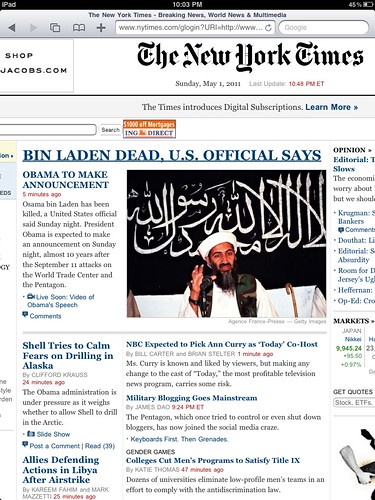
  • Behind the Hunt for Bin Laden

    Pete Souza/The White House

    President Obama and members of his national security team receiving an update on Sunday. A classified document in front of Hillary Rodham Clinton was blurred before this photo was released. More Photos »


    May 2, 2011
     

    Behind the Hunt for Bin Laden

    WASHINGTON — For years, the agonizing search for Osama bin Laden kept coming up empty. Then last July, Pakistanis working for theCentral Intelligence Agency drove up behind a white Suzuki navigating the bustling streets near Peshawar, Pakistan, and wrote down the car’s license plate.

    The man in the car was Bin Laden’s most trusted courier, and over the next month C.I.A. operatives would track him throughout central Pakistan. Ultimately, administration officials said, he led them to a sprawling compound at the end of a long dirt road and surrounded by tall security fences in a wealthy hamlet 35 miles from the Pakistani capital.

    On a moonless night eight months later, 79 American commandos in four helicopters descended on the compound, the officials said. Shots rang out. A helicopter stalled and would not take off. Pakistani authorities, kept in the dark by their allies in Washington, scrambled forces as the American commandos rushed to finish their mission and leave before a confrontation. Of the five dead, one was a tall, bearded man with a bloodied face and a bullet in his head. A member of the Navy Seals snapped his picture with a camera and uploaded it to analysts who fed it into a facial recognition program.

    And just like that, history’s most expansive, expensive and exasperating manhunt was over. The inert frame of Osama bin Laden, America’s enemy No. 1, was placed in a helicopter for burial at sea, never to be seen or feared again. A nation that spent a decade tormented by its failure to catch the man responsible for nearly 3,000 fiery deaths in New York, outside Washington and Pennsylvania on Sept. 11, 2001, at long last had its sense of finality, at least in this one difficult chapter.

    For an intelligence community that had endured searing criticism for a string of intelligence failures over the past decade, Bin Laden’s killing brought a measure of redemption. For a military that has slogged through two, and now three vexing wars in Muslim countries, it provided an unalloyed success. And for a president whose national security leadership has come under question, it proved an affirming moment that will enter the history books.

    The raid was the culmination of years of painstaking intelligence work, including the interrogation of C.I.A. detainees in secret prisons in Eastern Europe, where sometimes what was not said was as useful as what was. Intelligence agencies eavesdropped on telephone calls and e-mails of the courier’s Arab family in a Persian Gulf state and pored over satellite images of the compound in Abbottabad to determine a “pattern of life” that might decide whether the operation would be worth the risk.

    As more than a dozen White House, intelligence and Pentagon officials described the operation on Monday, the past few weeks were a nerve-racking amalgamation of what-ifs and negative scenarios. “There wasn’t a meeting when someone didn’t mention ‘Black Hawk Down,’ ” a senior administration official said, referring to the disastrous 1993 battle in Somalia in which two American helicopters were shot down and some of their crew killed in action. The failed mission to rescue hostages in Iran in 1980 also loomed large.

    Administration officials split over whether to launch the operation, whether to wait and continue monitoring until they were more sure that Bin Laden was really there, or whether to go for a less risky bombing assault. In the end, President Obama opted against a bombing that could do so much damage it might be uncertain whether Bin Laden was really hit and chose to send in commandos. A “fight your way out” option was built into the plan, with two helicopters following the two main assault copters as backup in case of trouble.

    On Sunday afternoon, as the helicopters raced over Pakistani territory, the president and his advisers gathered in the Situation Room of the White House to monitor the operation as it unfolded. Much of the time was spent in silence. Mr. Obama looked “stone faced,” one aide said. Vice President Joseph R. Biden Jr. fingered his rosary beads. “The minutes passed like days,” recalled John O. Brennan, the White House counterterrorism chief.

    The code name for Bin Laden was “Geronimo.” The president and his advisers watched Leon E. Panetta, the C.I.A. director, on a video screen, narrating from his agency’s headquarters across the Potomac River what was happening in faraway Pakistan.

    “They’ve reached the target,” he said.

    Minutes passed.

    “We have a visual on Geronimo,” he said.

    A few minutes later: “Geronimo EKIA.”

    Enemy Killed In Action. There was silence in the Situation Room.

    Finally, the president spoke up.

    “We got him.”

    Filling in the Gaps

    Years before the Sept. 11 attacks transformed Bin Laden into the world’s most feared terrorist, the C.I.A. had begun compiling a detailed dossier about the major players inside his global terror network.

    It wasn’t until after 2002, when the agency began rounding up Qaeda operatives — and subjecting them to hours of brutal interrogation sessions in secret overseas prisons — that they finally began filling in the gaps about the foot soldiers, couriers and money men Bin Laden relied on.

    Prisoners in American custody told stories of a trusted courier. When the Americans ran the man’s pseudonym past two top-level detainees — the chief planner of the Sept. 11 attacks, Khalid Shaikh Mohammed; and Al Qaeda’s operational chief, Abu Faraj al-Libi — the men claimed never to have heard his name. That raised suspicions among interrogators that the two detainees were lying and that the courier probably was an important figure.

    As the hunt for Bin Laden continued, the spy agency was being buffeted on other fronts: the botched intelligence assessments about weapons of mass destruction leading up to the Iraq War, and the intense criticism for using waterboarding and other extreme interrogation methods that critics said amounted to torture.

    By 2005, many inside the C.I.A. had reached the conclusion that the Bin Laden hunt had grown cold, and the agency’s top clandestine officer ordered an overhaul of the agency’s counterterrorism operations. The result was Operation Cannonball, a bureaucratic reshuffling that placed more C.I.A. case officers on the ground in Pakistan and Afghanistan.

    With more agents in the field, the C.I.A. finally got the courier’s family name. With that, they turned to one of their greatest investigative tools — the National Security Agency began intercepting telephone calls and e-mail messages between the man’s family and anyone inside Pakistan. From there they got his full name.

    Last July, Pakistani agents working for the C.I.A. spotted him driving his vehicle near Peshawar. When, after weeks of surveillance, he drove to the sprawling compound in Abbottabad, American intelligence operatives felt they were onto something big, perhaps even Bin Laden himself. It was hardly the spartan cave in the mountains that many had envisioned as his hiding place. Rather, it was a three-story house ringed by 12-foot-high concrete walls, topped with barbed wire and protected by two security fences. He was, said Mr. Brennan, the White House official, “hiding in plain sight.”

    Back in Washington, Mr. Panetta met with Mr. Obama and his most senior national security aides, including Mr. Biden, Secretary of StateHillary Rodham Clinton and Defense Secretary Robert M. Gates. The meeting was considered so secret that White House officials didn’t even list the topic in their alerts to each other.

    That day, Mr. Panetta spoke at length about Bin Laden and his presumed hiding place.

    “It was electric,” an administration official who attended the meeting said. “For so long, we’d been trying to get a handle on this guy. And all of a sudden, it was like, wow, there he is.”

    There was guesswork about whether Bin Laden was indeed inside the house. What followed was weeks of tense meetings between Mr. Panetta and his subordinates about what to do next.

    While Mr. Panetta advocated an aggressive strategy to confirm Bin Laden’s presence, some C.I.A. clandestine officers worried that the most promising lead in years might be blown if bodyguards suspected the compound was being watched and spirited the Qaeda leader out of the area.

    For weeks last fall, spy satellites took detailed photographs, and the N.S.A. worked to scoop up any communications coming from the house. It wasn’t easy: the compound had neither a phone line nor Internet access. Those inside were so concerned about security that they burned their trash rather than put it on the street for collection.

    In February, Mr. Panetta called Vice Adm. William H. McRaven, commander of the Pentagon’s Joint Special Operations Command, to C.I.A. headquarters in Langley, Va., to give him details about the compound and to begin planning a military strike.

    Admiral McRaven, a veteran of the covert world who had written a book on American Special Operations, spent weeks working with the C.I.A. on the operation, and came up with three options: a helicopter assault using American commandos, a strike with B-2 bombers that would obliterate the compound, or a joint raid with Pakistani intelligence operatives who would be told about the mission hours before the launch.

    Weighing the Options

    On March 14, Mr. Panetta took the options to the White House. C.I.A. officials had been taking satellite photos, establishing what Mr. Panetta described as the habits of people living at the compound. By now evidence was mounting that Bin Laden was there.

    The discussions about what to do took place as American relations with Pakistan were severely strained over the arrest of Raymond A. Davis, the C.I.A. contractor imprisoned for shooting two Pakistanis on a crowded street in Lahore in January. Some of Mr. Obama’s top aides worried that any military assault to capture or kill Bin Laden might provoke an angry response from Pakistan’s government, and that Mr. Davis could end up dead in his jail cell. Mr. Davis was ultimately released on March 16, giving a freer hand to his colleagues.

    On March 22, the president asked his advisers their opinions on the options.

    Mr. Gates was skeptical about a helicopter assault, calling it risky, and instructed military officials to look into aerial bombardment using smart bombs. But a few days later, the officials returned with the news that it would take some 32 bombs of 2,000 pounds each. And how could the American officials be certain that they had killed Bin Laden?

    “It would have created a giant crater, and it wouldn’t have given us a body,” said one American intelligence official.

    A helicopter assault emerged as the favored option. The Navy Seals team that would hit the ground began holding dry runs at training facilities on both American coasts, which were made up to resemble the compound. But they were not told who their target might be until later.

    Last Thursday, the day after the president released his long-form birth certificate — such “silliness,” he told reporters, was distracting the country from more important things — Mr. Obama met again with his top national security officials.

    Mr. Panetta told the group that the C.I.A. had “red-teamed” the case — shared their intelligence with other analysts who weren’t involved to see if they agreed that Bin Laden was probably in Abbottabad. They did. It was time to decide.

    Around the table, the group went over and over the negative scenarios. There were long periods of silence, one aide said. And then, finally, Mr. Obama spoke: “I’m not going to tell you what my decision is now — I’m going to go back and think about it some more.” But he added, “I’m going to make a decision soon.”

    Sixteen hours later, he had made up his mind. Early the next morning, four top aides were summoned to the White House Diplomatic Room. Before they could brief the president, he cut them off. “It’s a go,” he said. The earliest the operation could take place was Saturday, but officials cautioned that cloud cover in the area meant that Sunday was much more likely.

    The next day, Mr. Obama took a break from rehearsing for the White House Correspondents Dinner that night to call Admiral McRaven, to wish him luck.

    On Sunday, White House officials canceled all West Wing tours so unsuspecting tourists and visiting celebrities wouldn’t accidentally run into all the high-level national security officials holed up in the Situation Room all afternoon monitoring the feeds they were getting from Mr. Panetta. A staffer went to Costco and came back with a mix of provisions — turkey pita wraps, cold shrimp, potato chips, soda.

    At 2:05 p.m., Mr. Panetta sketched out the operation to the group for a final time. Within an hour, the C.I.A. director began his narration, via video from Langley. “They’ve crossed into Pakistan,” he said.

    Across the Border

    The commando team had raced into the Pakistani night from a base in Jalalabad, just across the border in Afghanistan. The goal was to get in and get out before Pakistani authorities detected the breach of their territory by what were to them unknown forces and reacted with possibly violent results.

    In Pakistan, it was just past midnight on Monday morning, and the Americans were counting on the element of surprise. As the first of the helicopters swooped in at low altitudes, neighbors heard a loud blast and gunshots. A woman who lives two miles away said she thought it was a terrorist attack on a Pakistani military installation. Her husband said no one had any clue Bin Laden was hiding in the quiet, affluent area. “It’s the closest you can be to Britain,” he said of their neighborhood.

    The Seal team stormed into the compound — the raid awakened the group inside, one American intelligence official said — and a firefight broke out. One man held an unidentified woman living there as a shield while firing at the Americans. Both were killed. Two more men died as well, and two women were wounded. American authorities later determined that one of the slain men was Bin Laden’s son, Hamza, and the other two were the courier and his brother.

    The commandos found Bin Laden on the third floor, wearing the local loose-fitting tunic and pants known as a shalwar kameez, and officials said he resisted before he was shot above the left eye near the end of the 40-minute raid. The American government gave few details about his final moments. “Whether or not he got off any rounds, I frankly don’t know,” said Mr. Brennan, the White House counterterrorism chief. But a senior Pentagon official, briefing on the condition of anonymity, said it was clear Bin Laden “was killed by U.S. bullets.”

    American officials insisted they would have taken Bin Laden into custody if he did not resist, although they considered that likelihood remote. “If we had the opportunity to take Bin Laden alive, if he didn’t present any threat, the individuals involved were able and prepared to do that,” Mr. Brennan said.

    One of Bin Laden’s wives identified his body, American officials said. A picture taken by a Seals commando and processed through facial recognition software suggested a 95 percent certainty that it was Bin Laden. Later, DNA tests comparing samples with relatives found a 99.9 percent match.

    But the Americans faced other problems. One of their helicopters stalled and could not take off. Rather than let it fall into the wrong hands, the commandos moved the women and children to a secure area and blew up the malfunctioning helicopter.

    By that point, though, the Pakistani military was scrambling forces in response to the incursion into Pakistani territory. “They had no idea about who might have been on there,” Mr. Brennan said. “Thankfully, there was no engagement with Pakistani forces.”

    As they took off at 1:10 a.m. local time, taking a trove of documents and computer hard drives from the house, the Americans left behind the women and children. A Pakistani official said nine children, from 2 to 12 years old, are now in Pakistani custody.

    The Obama administration had already determined it would follow Islamic tradition of burial within 24 hours to avoid offending devout Muslims, yet concluded Bin Laden would have to be buried at sea, since no country would be willing to take the body. Moreover, they did not want to create a shrine for his followers.

    So the Qaeda leader’s body was washed and placed in a white sheet in keeping with tradition. On the aircraft carrier Carl Vinson, it was placed in a weighted bag as an officer read prepared religious remarks, which were translated into Arabic by a native speaker, according to the senior Pentagon official.

    The body then was placed on a prepared flat board and eased into the sea. Only a small group of people watching from one of the large elevator platforms that move aircraft up to the flight deck were witness to the end of America’s most wanted fugitive.

    Reporting was contributed by Elisabeth Bumiller, Charlie Savage and Steven Lee Myers from Washington, Adam Ellick from New York, and Ismail Khan from Peshawar, Pakistan.

    Copyright. 2011. The New York Times Company. All Rights Reserved

  • Enforcing Copyrights Online, for a Profit

    Carly Calhoun for The New York Times

    Brian Hill posted a newspaper’s photo on his blog and was sued by Righthaven for infringement.


    May 2, 2011
     

    Enforcing Copyrights Online, for a Profit

    DENVER — When Brian Hill, a 20-year-old blogger from North Carolina, posted on his Web site last December a photograph of an airport security officer conducting a pat-down, a legal battle was the last thing he imagined.

    A month later, Mr. Hill received an e-mail from a reporter for The Las Vegas Sun who was looking into a Nevada company that files copyright lawsuits for newspapers. The e-mail informed Mr. Hill that he was one of those that the company, Righthaven, was suing. Though the airport photo had gone viral before Mr. Hill plucked it off the Web, it belonged to The Denver Post, where it first appeared on Nov. 18.

    Mr. Hill took down the photo. He was too late. A summons was delivered to his house. The lawsuit sought statutory damages. It did not name a figure, but accused Mr. Hill of “willful” infringement, and under federal copyright law up to $150,000 can be awarded in such cases.

    “I was shocked,” Mr. Hill said. “I thought maybe it was a joke or something to scare me. I didn’t know the picture was copyrighted.”

    Over the last year, as newspapers continue to grapple with how to protect their online content, Righthaven has filed more than 200 similar federal lawsuits in Colorado and Nevada over material posted without permission from The Denver Post or The Las Vegas Review-Journal.

    The company has business relationships with both newspapers. Like much of the industry, the papers see the appropriation of their work without permission as akin to theft and harmful to their business, and are frustrated by unsuccessful efforts to stem the common practice, whether it’s by a one-man operation like Mr. Hill’s, or an established one like Matt Drudge’s.

    Sara Glines, a vice president for the MediaNews Group, which owns The Denver Post, wrote in an e-mail that the pat-down photo had been used on more than 300 Web sites with no credit to The Post or the photographer.

    “We have invested heavily in creating quality content in our markets,” Ms. Glines wrote. “To allow others who have not shared in that investment to reap the benefit ultimately hurts our ability to continue to fund that investment at the same level.”

    Mark Hinueber, general counsel for Stephens Media, owner of The Review-Journal, echoed Ms. Glines’s concerns, saying that cutting and pasting articles “steals the potential audience for our editorial material and traffic to our Web sites.”

    Some critics, however, contend that Righthaven’s tactics are draconian, and that the company hopes to extract swift settlements before it is clear that there is a violation of federal copyright law. Typically, the suits have been filed without warning. Righthaven rarely sends out notices telling Web sites to take down material that does not belong to them before seeking damages and demanding forfeiture of the Web domain name.

    Defendants in these cases run the gamut. They have included the white supremacist David Duke, the Democratic Party of Nevada and Mr. Drudge. But little known Web sites, nonprofit groups and so-called mom-and-pop bloggers — people who blog as a hobby — are not exempt from Righthaven’s legal actions.

    According to some Internet legal experts who have been watching the cases with growing interest, the way it works is simple: Righthaven finds newspaper material that has been republished on the Web — usually an article, excerpts or a photograph — and obtains the copyrights. Then, the company sues.

    Whether the defendant credits the original author or removes the material after being sued matters little. None of the cases have gone to trial yet, and many have been settled out of court. In two instances, judges have ruled against Righthaven in pretrial motions. According to The Las Vegas Sun, which has tracked the cases, the only two publicly disclosed settlements were for $2,185 and $5,000.

    In describing his company’s approach, Steve Gibson, Righthaven’s chief executive, said that there has been “voluminous, almost incalculable infringement” since the advent of the Internet and that years of warning people to take down copyrighted content had not worked. Newspapers, he said, needed a new way to address the problem of people appropriating their material without permission.

    Eric Goldman, director of the high-tech law institute at the Santa Clara University School of Law, said reposting published material online could qualify as “fair use” if it didn’t diminish the market value of the original. Other critics of the suits contend that reposting material for the purposes of discussion does not constitute infringement.

    “Many of the defendants are ill-informed about copyright law,” Mr. Goldman said. “They’re not trying to compete with a newspaper. They just don’t know the rules.” Mr. Goldman informally advised a company that was sued by Righthaven and settled out of court.

    In an amicus brief filed on behalf of the Media Bloggers Association regarding a Righthaven suit in Nevada, Marc J. Randazza, a lawyer specializing in First Amendment issues, accused the company of acquiring copyrights for the sole purpose of going after defendants who could not afford legal help.

    “Nobody can seriously believe that Righthaven, which publishes nothing anywhere, has acquired the full ownership of the articles it sues upon,” wrote Mr. Randazza, whose legal group recently filed motions to dismiss two other Righthaven cases, accusing the company of making fraudulent copyright claims.

     Mr. Gibson denies that unwitting bloggers are a particular target and points to lawsuits like the one against Mr. Drudge. Righthaven accused Mr. Drudge of posting the airport pat-down photo on his Drudge Report Web site without permission. The suit was settled out of court, Mr. Gibson said.“The harm of viewer diversion has been achieved whether it is being shown on Momandpop.com or Chicagotribune.com,” he said. “If the accusation were true that we were just a purely greedy operation not advancing the interests of copyright law, then we wouldn’t be addressing viewer diversion.”

    Ms. Glines said that MediaNews “reviewed every violation and only approved actions against sites that carried advertising and were not charities.”

    Rachel Bjorklund wishes she had been sent a simple e-mail rather than slapped with a lawsuit. A stay-at-home mother in Oregon, Ms. Bjorklund was sued by Righthaven in March after she posted the airport pat-down photo on her blog, thoughtsfromaconservativemom.com.

    “My reaction was, ‘Why didn’t you just contact me and ask me to take it down?’ That would have been no problem,” said Ms. Bjorklund, who plans to challenge the suit.

    Mr. Hill, who suffers from autism and diabetes and lives on disability checks with his mother, said at that at one point Righthaven had offered to settle for $6,000, but he refused. A Colorado lawyer, David Kerr, has been defending him pro bono.

    A federal judge presiding over the case criticized Righthaven last month for using the courts to settle with defendants scared of the potential cost of litigation. Shortly after, Righthaven moved to voluntarily drop the suit, saying it had not been aware of Mr. Hill’s health problems. But Righthaven also stated in court filings that a dismissal did not exonerate others it was suing and warned Mr. Hill against continuing to use copyrighted material.

    Mr. Hill recently decided to revive his Web site, uswgo.com, where he posts links to various political articles and his own musings, which he had taken down after being sued. On the site, there is a notice explaining Mr. Hill’s belief that material posted there, even without permission, constitutes fair use. This time, though, Mr. Hill said he’s steering clear of any image or story that could cause him trouble with Righthaven.

    Copyright. 2011 The New York Times Company. All Rights Reserved

  • Cool Hand Barack

    Fred R. Conrad/The New York Times
    Maureen Dowd

     
    May 3, 2011


    Cool Hand Barack


    WASHINGTON

    No wonder the president’s top generals call him “a Cool Hand Luke.”

    After giving the order for members of a Navy Seals team to execute a fantastically daring plan to, let’s be honest, execute Osama bin Laden, Barack Obama put on a tuxedo and gave a comedy speech Saturday night in a Washington ballroom of tippling journalists and Hollywood stars.

    If we could have seen everything unfolding in real time, it would have had the same dramatic effect as the intercutting in the president’s favorite movie, “The Godfather,” when Michael Corleone calmly acts as godfather at his nephew’s baptism at church, even as his lieutenants carry out the gory hits he has ordered on rival mobsters.

    Just substitute “Leave the copter, take the corpse” for “Leave the gun, take the cannoli.”

    The president’s studied cool and unreadable mien have sometimes distanced him from the public at moments of boiling crisis. But in the long-delayed showdown with Public Enemy No. 1, these qualities served him perfectly.

    The timing was good, blunting the infelicitous  remarks made recently to The New Yorker’s Ryan Lizza by an Obama adviser, who described the president as the un-John Wayne ushering a reviled and chastened America away from the head of the global table. The unnamed adviser described the Obama doctrine on display in Libya as “leading from behind,” which sounds rather pathetic.

    But now the president has shown he can lead straight-on and that, unlike Jimmy Carter, he knows how to order up that all-important backup helicopter. He has said that those who call him a wimp are mistaken, that there is often muscular purpose beneath his diffident surface.

    Dick Cheney and Sarah Palin, who was so tacky that she didn’t mention Obama’s name in her congratulations, tried to draw credit to the Bush administration.

    But there can be no doubt that justice for the families of the 9/11 victims was agonizingly delayed because the Bush team took a megalomaniacal detour to Baghdad.

    A pigheaded Donald Rumsfeld, overly obsessed with a light footprint, didn’t have the forces needed at Tora Bora to capture Osama after the invasion of Afghanistan. To justify the switch to Saddam and the redeployment of troops to Iraq, W. and his circle stopped mentioning Osama’s name and downplayed his importance. When the White House ceases to concentrate on something, so does the C.I.A. 

    The hunt got so cold by 2005 that the Bin Laden unit at the C.I.A. was disbanded and overhauled. Four years after the monster felled the twin towers, the Bush team finally put more officers on the ground in Afghanistan and Pakistan.

    In his East Room address Sunday night, President Obama made it clear that he had shooed away the distracting Oedipal ghosts.

    “Shortly after taking office,” he said, “I directed Leon Panetta, the director of the C.I.A., to make the killing or capture of  Bin Laden the top priority of our war against Al Qaeda.”

    Many famous invaders throughout history, from Genghis Khan to Tamerlane to Babur, have marched along the same route the Navy Seals took on their moonless flight, going from Kabul to Jalalabad to Peshawar.

    The mesmerizing narrative stitched together by The Times’s Mark Mazzetti, Helene Cooper and Peter Baker begins with C.I.A. agents getting the license plate of Bin Laden’s most trusted courier in Peshawar. Peshawar is the ultimate mystery town, famous for secrets and falsehoods. It’s known for its bazaars, especially the Story Tellers Bazaar.

    And that is exactly where President Obama now finds himself. He will now have to sort through the bazaar of Pakistan’s deceptive stories and deal with lawmakers angry about giving $20 billion since 9/11 to a country where Osama was comfortably ensconced. For years, top Pakistanis have said that Osama was dead or in Afghanistan.

    Even Condi Rice proclaimed she was shocked to find “Geronimo” settled in Abbottabad for six years, living in plain sight in a million-dollar house in an affluent suburb near a military base and the Pakistani version of West Point. As one of Osama’s neighbors put it: “It’s the closest you can be to Britain.”

     At a House homeland security subcommittee hearing on Tuesday, Representative Patrick Meehan asked the question about Pakistan that is ricocheting through Washington: “Does it reflect to some extent some kind of divided loyalty or complicity in some part, or incompetence or both?”

    Seth Jones of the RAND Corporation, who used to advise the U.S. military in Afghanistan on Al Qaeda, replied with equal bluntness: “Whether there was complicity, or incompetence, at the very least there has not been a high priority in targeting the senior Al Qaeda leaders in Pakistan. Based on the threat streams coming from this area, those interests have to change.”

    Copyright.2011. The New York Times Company. All Rights Reserved

  • What Bin Laden’s Death Teaches Us About Modern Media

    Comments

    It’s true, I was at work when word started coming in. The person that told me heard it on Facebook. I then Googled it to confirm it. At that point it was so new that all I could find was Twitter feeds talking about it. Shortly after the news started to really pick it up and I watched that from there. With social media, Google, and Twitter, I learned more about what was going on before the news media even really broke into the story.


  • Larry Page Wants to Return Google to Its Startup Roots

    Illustration: Grafilu

    Illustration: Grafilu; photo: Getty

    One afternoon about 12 years ago, Larry Pageand Sergey Brin gave John Doerr a call. A few months earlier, the Google cofounders had accepted $12.5 million from Kleiner Perkins Caufield & Byers, Doerr’s venture-capital firm, as well as an equal amount from Sequoia Capital. When they took the cash, they agreed that they would hire an outsider to replace Page as CEO, a common strategy to provide “adult supervision” to inexperienced founders. But now they were reneging. “They said, ‘We’ve changed our mind. We think we can run the company between the two of us,’” Doerr recalls.

    Doerr’s first instinct was to immediately sell his shares, but he held off. He made Page and Brin an offer: He would set up meetings for them with the most brilliant CEOs in Silicon Valley, so they could get a better sense of what the job entailed. “After that,” he told them, “if you think we should do a search, we will. And if you don’t want to, then I’ll make a decision about that.” Page and Brin took a Magical Mystery Tour of high tech royalty: Apple’sSteve Jobs, Intel’s Andy Grove, Intuit’s Scott Cook, Amazon .com’s Jeff Bezos, and others. Then they came back to Doerr.

    “We agree with you,” they told him; they were ready to hire a CEO. But they would only consider one person: Steve Jobs.

    Happily, Doerr was able to persuade them to widen their net and would soon introduce them to Eric Schmidt, who took the CEO spot in 2001. The first couple of years were rocky. As late as 2002, the founders still sounded bitter when discussing Schmidt’s hire. Investors, Brin told a reporter, “feel more comfortable with us” now that they didn’t need to worry what “two hooligans are going to do with their millions.” But as the years went by, and as Google under Schmidt grew into the third-largest technology company in the world, Page and Brin came to genuinely appreciate their CEO. Page would later describe hiring Schmidt as “brilliant.”

    Now, after a 10-year run in which Google’s revenues grew from less than $100 million to almost $30 billion, Page is finally CEO again, a role he always felt he could handle. The general public may not appreciate the magnitude of the change—to most, Page is just one of the seemingly interchangeable pair of wacky “Google guys.” But Page is sui generis and could potentially have the kind of impact Bill Gates and Steve Jobs have had. Nobody better encapsulates Google’s ambitions, its ethics, and its worldview. At the same time, Page can be eccentric, arrogant, and secretive. Under his leadership, the company will be even harder to predict.

    Google’s 2004 pre-IPO filing with the SEC included a note from Page to prospective shareholders. In it, he famously warned that “Google is not a conventional company. We do not intend to become one.” In the ensuing years, Google made good on that promise. But under its ruling troika, Schmidt helped balance the founders’ idiosyncratic urges with more traditional practices. With Page taking the helm, no one is sure how—or if—that delicate balance will be maintained. Now the company is in the hands of a true corporate radical.

    A few ingredients in Larry Page’s stew of traits stand out unmistakably. He is brainy, he is confident, he is parsimonious with social interaction. But the dominant flavor in the dish is his boundless ambition, both to excel individually and to improve the conditions of the planet at large. He sees the historic technology boom as a chance to realize such ambitions and sees those who fail to do so as shamelessly squandering the opportunity. To Page, the only true failure is not attempting the audacious. “Even if you fail at your ambitious thing, it’s very hard to fail completely,” he says. “That’s the thing that people don’t get.”

    Page is a reflexive champion of big—sometimes quixotic—ideas. Even Googlers, no Luddites themselves, joke that Page “went to the future and came back to tell us about it.” One engineer recounts the time he went to discuss an ill-fated project with Page and ended up talking about the finer points of nuclear fusion. “What Larry asks himself is not ‘How can I help this person?’” he says. “Instead he’s asking himself, ‘Ten years from now, what is going to have the maximum impact on humanity?’”

    Page’s mandate now is to renew Google’s energy and drive, and in some ways he is the perfect person to perform that task. He is also perhaps the quirkiest person to ever run a $30 billion company. Google has had a wild ride over its first 12 years. It’s about to get even wilder.

    “You can’t understand Google,” vice president Marissa Mayer says, “unless you know that both Larry and Sergey were Montessori kids.” She’s referring to schools based on the educational philosophy of Maria Montessori, an Italian physician born in 1870 who believed that children should be allowed the freedom to pursue their interests. “In a Montessori school, you go paint because you have something to express or you just want to do it that afternoon, not because the teacher said so,” she says. “This is baked into how Larry and Sergey approach problems. They’re always asking, why should it be like that? It’s the way their brains were programmed early on.”

    Page grew up in East Lansing, Michigan, where his father taught computer science at Michigan State. He wanted to be an inventor, not simply because of his interests and abilities in math and technology but because, he says, “I really wanted to change the world.”

    Page was not a social animal—those who interacted with him often wondered if there were a jigger of Asperger’s in the mix—and he could unnerve people by simply not talking. But when he did speak, he often came out with ideas that bordered on the fantastic. As an undergraduate at the University of Michigan, he became obsessed with transportation and drew up plans to replace the school’s mundane bus network with an elaborate monorail system, providing a “futuristic” commute between the dorms and the classrooms.

    Page’s ideas may have been fantastic, but his vision always extended to the commercial. “From when I was 12, I knew I was going to start a company,” he says. In 1995, he went to Stanford to pursue his graduate degree. It was not only the best place to study computer science but, because of the Internet boom, was also the world capital of entrepreneurial ambition. Page had been impressed by the biography of Nikola Tesla, the brilliant Serb scientist who died in obscurity, despite contributions that arguably matched Thomas Edison’s. “It was a sad story,” Page says. “I feel like he could’ve accomplished much more if he had more resources. And he had trouble commercializing the stuff he did. Probably more trouble than he should’ve had. I think that was a good lesson. I didn’t want to just invent things, I also wanted to make the world better.”

    Page did invent something. In collaboration with Sergey Brin, a classmate he’d met in the spring of 1995, he created BackRub, a search engine that used the linking structure of the web to deliver results superior to those of the best commercial products of the time. At first Page and Brin, reluctant to leave the PhD program, tried to license the technology to existing web companies. When they failed, they renamed their search engine Google, formed their own company, and sought funding.

    “If the company failed, too bad,” Page says. “We were really going to be able to do something that mattered.”

    While both founders were technical and imaginative, Page was the driver of the vision. “Larry always wanted it to be a bigger thing—as soon as the opportunity presented, it was full speed ahead,” says Craig Silverstein, Google’s first employee. “I don’t think Sergey has that drive to the same extent Larry does. I don’t feel as confident saying what would’ve happened had Sergey called all the shots.”

    Even after Schmidt came aboard, Page continued to set the core precepts of the company. Page wanted everyone at Google to think big. It was a defining habit for him. When someone pitched an idea, Page would invariably counter with a variation that was an order of magnitude more ambitious. In 2003, when executives met to consider opening engineering offices overseas, Schmidt asked Page how quickly he would like to grow.

    “How many engineers does Microsoft have?” Page asked.

    About 25,000, he was told.

    “We should have a million,” Page said, in all seriousness.

    At that point, Schmidt put an avuncular hand on Page’s shoulder and brought him back to the real world. Now, with Page as CEO, that hand is less likely to be there.

    What will that mean? If history is any guide, Page’s idealistic impulses could result in a vaster, more sprawling company. In 2008, Google participated in an FCC auction for radio spectrum to be used for mobile broadband. By the terms of the auction, if the spectrum was sold above a certain price, the winner would have to allow other companies to run devices on their networks—something Google strongly favored but that telecom companies dearly hoped to avoid. Google executives worried that the telecoms would conspire to keep bidding below that baseline price. So the company got involved in a high-stakes game of chicken. Google would bid on the spectrum, high enough to get it over the threshold, and then bow out. It left Google potentially vulnerable; if nobody else topped its bid, the company would be stuck with a multibillion-dollar piece of spectrum that it was unequipped to exploit. “Google definitely wanted to lose,” the company’s chief economist, Hal Varian, says. To Google’s great relief, Verizon did top its bid, and the company was off the hook.

    It turns out, though, that Page had other ideas—according to Richard Whitt, the Google policy person who headed the auction effort, Page urged Google to consider topping the Verizon bid. Later, he justified the impulse by a kind of circular logic. “Obviously, you wouldn’t have made the bid if you thought you were wasting your money,” he said. “If someone else bids, you know you’re probably not wasting your money. So that means you might be willing to pay more. And so you’ve really got to think about that.” (Ultimately, Google let Verizon’s bid stand.)

    “Larry always has far-fetched ideas that may be very difficult to do,” Google software engineer Eric Veach says. “And he wants them done now.” In the early 2000s, Veach worked on what would become the company’s advertising system. Page was adamant that the program be simple and scalable—advertisers shouldn’t have to deal with salespeople, pick keywords, or do anything more than give their credit card number. That approach helped create the most successful Internet commerce product in history. But some other suggestions were baffling. During one session, Veach pointed out that not all countries commonly used credit cards. Page proposed taking payments appropriate to the home country—in Uzbekistan, he suggested, Google could take its payment in goats. “Maybe we can get to that,” Veach responded, “but first let’s make sure we can take Visa and MasterCard.”

    Still, even as CEO, Page’s nuttier instincts will be tempered by those around him. Indeed, Googlers have learned that the best way to counter some of his more problematic idiosyncrasies is not by having a frank discussion but through misdirection. For instance, Wesley Chan, a top product manager, fundamentally disagrees with Page’s ideas on product design. 1 But he has learned that instead of arguing his case with Page, a better strategy is “giving him shiny objects to play with.” At the beginning of one Google Voice product review, for instance, he offered Page and Brin the opportunity to pick their own phone numbers for the new service. For the next hour, the two brainstormed sequences that embodied mathematical puns while the product sailed through the review.

    But while it’s easy to scoff at Page’s quirks—his odd obsessions, his unrealistic expectations, his impatience for a future dangling out of immediate reach—sometimes his seemingly crazy ideas wind up creating breakthrough innovations, and skeptical Googlers wind up admitting Page was right, after all. That was the reaction in 2003 when Denise Griffin, the person in charge of Google’s small customer-support team, asked Page for a larger staff. Instead, he told her that the whole idea of customer support was ridiculous. Rather than assuming the unscalable task of answering users one by one, Page said, Google should enable users to answer one another’s questions. The idea ran so counter to accepted practice that Griffin felt like she was about to lose her mind. But Google implemented Page’s suggestion, creating a system called Google Forums, which let users share knowledge and answer one another’s customer-support questions. It worked, and thereafter Griffin cited it as evidence of Page’s instinctive brilliance.

    One complaint of the current, supersized version of Google Inc. is that bureaucracy slows down progress. Expect that to change, because speed is one of Page’s primary obsessions. “He’s always measuring everything,” early Googler Megan Smith says. She was once walking with Page down a street in Morocco when he suddenly dragged her into an Internet cafè9. Immediately, he began timing how long it took web pages to load into a browser there.

    “When people do demos and they’re slow, I’m known to count sometimes,” Page says. “One one-thousand, two one-thousand. That tends to get people’s attention.” Paul Buchheit, the creator of Gmail, remembers performing an early demo of that service in Page’s office. Page made a face and told him that it was way too slow. Buchheit objected, but Page reiterated his complaint, charging that it was taking at least 600 milliseconds to reload. Buchheit thought, “You can’t know that.” But when he got back to his office he checked the server logs. Six hundred milliseconds. “He nailed it,” Buchheit says. (Page’s fixation on speed probably drives his notorious bias toward utilitarian—some say boring—design. He maintains a militant opposition to eye-catching animations, transitions, or anything that veers from stark simplicity.)

    When Schmidt was at the helm, Page was free to pursue whatever interested him. He devoted himself to passion projects that he felt could make the biggest impact on the company. It was Page who asked for an interview with the head of a small mobile software startup called Android—startling its founder, Andy Rubin, by asking to buy the company. Rubin is now vice president of engineering at Google, and Android is one of the company’s biggest assets.

    It was also Page who dreamed of digitizing the world’s books. Many assumed the task was impossible, but Page refused to accept that. It might be expensive, but of course it was possible. To figure out just how much time it would take, Page and Marissa Mayer jury-rigged a book scanner in his office, coordinating Mayer’s page-turning to a metronome. Then he filled up spreadsheets with calculations: how many pages he would need to scan, how much it would cost to scan each page, how much storage he would need. Eventually, he became convinced that the costs and timing were reasonable. What astounded him was that even his spreadsheets didn’t dissolve the skepticism of those with whom he shared his scheme. “I’d run through the numbers with people and they wouldn’t believe them,’” he later said. “So eventually I just did it.”

    Page was disappointed when critics glossed over the benefits of the book search project and launched aseries of legal challenges that might eventually sink it. “Do you really want the whole world not to have access to human knowledge as contained in books?” Page asks. “You’ve just got to think about that from a societal point of view.” He chalked up a lot of the opposition’s passion as phony—a negotiating tactic. Page also says that, while privacy is important to him, he thinks the criticism of Google’s privacy policies is often overblown. “There’s a 10 percent chance of any product becoming an issue, and it’s not possible to predict which one,” he says. “Oftentimes the thing that people are upset about isn’t the actual thing they should be upset about.”

    Page’s blithe dismissal of Google’s critics is impolitic at the least. And his black-and-white view of corporate morality—with Google always wearing white—has probably contributed to some of the damage the company’s reputation has sustained in recent years. Yet his refusal to dwell on shades of gray has also given him the fortitude to order up risky moon shots, like Book Search and Google’s recently announced autonomous vehicle project. Critics said that the latter effort was an indulgent distraction. But if you take into account Page’s core vision—making Google into a learning machine that processes massive data—it’s easy to see how the self-driving cars, loaded with lasers and sensors that continuously gather information, fit into it. “This is all information,” says Sebastian Thrun, the AI scientist who heads the project. “And it will make our physical world more accessible.” Even more satisfying for Google, some people considered it impossible. With Page in charge, Google will undoubtedly take on more moon shots.

    Page has one task that may indeed prove to be impossible: making a company of more than 24,000 employees act like a startup. Page and Brin have long been obsessed with keeping Google nimble—an impulse that sometimes leads them toward simple denial. As early as 2001, as the company reached 400 employees, Page worried that a growing layer of middle managers would bog it down. So he and Brin came up with a radical solution: They decided to do away with managers entirely. The HR team begged them not to, but the founders went ahead with the plan. When it soon became clear that the idea was a disaster—more than 100 people were reporting directly to an overwhelmed head of engineering—Google quietly reinstated the managers. But it was only the beginning of a long struggle to maintain the speed and hunger of a small company even as it grew.

    One way Page tries to keep his finger on Google’s pulse is his insistence on signing off on every new hire—so far he’s vetted well over 30,000. For every candidate, he is given a compressed version of the lengthy packet created by the company’s hiring council, generated by custom software that allows Page to quickly scan the salient data. He gets a set every week and usually returns them with his approvals—or in some cases bounces—in three or four days. “It helps me to know what’s really going on,” he says.

    Page has little patience for the bureaucracy that most large companies require. In 2007, he noticed that having an assistant made it easier for his coworkers to schedule meetings with him. “Most people aren’t willing to ask me if they want to meet with me,” he says. “They’re happy to ask an assistant.” That was an undesirable situation, Page says, “because my favorite meeting is the absence of meetings.” So one day, Brin and Page abruptly got rid of their assistants. Anyone who wanted to talk to them had to stalk them. Like the plane spotters who log the peregrinations of aircraft, Googlers often swap data concerning Page’s and Brin’s ambulatory patterns. Even so, it can sometimes be tricky to catch Page; he is a master of the drive-by greeting, flashing a wide, happy-to-see-you smile while slightly picking up his pace, leaving a potential interlocutor talking to his receding back.

    But Page’s least favorite interactions are with the press. “Larry can be a very, very sensitive and good person,” says a former PR employee. “But he has major trust issues and few social graces.”

    The question now is whether Page has developed the tolerance, will, and grace to dispatch the mundane duties of a CEO while still retaining the qualities that make him unique. Schmidt seems to think that Page has grown into the role. “Sergey and Larry are not kids anymore,” he told me in early 2010. “They are in their midthirties, accomplished senior executives in our industry. They are learning machines, and 10 years after founding the company, they’re much more experienced than you’d ever imagine.” When he announced in January that Page would assume the CEO role, Schmidt was more specific. “Larry is ready,” he said. Later that day, he tweeted his further approval: “Day to day adult supervision no longer needed!”

    The accuracy of that statement remains to be seen. But within days of the announcement, Googlers took note of a development that seemed to indicate the new CEO was growing into the position: Larry Page has taken on an administrative assistant.

    Adapted from In the Plex: How Google Thinks, Works, and Shapes Our Lives, copyright © 2011 Steven Levy, to be published by Simon & Schuster in April.

    [March 18/6:30 p.m. EST appended]: Wesley Chan is a Google product manager, not a production designer.


    Copyright. 2011. wired.com. All Rights Reserved

  • Lewis Hamilton is the best-paid sportsperson in England, according to figures from ESPN Magazine

    May 3, 2011
     

    .

    The 2008 world champion earned $18,473,684 last year, as drivers made numerous appearances on the list for their respective countries.

    Felipe Massa topped Brazil’s earners with $17,052,632, Fernando Alonso’s $22,736,842 put him at the head of Spain’s list, and Robert Kubica is the highest earning Pole with $10,657,895.

    From other areas of motorsport, Valentino Rossi’s $20,800,000 made him the best paid Italian, while Kimi Raikonnen and Juan Pablo Montoya are both doing well for themselves outside of Formula One, with $26,333,333 and $5,088,410 making them the biggest earners in Finland and Columbia respectively.

    © ESPN EMEA Ltd.

  • News Corporation and Exor bid for F1

    May 3, 2011 by joesaward

    Sky News, the preferred leaking destination of CVC Capital Partners, has declared that News Corporation and Exor, an Italian holding company, are bidding to buy the Formula One group from CVC.

    Exor is an industrial holding company controlled by the Agnelli Family, who are also known as the owners of Ferrari. The firm can be traced back to the 1920s but became Exor in 2008 when two Agnelli companies IFI and IFIL were merged. Giovanni Agnelli & C. owns 59 percent of the company’s stock, while other investors includethe Mackenzie Cundill Group and Bestinver. The remainder of the shares are traded on the Italian stock market. The company owns a 30 percent stake in Fiat, plus 60 percent of Juventus and various other companies.

    Exor is headed by John Elkann, chairman and chief executive of Fiat.

    The word is that there will be other members of the consortium as momentum builds. The aim is to buy out CVC Capital Partners and, one assumes, set up a new structure to take the sport into the future. It remains to be seen what will happen with Bernie Ecclestone, who remains a shareholder in the business. For all of those who struggle to understand who owns what in F1, I am also posting a chart of the companies involved.