Month: May 2011

  • Mastering Monaco

    Chris Medland

    May 25, 2011


    ESPN F1 Weekly: Monaco GP Preview

     
    Related Links
     

    The entertaining Spanish Grand Prix has shown that the 2011 rules are a recipe for exciting racing on any circuit on the calendar. The one unknown that remains appears to be the crown jewel event that is the Monaco Grand Prix. Overtaking is not going to be easy by any stretch, but the tyre degradation and undercut available to earlier stoppers mean we should see positions changing and another intriguing race unfolding around the streets of the principality.

    The drivers are all still chasing one man: Sebastian Vettel. While the close race in Barcelona will have heightened hopes of another McLaren challenge, Red Bull still have by far the quickest car in qualifying trim, and that could be crucial on what is likely to be the most important Saturday of the season.


    In Form

    Sebastian Vettel’s form doesn’t look like dipping anytime soon, and Lewis Hamilton matched him in Spain with an excellent drive, but Jenson Button put in an impressive performance that shouldn’t be overlooked. His only error was a poor start, and having been 10th after the first lap Button soon found himself 20 seconds off the lead as he had only made up one place by the first round of pit stops. His three-stop strategy was not a reaction to his position though, it was planned all weekend, and Button made it work beautifully to climb through the field to take the final podium position. He may have finished half a minute down but the number of cars he had to dispatch means he would have been right in the hunt but for the bad getaway.


    Out of Form

    He may have had an encouraging start to the season, but Vitaly Petrov turned in a surprisingly below-par performance in Spain. Having climbed to fifth off the line, he was running solidly until the first pit stop, after which he displayed no pace at all to slip backwards. He was passed by Nick Heidfeld – who had started last – after two-thirds of the race, and proceeded to finish 38 seconds behind his team-mate. While you can argue that Heidfeld had many new tyres available to him after qualifying, the fact that Kamui Kobayashi comfortably beat him to the final point despite a first lap puncture displayed how slow he was.


    Kamui Kobayashi has finished in the points at four of the five races he’s been classified in this season © Sutton Images
    Enlarge


    One to watch

    Kamui Kobayashi has put in excellent recovery drives in the last two races, displaying the pace that would make him a contender for serious points. While his drive up from the back in Turkey was helped by a number of fresh tyres, in Spain he didn’t have the same luxury and a first lap puncture cost him a set of softs and left him well adrift. He climbed as high as fifth in Monaco last year in a less competitive Sauber before a gearbox failure ended his race prematurely.


    Talking Points

    DRS - It’s been a talking point at many races this year, but the drivers seemed pretty united on one front for Monaco: it’s too dangerous and should be banned. The FIA doesn’t agree, and Charlie Whiting has said that it would be wrong to outlaw an overtaking aid where it could be needed the most. There is talk that drivers may be prevented from using it in the tunnel, but anyone who misjudges a braking point having used it will be heading for the barriers, and probably for a moan at the governing body.

    Diffuser protest - The pre-Barcelona row rumbles on, but has taken a new twist ahead of this weekend. After the FIA gave the teams a reprieve by delaying a planned ban on the use of exhaust gases off-throttle to blow the diffuser, HRT team principal Colin Kolles believes that the practice is clearly illegal, and has asked the FIA to prohibit it immediately. If it doesn’t respond to his request, he says he will be forced to protest at some point during the race weekend, and claims his team is not the only one willing to do so.

    Traffic - It’s always been notoriously difficult to pass around Monaco, and the relative lack of competitiveness from Virgin and HRT is no real surprise either. However, both have shown improved reliability compared to last year, and are fighting each other closely. In qualifying drivers will struggle to find clear air for a lap around the tight circuit, and the upshot in the race could be a lot of squabbling backmarkers for the leaders to overtake, especially when you take in to consideration the fact that every car up to and including fifth-placed Fernando Alonso was lapped at least once in Barcelona. Although such a difference in performance is not expected in Monaco, one bad in or out lap could have a major influence on the outcome of the race.

    Soft tyres - It could hardly be a talking point section without mentioning the Pirelli rubber which has been such a focal point this year. The soft and supersoft compounds are going to be used in Monaco, as the lack of high-speed corners should see tyres wearing less rapidly. While drivers have been able to use the difference in tyres to make relatively simple overtaking manoeuvres, the tight confines of the street circuit will make it much tougher to pass even with tyres in superior condition.

     

    Weekend Timings

    • May 26 Free practice 1 0800 GMT / 1000 Local
      Free practice 2 1200 GMT / 1400 Local
      May 28 Free practice 3 0900 GMT / 1100 Local
      Qualifying 1200 GMT / 1400 Local
      May 29 Race 1200 GMT / 1400 Local

    Fast facts

    • This will be the fifty-seventh consecutive Monaco Grand Prix
    • The man on the grid with the most victories around the streets is Michael Schumacher, who has five. He’s level with Graham Hill and one shy of Ayrton Senna’s record of six
    • Michael Schumacher holds the lap record with a 1:14.439 set in 2004
    • Six of the last 10 Monaco Grands Prix have been won from pole position


    Trivia

    • Monaco is renowned for its safety car periods as almost any accident requires one. In 2010 alone there were four occasions that the safety car was called upon, and historically there is a 60% chance of a safety car period in each race
    • Olivier Panis secured his one and only grand prix victory in Monaco in 1996, and in doing so set the record for winning from the highest grid position having started the race 14th
    • Two drivers have ended up in the harbour as results of crashes at Monaco – Alberto Ascari in 1955 and Paul Hawkins in 1965
    • A loose manhole cover last year caused Rubens Barrichello to have a major crash on the climb up to Massanet, and saw the race continue under the safety car for a few laps while stewards decided if it was unsafe. In his anger Barrichello threw his steering wheel out of the car and it was runover by Karun Chandhok’s HRT


    Circuit

    Monaco is worlds apart from the last track in Barcelona, and is the circuit where driver performance has the greatest influence. The tight and twisting slow speed corners require good traction and mechanical grip, while the length of the circuit – just 2 miles – means there are few straights of any note, with 180mph the top speed reached exiting the tunnel. The slowest corner on the circuit is the Loews hairpin, which is taken at just 30mph, and the quickest is the first chicane section of the swimming pool at 130mph. Being a street circuit the track surface is not overly abrasive, but cars need to be able to ride the bumps and undulations well. Overtaking is possible on the run out of the tunnel down in to the turn 10 chicane.


    FIA driver steward

    Former Toyota driver Allan McNish makes his debut on the steward’s panel as a late replacement for Alain Prost.


    © ESPNF1
    Enlarge
     

    Weather

    Thursday’s running will be done on what looks likely to be the highest track temperatures, so the teams should be in for no surprises with the tyres. Rain isn’t unheard of in Monaco but the chances of the wet weather tyres being required on race day are almost non-existent. Good for those planning to watch from the deck of a yacht in the harbour, as you do.


    Betting

    Sebastian Vettel’s odds seem to get shorter by the day, and he’s favourite once again at 10/11. Mark Webber is reasonably priced at 9/2 alongside Lewis Hamilton, especially taking in to account his win last year. Nick Heidfeld is a good outside bet at 20/1, while his team-mate Vitaly Petrov’s poor race in Barcelona sees him out at 33/1 but still worth an each way look.


    ESPN prediction

    Sebastian Vettel was once again standing on the top step of the podium in Spain, but for the first time this season he didn’t start the race on pole. Mark Webber is closing in on his team-mate, and was untouchable when winning in Monaco last year as he seems to be able to get more out of the Red Bull in the more technical sectors, so ESPNF1 keeps it fresh by backing the Australian to pick up 25 points.

    Chris Medland is an assistant editor on ESPNF1.

    © ESPN EMEA Ltd.

    Feeds Feeds: ESPNF1 Staff


  • At Least 14 People Are Killed in Storms in 3 States


    Charlie Riedel/Associated Press

    Beverly Winans embraced her daughter, Debbie Surlin, while salvaging items from Winans’ devastated home in Joplin, Mo., on Wednesday.


    May 25, 2011
     

    At Least 14 People Are Killed in Storms in 3 States

    Residents of the South and Midwest braced for another round of severe weather on Wednesday, only hours after at least 14 people were killed in a series of storms that struck portions of Arkansas, Kansas and Oklahoma, including a tornado that killed five people near Oklahoma City.

    “We are looking for a widespread tornado outbreak,” said Walt Zaleski, a meteorologist with the National Weather Service. “There is the very high potential for tornadoes, hail and damaging winds.”

    Mr. Zaleski said tornadoes could reach speeds of 200 miles per hour in an area that includes western Tennessee, northeastern Arkansas, southern Illinois, western Kentucky, southeastern Missouri and southern Indiana.

    Because the storms are expected to hit after nightfall, officials warned residents they should not wait to see a tornado before taking cover. In addition to tornadoes, the storm system is likely to bring with it hail the size of golf balls or larger and straight line winds in excess of 60 miles per hour, Mr. Zaleski said.

    The previous round of storms, which started Tuesday and did not let up until early Wednesday, were the latest in a spate of violent weather that has ravaged much of the Midwest and South this spring and killed several hundred people.

    The Oklahoma tornado, the largest and most severe of the most recent storms, struck around midday Tuesday, touching down in Caddo County before sweeping into Canadian County, where it devastated El Reno, a town of 15,000 people about 25 miles west of downtown Oklahoma City, officials said.

    At least five people were killed and officials said the number could rise Wednesday as rescue teams searched through the rubble of houses, businesses and churches in the area. Among the dead was a 15 month old, officials said.

    Five people died in Canadian County, two in Logan County and one in the Grady County town of Chickasha, where a woman died when a tornado hit a mobile-home park, said Cherokee Ballard, a spokeswoman for the Oklahoma medical examiner. Each of the three counties is in the Oklahoma City metropolitan area.

    At least 60 people were injured across central Oklahoma, many along the Interstate 40 corridor that runs past El Reno. The tornado left a trail of shredded and overturned cars along I-40, destroyed livestock, set off a gas line explosion and spurred people across El Reno to evacuate their homes.

    On Wednesday, about 70,000 people remained without electricity in Oklahoma.

    Amy Brandley, the Canadian County flood plain manager, said emergency crews had only just begun to assess the damage.

    “Our county commissioner’s crews are out with heavy equipment clearing roads right now so search and rescues can take place,” she said.

    In Kansas, two people died when winds blew a tree into their van near St. John, about 100 miles west of Wichita, the authorities said..

    And in Arkansas, at leas four people died in storms, including one killed by a tornado in Franklin County, said Tommy Jackson, spokesman for the state Department of Emergency Management. Other tornadoes were reported in Texas near Springtown and Azle, just northwest of Fort Worth, and near Muenster, 65 miles north of Fort Worth. The Texas tornadoes caused no injuries.

    Even the National Weather Service was not immune to the danger. Earlier in the day, its Storm Prediction Center in Norman, Okla., about 20 miles south of downtown Oklahoma City, had to be evacuated as one of the day’s tornadoes approached.

    Copyright.2011. The New York Times Company. All Rights Reserved

  • Searches Restart in Deadliest U.S. Tornado in 60 Years

    Eric Thayer/Reuters

    Volunteers look for victims of a devastating tornado in Joplin, Mo., on Tuesday. More Photos »


    May 24, 2011
     

    Searches Restart in Deadliest U.S. Tornado in 60 Years

    JOPLIN, Mo. — The sun shone for the first time in days on this battered city Tuesday, lifting spirits even as rescue workers performed the grim task of searching for survivors and victims in buildings leveled by the United States’ deadliest tornado in more than 60 years. At least 117 people have died.

    On Tuesday morning, as search teams with dogs took advantage of a break in windy, rainy weather to comb the wreckage that includes as many as 30 percent of Joplin’s buildings, the death toll is expected to rise.

    More bad weather may be on the way: An unusually strong weather system moving east across the Rockies is expected to mix with moist air heading north from the Gulf of Mexico, carrying with it the possibility of creating severe storms late Tuesday.

    “We are expecting some violent storms to develop across Kansas and Oklahoma today bringing rain, hail and the risk of tornadoes that could move into the Joplin area this evening,” said Doug Cramer, a meteorologist with the National Weather Service. “This is a very good set up for very big tornadoes.”

    The National Weather Service said the tornado that struck the city Sunday evening had reached wind speeds of up to 198 miles per hour, just below the 201-mile-an-hour wind speed level of the most powerful category of tornadoes.

    On Tuesday morning, American flags flew outside many houses in Joplin, including flags that had been draped over sections of ruined homes. When there was not enough structure of a house left behind to support a flag, flags were placed in nearby trees that had somehow managed to retain a few branches.

    About one-third of the most heavily damaged sections of the city were cordoned off by the authorities on Tuesday as rescue teams with dogs combed rubble. The doors of houses that had been searched were marked with an “X.” If bodies were found inside, a number was listed under the “X.”

    The authorities said they planned to complete a second sweep through the city on Tuesday, methodically examining every structure that had been damaged — at least 2,000.

    On Monday, crews pulled seven people out of buildings that had collapsed, officials said. But on Tuesday, some 60 hours after the hurricane struck, no survivors had been found.

    “We’re hoping to find more folks, that’s why we’re doing these searches,” said Keith Stammer, the Jasper County emergency management director.

    Mr. Stammer said the city planned on conducting at least two more rounds of searches, but those would likely not take place until after the storm expected Tuesday evening had passed.

    Earlier Tuesday, President Obama, who is on a state trip in Britain, said that he was monitoring the federal response to the tornado and that he planned to visit Missouri on Sunday “to talk with folks who’ve been affected, to talk to local officials about our response effort and hopefully to pray with folks and give them whatever assurance and comfort I can that the entire country is going to be behind them.”

    Among the buildings that search and rescue teams were focusing on Tuesday was Hampshire Terrace, a 100-unit apartment complex with about 300 tenants, where the tornado’s fierce winds had ripped off and blown away nearly the entire second story of the two-floor building.

    Jessica Blackwood, 22, who had lived in Hampshire Terrace with her 2-year-old son, was not at home when the tornado hit. Her grandmother, who lived in another unit in the complex was also not home and escaped harm. But Ms. Blackwood said she is very worried about her neighbors.

    “I keep hearing the count go up and I keep praying it stops,” she said. “I’m so scared one of these times I’m going to hear a name a know.”

    Firefighters and cadaver-sniffing dogs have been through the building twice, officials said and have not reported finding bodies or making rescues.

    “It’s absolutely gone. It’s a total loss,” said Rick Plush, president of the building’s management agency, the Heritage Management Corporation, based in Topeka, Kan. “You want to be optimistic, but when you see the level of devastation, you wonder if there aren’t parts of people in the rubble. We are as optimistic as we can be.”

    Most of the building’s residents were low- or moderate-income families, including elderly people and families with children, said Amy Thompson, vice president of Heritage Management. About 20 percent of the tenants received federal Section 8 housing vouchers.

    The company said that it had set up a special Web site and that it had established a special phone number for tenants to call, but that the whereabouts of only seven or eight tenants had been determined so far.

    “When something like this happens, people scatter and I think most people are still in survival mode – making sure they have food and a place to live,” Ms. Thompson said. “Hopefully within three or four days, we’ll have heard from a lot more people.”

    Timothy Williams contributed reporting from New York


    Copyright.2011. The New York Times Company. All  Rights Reserved

  • Vettel holds off Hamilton to win Spanish Grand Prix

    By Andrew Benson

    Spanish Grand Prix highlights

    Highlights – Spanish Grand Prix

    Red Bull’s Sebastian Vettel held off a stern challenge from McLaren’s Lewis Hamilton to win a thrilling Spanish Grand Prix.

    It was Vettel’s fourth win in five races, but the huge pace advantage Red Bull showed in qualifying vanished and Hamilton pressured him throughout.

    Hamilton’s team-mate Jenson Button made one fewer stop in taking third.

    Ferrari’s Fernando Alonso led the first 18 laps but faded to fifth behind Red Bull’s Mark Webber.

    “That was an immense fight,” said BBC F1 co-commentator David Coulthard and Vettel’s pleasure at holding off Hamilton’s challenge was clear from the world champion’s thrilled response to his team’s congratulations on the slowing down lap. “Yabba-dabba-dee,” the 23-year-old screamed.

    ANDREW BENSON’S BLOG


    Vettel has had to work hard for all four of his wins

    Read more from the blog

    The world champion acknowledged he had been pushed hard until the end.

    “McLaren were very strong, Lewis in particular,” he said.

    “The last few laps I felt like China, with my tyres falling away. He [Hamilton] was always getting in the DRS zone but in the last few laps I got a good run in the last sector to make it stick.”

    While frustrated at finishing just 0.6 seconds behind Vettel, Hamilton was hugely encouraged by McLaren’s pace compared to the Red Bulls.

    “I wasn’t expecting to be so quick today, as the race went on we had some serious pace, but he [Vettel] was massively quick in the high speed corners,” said Hamilton.

    BBC F1 commentator Martin Brundle added: “That will be a warning sign to Red Bull.”

    Lewis Hamilton, Sebastian Vettel, Jenson Button

    Spanish Grand Prix – top three drivers

    Red Bull had been expected to dominate the race after qualifying nearly a second clear of their rivals, with Webber on pole ahead of Vettel.

    The thrills began as soon as the lights went out at the start of the race, when Alonso catapulted away from fourth place on the grid to lead into the first corner.

    Alonso’s start was one of the best seen for a long time as he shrugged off the disadvantage of starting on the dirty, more slippery side of the grid to power off the line.

    He tracked the Red Bulls down to the first corner and dived down the inside to claim the lead, drawing huge cheers from the 80,000 crowd of his adoring compatriots.

    “That was fantastic,” said BBC F1 co-commentator David Coulthard. “The motivation he had to lead this grand prix.”

    Ultimately, it did not help Alonso but, while holding off a train comprising Vettel, Webber and Hamilton, he was able to lead superbly through the first pit stops until the key turning point came on lap 18 of the 66-lap race.

    That was when Vettel came in for his second stop, and he made up enough time on his out lap to jump Alonso, who pitted on the next lap in a vain attempt to hold on to the lead.

    Hamilton and McLaren did not make that mistake, and were able to keep the pressure on the Red Bull.


    McLaren were very strong, Lewis in particular

    Race winner Sebastian Vettel

    They kept running until lap 23, coming out just over four seconds behind Vettel.

    They battled intensely for the rest of the race, Hamilton edging ever closer to Vettel before both their third and final pit stops, closing to within 1.2 seconds each time, only to lose a second at the stops on both occasions.

    They spent the final 10 laps nose to tail and although Vettel’s pace was compromised at times throughout the race by his Kers power-boost system working only intermittently, it returned for the final laps of the race.

    Hamilton had a look at passing him a couple of times but Vettel was able to hold on.

    Button finished more than 30 seconds behind the lead pair after choosing a three-stop strategy compared to the four of the other leading runners.

    “We never planned to do anything but a three-stop strategy as I thought doing two stints on a prime tyres was no good,” said Button.

    “It would have been interesting to see what would happened if I didn’t have a bad first lap, but all in all it was a good day and good to get a podium.”

    The decision helped him push Webber down to fourth place and the Australian will rue a poor start from pole position that left him third by the first corner, from which point his race unravelled.

    Red Bull's Mark Webber

    Webber ‘hampered by poor start’

    Webber spent much of the race stuck behind Alonso, finally clearing the Ferrari when it pitted on lap 39.

    Webber has been one of the harshest critics of some of the easy passes that have come about as a result of the rapidly degrading tyres and DRS overtaking device that have been introduced this season.

    But he may well have been wishing for some of the easy passes that were seen at the previous race in Turkey. They vanished at this track where overtaking has always been so difficult.

    Alonso fell further back throughout the race, but was well clear of the Mercedes of Michael Schumacher and Nico Rosberg, which were sixth and seventh.

    And Alonso admitted that his result was “what we deserved this weekend”.

    “It looks a little bit sad when you start losing positions but we need to understand that P1 was maybe not our position at that moment,” the Spaniard told the BBC.

    “We were not competitive, especially in the race pace, we were too slow – with the hard tyre even more.

    “There are clearly two teams ahead of everybody. We need to change this situation. We need to work more and more and we’ll see. Monaco is so special, anything can happen but in Canada, we need to make a step forward.”

    Renault’s Nick Heidfeld was eighth, with the Sauber drivers Sergio Perez and Kamui Kobayashi took the final two points positions.

    Red Bull team principal Christian Horner was a relieved man.

    “It was a full-on race, Fernando changed the dynamics completely getting into the lead,” said Horner.

    “He did not have fantastic pace but it was very hard to overtake. We managed to get Seb past with the undercut and he made that really work for him and hang on, but McLaren gave us a tough run today.”

    Hamilton, Button, Webber and Jaime Alguersuari were investigated after the race for not slowing down when yellow flags were waved after Heikki Kovalainen crashed out in his Lotus.

    All four were subsequently reprimanded but no further punishment applied.


    Copyright. 2011. BBCSport.com All Rights Reserved

  • Spanish Formula 1 Grand Prix 2011.


    A Tale Of The Spanish ‘KERS’

    By Hannah Taylor, F1 Correspondent

    Despite now being into round five of the 2011 Formula One season, it seems that Red Bull in particular, are still struggling with one key element on their cars. Among the new additions to the inside of the cockpits, is the KERS feature.

    The Kinetic Energy Recovery System (KERS) made its debut in Formula One at the beginning of the 2009 season and it was removed from the sport the following year, before returning for this current one. The feature was introduced to present a more environmentally friendly way, of a system used in road cars, to see the impact it has upon the motor racing industry. From the drivers’ point of view it puts them at an advantage, whereby it can assist them during an overtaking manoeuvre.

    KERS works while under braking, and kinetic energy is recovered from this, where it then converts to power and aids acceleration. An extra power boost of 80bhp is then on hand to propel the car and pass another to take a position from them.

    Pole winner Mark Webber, Red Bull Racing, second place Sebastian Vettel, Red Bull Racing, third place Lewis Hamilton, McLaren Mercedes
    Pole winner Mark Webber, Red Bull Racing, second place Sebastian Vettel, Red Bull Racing, third place Lewis Hamilton, McLaren Mercedes

    Photo by: xpb.cc


    As the lead up to the Spanish Grand Prix today proved, during practice and qualifying, for now the fourth time in five race weekends, the Red Bull team alone have faced problems with their KERS. As a result of this, the tables turned between team mates, Sebastian Vettel and Mark Webber. Vettel’s Australian team mate Webber, ended the German’s four consecutive pole position run yesterday. Vettel lost out on the top spot by two tenths of a second, and his KERS had let him down, in the final two sessions of qualifying as well. While he refused to lay the blame on this factor, he did suggest that KERS was not running so smoothly on his car.

    “I think we will be on top of KERS for the race, the guys are pushing hard and we have proved our car has become quicker, so big compliments to the aero guys in the factory and everyone here. We are working hard on KERS. I didn’t have it in Q2 or Q3 today, but I’m sure we will have it tomorrow for the race,” explained Vettel.

    Before the race had got underway earlier on, there was uncertainty as to whether or not Vettel had KERS working on his car. He explained that they had changed the battery and charged the KERS, so he was hoping it would work in the race. With this being a possible disadvantage, in the long run down to the first corner, Vettel also had the added pressure of starting from the dirty side of the track.

    Where the drivers in the midfield were concerned, it was interesting to see who was also running with KERS and who was not. Heikki Kovalainen for Team Lotus did not have KERS for the race but still managed to race well into the field, and keep his rivals on their toes. Sadly, the Finnish driver did not reach the end of the race when he crashed out on lap 48, as he lost control of his car into Turn four.

    Paul Di Resta is another driver who is not quite near the front-runners, but he started the race with the use of KERS. The Force India driver gained four places after making his way from 16th place, and finished just ahead of his team mate Adrian Sutil.

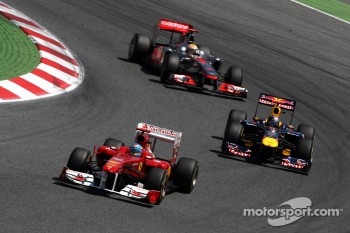
    Fernando Alonso, Scuderia Ferrari leads Sebastian Vettel, Red Bull Racing and Lewis Hamilton, McLaren Mercedes
    Fernando Alonso, Scuderia Ferrari leads Sebastian Vettel, Red Bull Racing and Lewis Hamilton, McLaren Mercedes

    Photo by: xpb.cc


    Nevertheless, once the lights went out to mark the start of the race, Webber in the sister Red Bull dropped from pole to third place. Vettel remained in second place but failed to challenge Fernando Alonso, who stormed through to take the lead on his home soil in Barcelona. At the start of the race it looked like Vettel was running without KERS, and he could not keep up with the Ferrari driver in front.

    After a pit stop for fresh option tyres on lap 11, the situation was looking more hopeful for Vettel just three laps later. It was reported via the team radio to him “Remember to use all of the KERS every lap, remember to use all of the KERS every lap”. This indicated that Vettel might have had the use of KERS from that point. Just a little further into that particular lap, and he was scrapping for position with McLaren’s Lewis Hamilton. Vettel was holding onto second place, whilst Hamilton was attempting to snatch it from him. During this battle between the World Champions, both drivers put their KERS to use against each other.

    As the competition between the front-runners began to heat up, both Webber and Vettel were advised by their team, to use half of their KERS on the straight. At the time the Ferrari duo of Alonso and Felipe Massa, appeared to be setting a faster pace, and Red Bull needed to keep up with them.

    On lap 20 the fortune seemed to change and favour Hamilton, who remained out on track on older tyres, which allowed him to set a few quick laps, ahead of his Championship rivals who were in the pits. In the middle stage of the race it looked like Webber was not using KERS, but this did not appear to affect his speed on the track. Unlike his team mate Vettel who was losing a bit of time lap by lap, Webber was making good progress on lap 32. He fought with Alonso at the time, who was in third position, and Webber in fourth place. The pair did swap places temporarily, but they soon reversed when Alonso snatched it back.

    KERS was on and off, which meant I was playing around with the brake distribution a lot.

    Sebastian Vettel


    As well as battling for position with Alonso, Webber also lost out to McLaren’s Jenson Button who gained fourth place. Button activated his KERS to slip passed Webber and then Alonso. Both drivers failed to stop the 2009 Champion coming through.

    Although it was reported to Vettel on lap 45, that his KERS seemed to be out of action, this did not hinder his progress as the team reported later on “KERS two, two clicks forwards, use KERS”. At this stage of the race, Vettel was leading the field from Hamilton who was not far behind him.

    Sadly, on lap 53 it was Webber’s turn to suffer KERS issues, and he did not seem to have the use of it from then on. Meanwhile, on lap 58 as the race was getting to the closing stages, the McLaren team reported to Hamilton “Lewis, it might be an idea to save your KERS until the start/finish line”. This indicated that maybe he was hoping to catch Vettel and snatch the race win. Unfortunately, this was not the case for the 2008 World Champion. As a result of Vettel’s victory he has set a record, and become the first driver in 11 years, to win the Spanish Grand Prix without starting from pole position.

    Podium: race winner Sebastian Vettel, Red Bull Racing
    Podium: race winner Sebastian Vettel, Red Bull Racing

    Photo by: xpb.cc


    Over the weekend Vettel had mixed results, but achieved a positive outcome in the end. He described the issues he had with KERS, and on picking up another race victory for 2011.

    “KERS was on and off, which meant I was playing around with the brake distribution a lot. McLaren and Lewis especially gave us a hard time today. It’s quite a release when you cross the line and you know that you made it, so I’m very, very happy,” commented Vettel.

    Even though the racing action in Spain is over, there is only one week to wait until the drivers head to Monte Carlo. The Monaco Grand Prix is famous for the challenge that the street circuit poses on the drivers. With the new elements on the cars in play, like KERS, it will be interesting to see how these are put into action, on a track where overtaking in particular is near impossible.

  • Mark Webber beats Sebastian Vettel for pole in Spanish Grand Prix

    • German champion did not use the Kers system
    • Lewis Hamilton lines up third with Jenson Button fifth

    Mark Webber
    Red Bull’s Mark Webber during the third qualifying session at the Circuit de Catalunya in Barcelona. Photograph: Srdjan Suki/EPA

    The only hope for a competitive Formula One season this year is ifSebastian Vettel‘s Red Bull team-mate, Mark Webber, raises his game, making room for himself, Fernando Alonso or Lewis Hamilton. And that improbable scenario moved a little closer today.

    Webber, who started his run of four victories in eight races here a year ago, achieved his first pole for nine months – since the Belgium Grand Prix last August – when he topped qualifying ahead of Vettel and Hamilton. The Briton’s team-mate Jenson Button will be fifth on the grid today, with the McLarens split by Ferrari’s Alonso, the first time the Spaniard has not been fifth all season.

    The bad news for Webber is that Vettel, who had won the previous five poles going back to the final race of last season, did not use the kinetic energy recovery system in the second and third parts of qualifying, denying himself an estimated 0.5secs per lap. The bad news for everyone outside Red Bull is that the Milton Keynes-based team decided to make only one run in Q3. That might smack of arrogance but it was pure pragmatism as they decided to preserve their rubber for race.

    This raises another argument. Qualifying, which had become such a compelling Saturday spectacle in its own right, often proving more entertaining than the race the following day, is now a bit of a bore. Canny teams have reasoned that qualifying is no longer the be all and end all, in which case it is more important to look after the rubber. It needs to be looked at.

    But all this will not be filling Webber’s mind on Sunday morning. The Australian has cut a rather forlorn figure this season, his solitary chance of a world championship last season nothing more than a frustrating memory.

    However, it has been more of a case of Vettel raising his game than Webber falling away. The Australian said : “It was a good session. I think it was pretty clear going into qualifying that we might have a bit of margin, so it was Seb and I to fight for the front row.

    “You can never underestimate these guys but we thought we would battle for pole. We got through on the first set of hards, some other people did as well, and then the crucial part was getting it right for Q3. It was a nice lap, a good battle with Seb and today was my day.”

    Vettel appeared to be in a philosophical mood. “I don’t think we can speak of big disappointment,” he said. “We made a good step forward and Barcelona is usually a place where you bring lots of parts, and find out how they work.

    “In Q1 I didn’t get into the rhythm immediately but made it on prime tyres; in Q2 I felt much happier on the soft compound and in last qualifying I lost a little bit too much, and wasn’t happy with my lap.

    “We had some problems and Mark did a good job. It was between us, and he did a better job today. He deserved pole today.”

    Hamilton was once again fast but way off Red Bull’s pace. He said: “We are second best at the moment,” before adding: “I do have a slight flat spot, but fortunately we can re-balance the wheels so it shouldn’t be a problem for the race. You can see the gap between us and the Red Bulls has increased, however we have improved this weekend.”

    Meanwhile, Webber used his podium platform to take a swipe at the way current regulations were threatening to damage the sport.

    He said: “We [Formula One] need to be the pinnacle. We need to be able to push the cars to the limit throughout a Grand Prix and have very strong lap times, man against machine, and push the car to the limit.

    “So long as we can keep doing that then that’s good. But if you look at a GP3 lap time, I think they did 1min 38sec, and some of my laps at the end of my long run were in the 1m 30s. And I think the budget’s a little different.”


    How they line up: M Webber, Red Bull 1min 20.981sec; S Vettel, Red Bull 1:21.181; L Hamilton, McLaren 1:21.961; F Alonso, Ferrari 1:21.964; J Button, McLaren 1:21.996; V Petrov, Renault 1:22.471; 7N Rosberg, Mercedes 1:22.599; F Massa, Ferrari 1:22.888; P Maldonado, Williams 1:22.952; 10 M Schumacher, Mercedes no time; 11S Buemi, Toro Rosso 1:23.231; 12 S Perez, Sauber 1:23.367; 13 J Alguersuari, Toro Rosso 1:23.694; 14 K Kobayashi, Sauber 1:23.702; 15H Kovalainen, Lotus 1:25.403; 16 P Di Resta, Force India 1:26.126; 17 A Sutil, Force India 1:26.571; 18 J Trulli, Lotus 1:26.521; 19 R Barrichello, Williams 1:26.910; 20 T Glock, Virgin 1:27.315; 21 T Liuzzi, HRT 1:27.809; 22 N Karthikeyan, HRT 1:27.908; 23 J d’Ambrosio, Virgin 1:28.556; 24 N Heidfeld, Renault no time.


  • Webber beats team-mate Vettel to take pole in Spain

    Pag

    Spanish Grand Prix

    • Venue: Circuit de Catalunya
    •  

    • Date: 20-22 May
    •  

    • Coverage: Sunday: Race live on BBC One, HD, online and 5 live from 1210.
    Mark Webber

    Highlights – Spanish GP qualifying

    Mark Webber beat his Red Bull team-mate Sebastian Vettel for the first time this season to grab pole position for the Spanish Grand Prix.

    The Australian headed the German, who was on pole for all the season’s first four races, by 0.2 seconds as the Red Bulls were in a league of their own.

    The McLarens of Lewis Hamilton and Jenson Button were third and fifth, split by Ferrari’s Fernando Alonso.

    Renault’s Vitaly Petrov was sixth, ahead of Mercedes’s Nico Rosberg.

    Webber’s first pole since the Belgian Grand Prix last August is an important landmark after being dominated by his team-mate so far this season.

    BBC F1 commentator Martin Brundle said: “Webber psychologically scores a direct hit on Sebastian Vettel. It should be a fascinating duel between the Red Bull drivers. Can Lewis Hamilton, like last year, hang on and give them a hard time?”

    Webber is already 38 points behind Vettel in the championship, so a win on a track at which he dominated in 2010 would be an important boost for his already dwindling title hopes.

    Some of the shine was taken off his performance by the knowledge that Vettel was not able to use his Kers power-boost system in the second and final parts of qualifying, depriving him of potentially 0.2secs a lap.

    Spanish Grand Prix- Top three drivers

    Spanish Grand Prix – Top three qualifiers press conference

    But Webber probably would have been on pole anyway and Vettel graciously refused to blame his Kers problems for failing to take his fifth consecutive pole this season.

    “It’s not right to say Mark is on pole because I didn’t have Kers,” he said. “Mark did a better job today.

    “I’m not concerned, we are working hard on the Kers, and I think we will be on top of it in the race.”

    Webber added: “It was a good session. We thought he had an advantage and that we would probably battle for pole, not to underestimate the other guys. I was obviously praying my number went to number one on the gantry when I crossed the line and it did. Today was my day.”

    Webber was nearly a second faster than Hamilton, but the Englishman will have hopes of pushing the Red Bulls in the race, as he has been able to do several times this season.


    I’m pushing like crazy … but we’re not as quick as the Red Bulls

    Lewis Hamilton

    “I’m happy with the result,” Hamilton said.

    “I’m pushing like crazy, as you can tell. I made some changes going into qualifying, and it was the wrong choice. It’s good to be in P3, but it was massively close to the guys behind, and nowhere near as fast as the guys in front.

    “We’re not as quick as the Red Bulls, but nonetheless we’ll push as hard as we can. I’m starting on the clean side, and the aim is to get to P1 in turn one!”

    Perhaps the lap of the session was from Alonso. Ferrari had looked to be struggling for pace throughout practice and the first two parts of qualifying.

    He was 0.8secs slower than the McLarens in the second session but Alonso pulled some pace from somewhere in the final session and failed to snatch third from Hamilton by only a few thousandths of a second.

    He was helped by Hamilton locking a wheel on his qualifying lap. Nevertheless, Alonso’s race engineer Andrea Stella said over the radio: “That was a special lap.” A thrilled Alonso, who broke a run of qualifying fifth for every race this season, whooped in response.

    Afterwards, the Spaniard said: “I did a perfect lap. I reckon that if I tried to repeat it 20 times I could not do better. When you do a lap like that it’s hard to put into words what one feels: always being on the limit in every corner is a special feeling.”

    Kers has proved something of an Achilles’ heel for Red Bull this season – only at the Turkish Grand Prix have the team had a completely trouble-free weekend.

    If Red Bull can run at their own pace – which appears vastly superior to their rivals – that should not be a problem.

    Their main concern will be getting beaten down to the first corner of the race by Hamilton or Alonso, which could turn the grand prix on its head.

    That possibility is heightened by Vettel starting on the dirty side of the grid, where there is less grip than on the racing line.

    Jenson Button

    Race strategy not easy – Button

    Button said he was pleased with his qualifying lap.

    “I’m three hundredths [of a second] off third, and the positive thing is I’m starting from the clean side of the grid. It’s difficult to predict what will happen, but tyre-wise in particular I think we’re in pretty good shape.”

    There were impressive performances from Petrov and, particularly, Williams’s Pastor Maldonado, who shrugged off a difficult start to his grand prix career by getting into the top 10 qualifying shoot-out for the first time and make ninth spot on the grid, behind Ferrari’s Felipe Massa.

    Rosberg’s team-mate Michael Schumacher qualified 10th after opting not to use the faster soft tyres in final qualifying so he has an extra new set for the race, a potential advantage.

    The veteran was 0.1secs slower than Rosberg in the second part of qualifying.

    Schumacher explained: “We had a problem with Kers and we couldn’t go out for another qualifying lap so we preferred to save the tyres for tomorrow.

    “We went for soft tyres in Q1. I’m pretty sure Kers will work tomorrow and DRS so hopefully there will be some overtaking opportunities. We’ll have some fun.”

    Force India drivers Paul di Resta and Adrian Sutil did not use soft tyres in qualifying and were slowest in the second session, lining up 16th and 17th.

    BBC F1 co-commentator David Coulthard said: “That’s clearly sacrificing grid position so they can use more soft tyres in the race. A very interesting tactic.”

    Their decision meant Lotus driver Heikki Kovalainen was able to qualify ahead of them in 15th place, the team’s best qualifying position in the dry since they entered F1 at the beginning of last year.

    Kovalainen said: “We wanted to go for the qualifying time and maximise our performance. Everybody on the pit wall agreed, and I think it was the right choice.”

    BBC F1 chief analyst Eddie Jordan said he felt that was playing “too short a game”, to which Kovalainen responded: “That’s the boring approach.”

    Two big names missed the cut in the first part of qualifying.

    One was Renault’s Nick Heidfeld, whose mechanics were not able to repair his car in time after a huge fire in morning practice.

    “The fire was the biggest one I’ve had in F1,” said Heidfeld. “I still hope for a good race and with fresh tyres you can still move forward and fight.”

    More surprising was the failure of Williams driver Rubens Barrichello, who was afflicted by a gearbox problem and was unable to use the soft tyres he needed to be quick enough to make the cut.

    “We had a gearbox problem. The car was not doing very well when I was running and when I came back they said I couldn’t go out again.

    “It’s very frustrating because the car is not fast and it is not running often either, so it’s a bit of a mess right now.”


    Copyright. 2011. BBCSport.com All Rights Reserved

  • Obama Draws Peace Line at ’67 Borders

    Doug Mills/ The New York Times

    President Obama spoke about Middle East policy at the State Department on Thursday


    May 19, 2011
     

    Obama Draws Peace Line at ’67 Borders

    WASHINGTON — Seeking to harness the seismic political change still unfolding in the Arab world, President Obama on Thursday publicly called for the borders prevailing before the 1967 Israeli-Arab war to be the baseline for a settlement of the Israeli-Palestinian conflict, the first time an American president has explicitly taken that position.

    “At a time when the people of the Middle East and North Africa are casting off the burdens of the past, the drive for a lasting peace that ends the conflict and resolves all claims is more urgent that ever,” he said.

    Although Mr. Obama said that “the core issues” dividing Israelis and Palestinians remained to be negotiated, including the searing questions of Jerusalem and the fate of Palestinian refugees, he spoke with striking frustration that efforts to support an agreement had so far failed. “The international community is tired of an endless process that never produces an outcome,” he said.

    His decision to put the United States formally on record as supporting the 1967 borders as the starting point for negotiations over a Palestinian state marks a subtle — but, for the contentious Israeli-Palestinian peace process, potentially important — shift by the United States a step closer to the position of the Palestinians.

    The shift is vital to the Palestinians because it means the Americans implicitly back their view that new Israeli settlement construction would have to be reversed — or compensated for — in talks over the borders for a new Palestinians state.

    The outline for an Israeli-Palestinian peace agreement came in what the president called “a moment of opportunity” after six months of political upheaval that has at times left the administration scrambling to keep up. The speech was an attempt to articulate a cohesive American policy to an Arab Spring that took a dark turn as the euphoria of popular revolutions in Tunisia and Egypt gave way to violent crackdowns in Bahrain and Syria, a civil war in Libya and political stalemate in Yemen.

    It required a delicate balance, reaffirming support for democratic aspirations in a region where America’s strategic interests have routinely trumped its values. While Mr. Obama pushed for Hosni Mubarak’s exit in Egypt, he has backed up the Bahraini royal family’s effort to cling to power. While he called for the resignation of Col. Muammar el-Qaddafi and supported a bombing campaign against Libya with that ultimate goal, he vacillated as Bashar al-Assad of Syria turned tanks and troops on his people, authorizing sanctions against him only on Wednesday.

    Mr. Obama said the events in the region reflected an inexorable desire for democracy that nations — both friend and foe of the United States — could not suppress. He bluntly warned Mr. Assad that Syria would face increasing isolation if he did not respond to those demanding a transition to democracy, though again, he stopped short of explicitly calling for his removal.

    “President Assad now has a choice,” Mr. Obama said. “He can lead that transition, or get out of the way.”

    He was no less blunt in the case of Bahrain, a close ally that has brutally cracked down on protests there. “The only was forward is for the government and opposition to engage in a dialogue, and you can’t have real dialogue when parts of the peaceful opposition are in jail,” he said in one of the few phrases that drew applause from an audience that included State Department officials, lawmakers, military commanders and Arab diplomats.

    Mr. Obama, in his remarks, reaffirmed that the Middle East is a complex place, where different countries demand different responses, though he affirmed that America’s support for democracy should undergird its policies. It was a marked contrast to his landmark speech in Cairo in June 2009, when he addressed himself to the Islamic world as a whole, trying to heal a rift with the United States.

    He conceded bluntly that the United States had not been a central actor in the uprisings, but he sought to cast America’s role in the Middle East in a new context now that the war in Iraq is winding down and Osama bin Laden has been killed, in part, a primary goal of the war that began in Afghanistan nearly a decade ago.

    Mr. Obama’s aides and speechwriters labored on his remarks until the last hours before he delivered it in the stately Benjamin Franklin Dining Room on the eighth floor of the State Department.

    Until the end, for example, his aides debated how Mr. Obama would address the conflict that has fueled Arab anger for decades: the division between Israelis and Palestinians. A senior administration official said that Mr. Obama’s advisers remained deeply divided over whether he should formally endorse Israel’s pre-1967 borders as the starting point for negotiations over a Palestinian state.

    A sweeping Israeli victory over Egypt and other Arab neighbors in a six-day war that year expanded Israeli control over territory in the West Bank and Gaza inhabited by millions of Palestinians, creating a greater Israel, including all of the capital, Jerusalem, but one overseeing a resentful occupied population.

    “The borders of Israel and Palestine should be based on the 1967 lines, with mutually agreed swaps, so that secure and recognized borders are established for both states,” he said. “The Palestinian must have the right to govern themselves and reach their potential in sovereign and contiguous state.”

    Mr. Obama’s words were a strong signal that the United States expected Israel — as well as the Palestinians — to make concessions to restart peace talks that have been stalled since September.

    “Precisely because of our friendship, it is important that we tell the truth,” Mr. Obama said. “The status quo is unsustainable, and Israel, too, must act boldly to advance a lasting peace.”

    At the same time, he emphasized that no peace agreement should be allowed to jeopardize Israel’s security, to which he declared the United States had an “unshakable commitment.”

    Mr. Obama is to meet Israel’s prime minister, Benjamin Netanyahu, at the White House on Friday against the backdrop of the region’s tumult, which reached Israel itself on Sunday when thousands of Palestinians stormed border crossings from Syria, Lebanon, Gaza and the West Bank. The Arab uprisings have sharpened security concerns in Israel, intensified animus toward it and given momentum to global recognition of a Palestinian state.

    In a statement issued in Jerusalem after the speech, Mr. Netanyahu called the pre-1967 borders of Israel “indefensible,” The Associated Press reported.

    Much of the president’s dwelt on the security threats to Israel, and his specific reference to a “nonmilitarized” Palestinian state seemed likely to dismay Palestinians, who have long said that such matters should be decided in negotiations. He also warned Palestinians that their campaign to seek recognition in a vote of the United Nations General Assembly in September would not be constructive.

    And he warned that the recent unity agreement between two main Palestinian factions, Fatah and Hamas, raised “profound and legitimate questions from Israel.”

    “How can one negotiate with a party that has shown itself unwilling to recognize your right to exist,” he said, referring to Hamas, which the United States has designated as a terrorist organization. “In the weeks and months to come, Palestinian leaders will have to provide a credible answer to that question.”

    American and Israeli officials are struggling to balance national security interests against the need to adapt to a transformative movement in the Arab world. Mr. Netanyahu prepared to arrive in Washington with a package that he hoped would shift the burden of restarting the peace process to the Palestinians.

    The debate around Mr. Obama’s remarks, which the White House has billed as a major address, is made even more significant since the speech will serve as the beginning of what promises to be several intense days of debate over American policy in the region, its support for Palestinian statehood, and how far Mr. Obama is willing to push Israel and the Palestinians.

    Mr. Netanyahu plans to spend four days in Washington, addressing the American Israel Public Affairs Committee, the pro-Israel lobby, on Sunday and a joint session of Congress next week. Mr. Netanyahu, his aides say, is planning to tell Mr. Obama that Israel wants to keep a military presence along the Jordan River and sovereignty over Jerusalem and the settlement blocs — three major stumbling blocks for the Palestinians — but that it would be willing to negotiate away the rest of the West Bank, more territory than Mr. Netanyahu has been willing to specify in the past.

    Copyright. 2011. The New York Times Company. All Rights Reserved

  • New York merchant bank joins News Corp F1 bid

    In the latest twist in the intriguing case of News Corp/Exor’s investigation into a possible takeover of F1′s commercial rights, it seems the consortium has attracted a powerful new backer in the shape of American ’boutique merchant bank’ Raine Group LLC.

    It might have been dismissed practically out-of-hand by F1 commercial rights-holder Bernie Ecclestone, but News Corporation’s purported interest in gaining control of the sport from current majority owners CVC Capital Partners has seemingly revved up another gear with the revelation that an American ’boutique merchant bank’ has come on-board. 

    The grand prix paddock has been abuzz in recent weeks with talk that Rupert Murdoch’s global media empire is evaluating making a bid to seize the F1 reins, and News Corp has confirmed the speculation – adding that a somewhat controversial partner in the consortium is Exor, an Italian financial holding majority-owned by the same Agnelli family as wields a controlling stake in FIAT and therefore, by extension, Ferrari. There have also been rumours about the possible involvement of TELMEX billionaire Carlos Slim. 

    The latest development, according to SPEED.com, is that the New York-based Raine Group LLC is interested in joining the potential buy-in. Co-founder and CEO Jeff Sine was previously associated with F1 sponsor UBS, and Sky News reports that he has made contact with News Corp and Exor regarding a possible investment. The Financial Times claims Raine – affiliated with similarly New York-based global sports and media company IMG – has $500 million available to spend on sports, media and entertainment acquisitions. 

    One of Raine’s investors, intriguingly, is Abu Dhabi-based Mubadala, which owns a sizeable stake of Mercedes Grand Prix and has links to Ferrari – making it a powerful backer indeed. Amongst Raine’s most prominent financiers include Google executive chairman Eric Schmidt, former Facebook president Sean Parker, ex-Yahoo chief executive Terry Semel and Netscape founder Marc Andreesen. Erstwhile Goldman Sachs partner Joe Ravitch is also a key player, whilst several Hollywood stars have investments in the bank. 

    Leading representatives from F1 2011 front-runners Red Bull Racing, McLaren-Mercedes, Ferrari and Mercedes Grand Prix are all expected to meet with News Corp and Exor in Stuttgart tomorrow (Saturday) – but FIA President Jean Todt has admitted that he is somewhat bemused by the fact that the whole matter has been made so public and revealed that the governing body has the ability to veto any sale. 

    “The FIA is the regulator of the sport and is not involved with commercial matters,” the Frenchman underlined. “F1 commercial rights belong to CVC, and from what I know, CVC has no intention to sell. If it will be true in five years, ten years, honestly it’s not a question for me, it’s a question for CVC. 

    “If one day, CVC decide that they want to sell the rights they have for the commercial organisation of F1, as President of the FIA – if I am still by then the president – I need to speak with my people in the FIA to give the agreement whether we’re happy with the people who will take over or we are not happy. 

    “I feel it’s strange [for someone] to say ‘we want to buy’ before [they] know it’s for sale. I think the first action would be for whoever is keen to take over the commercial rights to find out with CVC what is the situation. First, CVC must be willing to sell – and for the time being, CVC doesn’t want to sell.” 

    As to Exor’s Ferrari link, meanwhile, the Scuderia’s former team principal was unequivocal – and in the wake of Ecclestone hitting out at teams for ostensibly being willing to entertain the prospect of new owners for F1, Todt stressed, simply, that ‘we would all be stronger if we worked together instead of against each other’.

    “Exor is the family company of the major shareholder of the FIAT Group,” he explained. “You have other examples in F1 where you have some organisers who are shareholders of some teams. For me, as President of the FIA, we would all be stronger if we worked together instead of against each other. It’s a fact of life, and it’s what I’ve been trying to do since I am head of the FIA.” 

    Meanwhile, sceptical ex-F1 team owner Eddie Jordan has echoed Ecclestone in casting doubt upon the sincerity of the News Corp/Exor bid, contending that the consortium would need to find some £7 billion to successfully complete a takeover – one of a whole series of obstacles. 

    Whilst acknowledging that the interest is ‘complimentary to the sport’, the Irishman pointed out that Formula One Management (FOM) chief executive Ecclestone has ‘delivered to each and every one of the teams financial stability’ – and as such, Murdoch would need to demonstrate that he could do the same since at the end of the day, ‘F1 is fuelled by money’. 

    Another potential stumbling-block, opined the BBC F1 pundit, is the present stipulation under the terms of the governing Concorde Agreement and European law that the sport must be broadcast on free-to-air television, whereas News Corp-owned BskyB operates according to a pay-per-view model. 

    Sky has got to put on the table where they think they can match the equivalent of the BBC, and at this moment in time, it’s hard to see where that is,” Jordan toldJeff Randall Live, adding in an interview with the Beeb: “I feel this is just a little bit of posturing. I’m still concerned as to how it can become effectual. The EU has been promised by Bernie Ecclestone in the past, and in the Concorde Agreement, that everything on TV would be free-to-air. 

    “If News Corp can find a way around that, then possibly I’ll take this more seriously. [Also] there is no Concorde Agreement after 2012. That needs to be negotiated, because you’d have to say [to] the future purchasers, what are they actually buying? What rights do they have?” 

     
    Copyright. 2011Crashnet.com  All Rights Reserved