Month: November 2010

  • Municipal Blondes A Novel of Money, Recession, and Manolos

    Have you ever met anyone named Grigsby Somerset or Thruce Cogson? Would you like to? Do you know the difference between Swifty’s and Fred’s or even what they are? Would you like to? Can you imagine a novel that could be pitched as “The Real Housewives of the Upper East Side meet Gordon Gekko”? Would you like to?

    If the answers are “no” and “yes” times three, this is the book for you.

    It’s called “The Recessionistas,” and it was contrived by Alexandra Lebenthal. If the name sounds familiar, her voice probably is, too. For years, Ms. Lebenthal and her chirpy pop, Jim, have been flogging municipal bonds for their family firm on radio commercials.

    Beneath all the charity-gala glitter and Manolo-dropping, her novel is essentially a Nancy Drew mystery in which two intrepid Wall Street women pursue an updated Gekko fraudster along a trail strewn with surreptitious Cayman Islands bank accounts, CUSIP numbers and hedge-fund gobbledygook.

    Illustration Works, Inc. Beata Szpura

    Grigsby (a pampered Wall Street wife) and Thruce (a gay companion of pampered Wall Street wives) are just two of the noisome characters we meet in Ms. Lebenthal’s exercise in 2010 chick lit, in which many of the chicks have ripened into plump pullets.

    There’s John Cutter, a hedge-fund meanie with a toilet mouth; his wife, Mimi, who is addicted to Bergdorf’s and Botox; and Amanda Belden, who used to date Mimi’s husband on the conference table at his hedge fund. Oh, and Amanda was nasty to Cutter’s new black assistant, Renee Parker, when Renee was a scholarship-girl classmate at snooty Spence. Renee’s mother, the saintly Donita, works as a maid for Grigsby and her husband, Blake, a Lehman Brothers bond salesman, at their Park Avenue co-op, where Grigsby has a 700-square-foot closet stuffed with Hermès Birkin bags, $5,000 dresses, $12,000 ball gowns and an Imelda’s ransom of shoes.

    Renee, who sets out to expose her rogue boss, is a paragon—kind, honest, reverent, trustworthy, brilliant and beautiful. Her partner in crime-solving turns out to be one of the few other admirable Recessionistas: Sasha Silver, good wife, devoted mother and nurturing chief of a family asset-management business that she has sold to an unappreciative out-of-town outfit but still runs. Sasha manages somehow to be a Wall Street star—and look great at all the big charity do’s—while matching Renee virtue for virtue. And her husband, Adam, another finance whiz, is a doll, unlike the evil, libidinous John Cutter, the scheming, overmatched Blake Somerset and bad, old Thruce Cogden, the racist, anti-Semitic walker.

    As Ms. Lebenthal confects the crimes, amateur sleuthing and heartwarming resolutions that give the novel a plot of sorts, she slathers on enough references to faux-chic restaurants, East Side private schools, society dermatologists, kamikaze divorce lawyers, shoe designers, personal trainers and hedged Southampton lanes to fill Women’s Wear Daily until doomsday. Not to mention Mimi Cutter’s stylist, Flamenco, who’s supposed to be Brazilian but sounds like Hervé Villechaize exclaiming “De playne, de playne!” on “Fantasy Island.”

    With its potted history of the financial crisis and a tutorial on hedge funds tossed into the mix, it can be a challenge to determine where the social satire in “The Recessionistas” ends and the unconscious parody begins.

    The Recessionistas

    By Alexandra Lebenthal
    Grand Central, 320 pages, $24.99

    Much as she tries to send up the charity-ball scene, Ms. Lebenthal can’t help conjuring its appeal: “There was always the palpable excitement as the car or taxi approached the party,” she writes. “It was as if every event . . . held the pregnant pause of what possibilities lay beyond the doors: business, love, dancing, and drinks or just a great photo op.” This will come as news to anyone who has been dragged to one of these affairs in a dinner jacket after a hard day at the office dreaming only of an anesthetic double vodka on the rocks.

    These unreal housewives could use some Zanax. There is, for instance, the scene in which one of them freaks out before the judge in her divorce case, wailing: “I will not live on that. . . . It’s bad enough that I have to pawn my jewelry to pay for the maid. . . . I have to do what no woman of my status should do. I have had to sell my clothes to resale stores for cash!!”

    And the scene when Sasha tells off her nemesis at the company that bought her firm: “I’d love to quote from Baby Boom, ‘I just think the rat race is gonna have to survive with one less rat,’ but that sounds so contrived. So I’ll leave it with this between us. I have always thought you were a complete jerk, incompetent, a bad dresser unable to hold your own in public, particularly in any kind of social atmosphere.”

    That’s about par for the dialogue here. People routinely say things like: “But now I’m back to my hellish existence” and “Steffi! That is dreadful! Your Christmas party is always the high point of the season!” and “Well, I am really in a dither, and I don’t know what to do” and, my favorite, “John Cutter, if it is the last thing I do, I will get you back.”

    Mimi Cutter does indeed get back at him. With a couple of allies (including the reformed mean girl Amanda Belden), Renee and Sasha penetrate the dastardly scheme concocted by John Cutter and the hapless Blake Somerset. The unredeemable baddies get what they deserve. Other baddies purified by misfortune embark on earnest new lives far from the corrupt canyons of Wall Street and Park Avenue. The goodies get their rewards. Even Grigsby and Thruce manage an ingenious merger and acquisition that is a blessing for both sides of the deal.

    There’s even a happy ending for capitalism. In the last sentence of “The Recessionistas,” the market closes up 189 points for the day!

    —Mr. Kosner is the author of “It’s News to Me,” a memoir of his career as the editor of Newsweek, New York magazine, Esquire and the New York Daily News.
     
    Copyright 2010. WSJ.com All Rights Reseerved

  • Drivers call for safety car rule changes


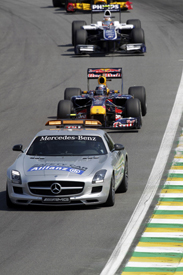
    The safety car leads the field in BrazilFormula 1 drivers are urging teams to reconsider the sport’s safety car rules following the chaos caused by backmarkers in the Brazilian Grand Prix.

    A thrilling battle for the leading positions at Interlagos after the safety car period was ruined by the top men losing time trying to work their way through heavy traffic.

    The situation has prompted calls for a rethink of the safety car rules – and a possible return to the old regulation that meant backmarkers were waved through so all the leading men were in race order at a restart.

    Force India’s Adrian Sutil told AUTOSPORT: “I think it was a complete mess. I was a fan of the rules from last year, that you could lap yourself back, it was all good.

    “We have seen so many problems caused by lapping cars after safety cars. Singapore for example, the [Mark] Webber/[Lewis] Hamilton incident happened because Webber had to lap another car, a Virgin, and he went out of the corner slower and created chaos.

    “That was very similar in Sao Paulo, even worse. I had no clue where I was, I was also getting lapped by [Fernando] Alonso, but nobody told me, I had no blue flags. I was trying to understand who was behind, if it was [Felipe] Massa or Alonso because Massa was still behind me [in the race order]. Then I thought ‘okay I think I have to let him by.’ It was just a mess.”

    He added: “Especially when it comes to the end of the season and drivers fight against each other for the championship it’s just a shame if first and second are split by three or four cars, it’s unfair. After a restart you have a possible chance to pass the other cars, but with cars in between it’s just not good. Hopefully they will try to make any changes for next year.

    “Last year the teams agreed to change it back again like it is this year. The drivers have power and if we all say we don’t want it, we also can talk to our teams to make complete agreement and then push for it. It has to be discussed first with everybody, but at the end we are racing and if we think the other rules are better, why not?”

    Rubens Barrichello said: “I would love to see Formula 1 a bit more flexible because in Brazil there was no doubt that it would have been a lot better to see the backmarkers coming back, and I was one of them in a way. But then they would argue that in Monaco in a wet race, how are you going to do it?

    “So the flexibility that I want is that you might envisage something for one race and not another, that is all. But for the show it would have been better.”

    Robert Kubica added: “I think it would be better [with the old rules], but it is very difficult. There are positives and negatives. It will take longer time because drivers need to re-catch the pack, but it is complicated for the fans. Everybody after the safety car would like to see the fight.”

    Nick Heidfeld, who was given a penalty for holding up the leaders while being lapped in the closing stages of Brazil said: “We have discussed it in briefings. We had it in the past and there was a dangerous situation once so that is the danger, but the danger is also if there are lapped slow cars in the middle of the field trying to let you by and you don’t see them. Yes I would prefer the restart to be the proper order.”

    Ferrari team principal Stefano Domenicali said after the Brazilian Grand Prix that he believed the safety car rules should at least be discussed.

    “I think that for sure at the restart we knew that it was impossible to attack,” he said. “We have seen what Fernando was able to do in the last couple of laps, in free air, he was really able to attack and when we saw it was not possible to attack we saved what we could do to keep the position.

    “We saw with the backmarkers not a really good situation with everyone, not in particular against anyone, but to see that this is a problem – also for safety. It is something that we need to discuss and talk for the future because it is not really good.”

    But not all the drivers believed that the Brazilian situation meant that a rules rethink was needed.

    Nico Rosberg said: “I don’t think it is an unmanageable situation as long as it is clear for everybody. That is the one area where everyone needs to improve so that all those drivers are informed very quickly that they are being lapped by me, for example.

    “I felt like I was in the middle of it, as I had three guys in front who didn’t know they were being lapped and two guys behind who were trying to un-lap themselves.

    “It is a question of communication being better from team to driver and from race control to the team. So I don’t think we need to straightaway think about changing the rules.”

    Rookie
    Copyright Autosport.com. 2010. All Rights Reserved

  • Las Vegas Casinos Are a Last Bastion for Smokers

    Las Vegas Casinos Are a Last Bastion for Smokers

    Jim Wilson/The New York Times

    A smoker lit up in a downtown Las Vegas casino.

    November 11, 2010

    Las Vegas Casinos Are a Last Bastion for Smokers

    LAS VEGAS — The notice on the door to the hotel-casino was emphatic. “The Westin Casuarina is a Smoke Free Environment. Thank you for not smoking.” Just beyond, four people were hunched over slot machines the other afternoon, wisps of cigarette smoke swirling around them as they happily puffed away.

    And it was perfectly legal. “This is good,” said Ray Wan, a flight attendant from Hawaii, lighting up a cigarette as the slot machine beeped and whirled before him.

    At a time when much of the rest of the nation — indeed much of the rest of the world — is on a crusade to banish smoking in public, the casinos of Las Vegas have emerged as a smokers’ oasis, perhaps the last place free from the restrictions that have spread from restaurants to bars to malls to cars carrying children. Nevada law trumps Westin policy.

    No matter that Nevada voters strongly approved a ban on public smoking four years ago: the powerful gambling industry made certain that it included an exception for casinos. Blackjack dealers and croupiers, alarmed about secondhand smoke, are pressing a $5 million federal class action lawsuit filed against the Wynn Las Vegas, to force the hotel to protect casino workers who have to sit in smoke-misted rooms. But the most the plaintiff’s lawyers expect from the case is the installation of high-technology air cleansing devices.

    Even the ominous warning labels for cigarette packages proposed by health regulators on Wednesday seem unlikely to make a difference here.

    This being Las Vegas, a place that has made an industry out of excess and risky behavior, smoking seems here to stay. Civic leaders, who might be uncomfortable enabling a habit that has, shall we say, its demonstrable downsides, point to evidence that a ban would hurt casino business, arguing that smoking is as integral to the Las Vegas experience as free drinks, playing the slots at 7 a.m. and escort services. Atlantic City banned smoking in 2008, and rolled back the ban a month later because of complaints from casinos.

    “There’s been a link between smokers and gamblers for years,” said Billy Vassiliadis, an advertising executive who represents the city’s tourism industry. “A lot of people do things here that they don’t do at home. It’s part of the overall appeal of Las Vegas. You have choices here.”

    So it is that in an era when smoking has become taboo in the rest of the country, smokers seem downright liberated when they step onto the Las Vegas Strip: Finally, there is someplace where they have nothing to be ashamed of as they romp through their bastion of freedom.

    “I mean, where else can you come in from outside smoking a cigarette, walk straight in and keep it lit?” said Andrew Garcia, a Las Vegas native.

    The other evening, a uniformed woman brandishing a tray loaded with packs of cigarettes and cigars (yes, a cigarette girl: only in Vegas) roamed the aisles of O’Sheas Las Vegas Casino. At the Bellagio, a gambler rolled her eyes at a seatmate who tried to clear the air with a wave of her hand, while up the street, at the Flamingo, a couple, with almost theatrical defiance, lighted cigarettes and thrust them in the air as they marched under pink neon tube lights down the main hall of the casino.

    “A woman sat next to me and started fanning the smoke away with her hands,” said Kelli Lee, 41, of Los Angeles, as she worked her way through a pack of Marlboro Lights while playing the slots at the Imperial Palace Casino. “Can you believe it?”

    “If cigarettes were illegal, then I would say not to smoke them,” she added. “But they’re legal. Tobacco is natural. I wouldn’t come here and gamble if I couldn’t smoke.”

    Paul Hynes, 36, of Toronto, hoisted a lit cigar as he and three friends, also puffing on thick cigars, walked among the croupier tables at the Bellagio. “This is part and parcel of the environment here,” Mr. Hynes said.

    At the same time, a walk through the casinos at any time of day or night is a reminder of the way the world used to be. The air in sections of some casinos — especially the older ones, where the ventilation systems are not exactly state of the art — is a swirl of cigarette smoke, leaving a distinctive odor on the clothes of anyone who happens to stroll through the place.

    Stephanie Steinberg, chairwoman of Smoke-Free Gaming — an organization of casino workers and patrons who are pressing casinos to ban smoking — said that while smoking was allowed in other casinos across the country, particularly on Indian reservations, Nevada had proved the most intractable. South Dakota approved a voter initiative this month to ban smoking in commercial casinos, joining Colorado, Delaware, Illinois and Montana in passing complete or partial bans.

    “The problem with Nevada — and the reason it stands out as a smoking state — is because of the power and control the gaming industry has in the state,” Ms. Steinberg said.

    Smoking is banned in restaurants, shops, public hallways and other nongambling parts of casinos; yet it is hard to tell where the no-smoking area ends and the yes-smoking area begins. “The reality is there’s no enforcement: People just walk around with cigarettes,” Ms. Steinberg said.

    The lawsuit filed by casino workers against the Wynn argues that the atmosphere there posed a serious and direct threat to their health. But Jay Edelson, the lawyer for the lead plaintiff, Kanie Kastroll, a dealer for 20 years, said the redress being sought was limited. The workers, he said, are looking for corrective action, like cleaner air, not a full ban on smoking.

    Ms. Kastroll said that dealers were often locked at tables for an hour at a time. “We get every kind of direct cigarette smoke, sometimes intentionally blown on us because they are losing,” she said. “You’re not allowed to fan, you can’t blow it back on them. Forget the employee — it’s all about their bottom line.”

    A lawyer for Wynn, James J. Pisanelli, declined comment.

    The issue has stirred passion among some casino workers. Buffy McKinney, whose mother, Cheryl Rose, a casino executive, died of lung cancer this year at age 62, said she was convinced that her mother had died of secondhand smoke. “Until there is a handful of casinos who are willing to put their foot down and say enough is enough, they are going to continue to fight to keep smoking allowed there,” she said.

    Ms. Steinberg, for one, said she was confident that with time, even casino smoking would be banned. Until then, she said, her organization would rely on a tweak of Las Vegas’s famous marketing slogan to try to rally gamblers to their cause, or at least away from cigarette packs: “What happens in a casino stays in your lungs.”

    Ana Facio Contreras contributed reporting.


    Copyright 2010. The New York Times Company. All Rights Reserved

  • Formula 1 drivers’ title is Red Bull’s to lose


    Sebastian Vettel

    Brazilian Grand Prix in 90 seconds

    By Mark Hughes
    BBC F1 commentary box producer

    The most realistic way for Mark Webber to overcome the numbers in his title fight with Fernando Alonso on Sunday is to head a Red Bull one-two in Abu Dhabi.

    Even if Alonso was third, the Australian would still seal overall victory.

    There are all sorts of permutations but this one does not stretch probability and is entirely conceivable.

    The Red Bull RB6 is demonstrably the fastest car and has scored four one-twos already this season. Doing that a fifth time would allow the team to put destiny in its own hands.

    But Alonso is adamant it was only the time he lost in getting past Lewis Hamilton and Nico Hulkenberg early on in the race in Brazil that prevented him being able to get among the Red Bulls, that he believed the Ferrari was every bit as fast.

    SARAH HOLT’S BLOG

    The Spaniard set a faster race lap than either Webber or Sebastian Vettel, who were only fourth and sixth respectively in the fastest race lap list, while Hamilton’s McLaren set the fastest lap of all, with a time just four-thousandths better than Alonso’s.

    So is Alonso right? Did the Brazil result flatter the Red Bulls?

    No, and it is hard not to detect a bit of title propaganda talk in Alonso’s claims.

    Alonso is quite right in saying he lost crucial amounts of time fighting his way up to third in the early laps but when he did get there his pace was still consistently 0.5s off that of the Red Bulls.

    Despite Webber nursing an engine that was running too hot, they continued to pull away from the Ferrari.

    The fast times of Alonso and Hamilton came after the late safety car, when the track and the tyres were in their prime condition.

    By this time, the Red Bulls were cruising, just protecting position and that engine of Webber’s.

    McLaren took a nothing-to-lose opportunity of pitting Hamilton under the safety car for a fresh set of tyres. The combination of new tyres with a fully rubbered-in track is what took Hamilton to the race’s fastest lap.

    That Alonso all but matched that time on old tyres confirms that the Ferrari was actually quicker than the McLaren but there is nothing to suggest the Red Bulls could not have obliterated that time had they been pushing full-on when the track and tyres were at their peak.

    Red Bull's Christian Horner

    Horner expects drivers to do the right thing in final race

    Comparing pre- to post-safety car laps, it was notable that there was a big increase in the pace of even the cars that did not change tyres.

    “I think everyone’s tyres were overheating,” explains McLaren’s Paddy Lowe. “Then, under the safety car, they cooled back to their optimum temperatures and so had a lot more grip when they restarted.”

    Bridgestone’s Hirohide Hamashima concurred.

    “Yes, the tyres were suffering from heat degradation here,” he said. “The track temperature was very high. The safety car speeds brought the rubber back to its peak working temperature, helped by the fact that the track temperature was falling during this time also.”

    There is nothing to suggest, in other words, that the two Red Bulls should not be the fastest two cars in Abu Dhabi. That one-two result is far from a straw-clinging exercise.

    But if there is one thing that should be worrying the team, it is just what Hamilton might manage in Abu Dhabi.

    He does not necessarily need to be in the absolute fastest car here to be the fastest. The track’s layout last year allowed him to conjure some very special magic in qualifying.

    If he can somehow win the race this time, then all bets are off and Red Bull are at the mercy of their fate.

    Mark Hughes has been an F1 journalist for 10 years and is an award-winning author of several books


    Copyright.2010.BBCsport.com All Rights Reserved

  • Fernando Alonso favourite for title insists Mark Webber


    Abu Dhabi Grand Prix, Yas Marina, 12-14 November
    Practice: Friday 12 November, 0855-1035 and 1255-1435; and Saturday 13 November 0955-1105, Red Button, online and 5 live sports extra
    Qualifying: 1215-1420 on BBC One, Red Button, online and 5 live sports extra
    Race: 1210-1515 on BBC One, Red Button, online and Radio 5 live sports extra

    Red Bull's Mark Webber

    Webber admits Alonso has ‘better chance’

    By Sarah Holt
    BBC Sport in Abu Dhabi

    Red Bull’s Mark Webber insists Fernando Alonso is best-placed to win the 2010 drivers’ world championship in Sunday’s final race of the season in Abu Dhabi.

    Ferrari’s Alonso leads Webber by eight points, Red Bull’s Sebastian Vettel by 15 and McLaren’s Lewis Hamilton by 24 with 25 points available for the win.

    But the Red Bull is the fastest car and their drivers are expected to occupy the front of the grid after qualifying.

    “Fernando is in the best position but I am looking forward to it,” said Webber.

    “I’ll initially be disappointed if it doesn’t happen but there have still been some positives this year.”

    Lewis Hamilton

    Hamilton dismisses title talk

    At 34, Webber confirmed he would be back for more next season, dismissing notions that this would be his last chance to clinch the drivers’ title.

    “I want to do it on Sunday, but if it doesn’t happen then I will have another crack next year,” said the Australian, who is a UK resident.

    “I know I have been very fortunate even to have a chance to get to this point, so I am not getting greedy, but it is human nature to always want more.”

    Alonso, who joined Ferrari at the start of this campaign from Renault, remained coy about his chances of winning a third drivers’ world championship.

    CHAMPIONSHIP PERMUTATIONS
    If Alonso wins or is second, he is champion
    If Webber wins, he wins the title if Alonso is third or worse
    If Vettel wins and Alonso is 5th or worse, Vettel wins the title
    If Hamilton wins, Alonso must fail to score, Webber be 6th or worse and Vettel 3rd or worse for Hamilton to win the title

    “We do not have the cornering speed of Red Bull nor the straight-line speed of McLaren but that has been the story of the season so far for us,” said the Spaniard. “But generally we are competitive overall.

    “You feel sad if you lose in the last moment but in my case I will not have anything to be disappointed about in 2010.

    “The last two years I was fighting to be in Q3 most of the time.

    “Ferrari had a tough year in 2009 as well but we have put ourselves back in the championship in the last race against two Red Bulls who have dominated this season in terms of the speed. It doesn’t matter what happens on Sunday as I have some great memories.

    “We can only depend on ourselves to win the championship. There is not anything we can do other than to finish first or second in the race. That is our goal.

    I have nothing to lose – it is the guys in front of me have everything to lose and I’m going to be flat out as always

    Lewis Hamilton

    “I will not lose even a second of energy thinking of what will happen on Sunday.”

    Vettel believes his team-mate and Alonso are likely to contest the title but repeated the hint he gave after winning in Brazil on Sunday that he might help the Australian if he cannot win the crown himself.

    “I said last Sunday, if we found ourselves in that position we’ll see on Sunday.

    “It’s pretty clear, there are more important things happening before we enter this stage.

    “There are more important things to focus our energy on. If the situation occurs then I think we know that we are driving for the team.”

    ANDREW BENSON’S BLOG

    Hamilton readily admits that his chances of winning are slim.

    The McLaren driver would need to win the race and hope that Alonso failed to pick up a point, while Webber finished no higher than sixth and Vettel third.

    But he remains upbeat, telling BBC Sport: “I think it’s good to have the experience and to have the pressure right down to the last race and being able to fight for the championship.

    “Sebastian and Mark may have had this experience in the lower categories. But it definitely does help, I feel quite comfortable being here having this experience in the past.

    “I can do my job better and I’m in a more relaxed mental state than 2007 and 2008.”


    Copyright 2010. BBCSport.com All Rights Reserved

  • Chasing Pirates: Inside Microsoft’s War Room

    Hazel Thompson for The New York Times

    In its battle against software counterfeiters, Microsoft checks for fake holograms and replicated disks, top left and right. It also compares certificates of authenticity, left, and stores its evidence.


    Hazel Thompson for The New York Times

    In its anti-piracy lab in Dublin, Microsoft uses microscopes and other equipment to detect counterfeits of its products


    November 6, 2010

    Chasing Pirates: Inside Microsoft’s War Room

    AS the sun rose over the mountains circling Los Reyes, a town in the Mexican state of Michoacán, one morning in March 2009, a caravan of more than 300 heavily armed law enforcement agents set out on a raid.

    All but the lead vehicle turned off their headlights to evade lookouts, called “falcons,” who work for La Familia Michoacana, the brutal Mexican cartel that controls the drug trade. This time, the police weren’t hunting for a secret stash of drugs, guns or money. Instead, they looked to crack down on La Familia’s growing counterfeit software ring.

    The police reached the house undetected, barreled in and found rooms crammed with about 50 machines used to copy CDs and make counterfeit versions of software like Microsoft Office and Xbox video games. They arrested three men on the spot, who were later released while the authorities investigate the case. “The entire operation was very complicated and risky,” says a person close to the investigation, who demanded anonymity out of fear for his life.

    The raid added to a body of evidence confirming La Familia’s expansion into counterfeit software as a low-risk, high-profit complement to drugs, bribery and kidnapping. The group even stamps the disks it produces with “FMM,” which stands for Familia Morelia Michoacana, right alongside the original brand of various software makers.

    The cartel distributes the software through thousands of kiosks, markets and stores in the region and demands that sales workers meet weekly quotas, this person says, describing the operation as a “form of extortion” on locals.

    The arrival of organized criminal syndicates to the software piracy scene has escalated worries at companies like Microsoft, Symantec and Adobe. Groups in China, South America and Eastern Europe appear to have supply chains and sales networks rivaling those of legitimate businesses, says David Finn, Microsoft’s anti-piracy chief. Sometimes they sell exact copies of products, but often peddle tainted software that opens the door to other electronic crime.

    “As long as intellectual property is the lifeblood of this company, we have to go protect it,” Mr. Finn says.

    Microsoft has adopted a hard-line stance against counterfeiting. It has set up a sophisticated anti-piracy operation that dwarfs those of other software makers; the staff includes dozens of former government intelligence agents from the United States, Europe and Asia, who use a host of “CSI”-like forensic technology tools for finding and convicting criminals.

    But the hunt for pirates carries with it a cost to Microsoft’s reputation.

    The company’s profit from Windows and Office remains the envy of the technology industry, and critics contend that Microsoft simply charges too much for them. In countries like India, where Microsoft encourages local police officers to conduct raids, the company can come off as a bully willing to go after its own business partners if they occasionally peddle counterfeit software to people who struggle to afford the real thing.

    “It is better for the Indian government to focus on educating its children rather than making sure royalties go back to Microsoft,” says Eben Moglen, a law professor at Columbia Law School and a leading advocate of free software.

    Mr. Finn argues that Microsoft has no choice but to be aggressive in its fight, saying its immense network of resellers and partners can’t make a living in areas flush with counterfeit software. He says consumers and businesses are being coaxed into buying counterfeit products that either don’t work or do serious harm by clearing the way for various types of electronic fraud.

    And, crucially, the counterfeit software cuts into Microsoft’s potential profit. A software industry trade group estimated the value of unlicensed software for all companies at $51.4 billion last year.

    The most vociferous critics of Microsoft and the overall proprietary software industry describe the anti-piracy crusade as a sophisticated dog-and-pony show. They say the software makers tolerate a certain level of piracy because they would rather have people use their products — even if counterfeit — than pick up lower-cost alternatives. At the same time, the critics say, the software companies conduct periodic raids to remind customers and partners that playing by the rules makes sense.

    “It has always been in Microsoft’s interests for software to be available at two different prices — expensive for the people that can afford it and inexpensive for those that can’t,” Mr. Moglen says. “At the end of the day, if you’re a monopolist, you have to tolerate a large number of copies you don’t get paid for just to keep everyone hooked.”

    Microsoft has demonstrated a rare ability to elicit the cooperation of law enforcement officials to go after software counterfeiters and to secure convictions — not only in India and Mexico, but also in China, Brazil, Colombia, Belize and Russia. Countries like Malaysia, Chile and Peru have set up intellectual-property protection squads that rely on Microsoft’s training and expertise to deal with software cases.

    As Mr. Moglen sees it, these efforts underscore a certain level of desperation on the part of American companies and the economy of ideas on which they have come to rely. “This is the postindustrial United States,” he says. “We will make other governments around the world go around enforcing rights primarily held by Americans. This is a very important part of American thinking around how the country will make its living in the 21st century.”

    MICROSOFT’S pursuit of software counterfeiters begins in Dublin, at one of the company’s 10 crime labs.

    Donal Keating, a physicist who leads Microsoft’s forensics work, has turned the lab into an anti-piracy playpen full of microscopes and other equipment used to analyze software disks. Flat-screen monitors show data about counterfeit sales, and evidence bags almost overflow with nearly flawless Windows and Office fakes. Mr. Keating serves as the CD manufacturing whiz on what amounts to Microsoft’s version of the A-Team, clad in business-casual attire.

    The undercover operative of this group is Peter Anaman, a lawyer who was born in Ghana and educated in England; he taught hand-to-hand combat to soldiers during a stint in the French army and then taught himself how to write software. Mr. Anaman has applied his software skills and training to explore a shift in piracy from groups that make CDs to those that offer downloads online.

    Through three online personas — two female and one male — Mr. Anaman chats with and sometimes befriends hackers in Russia and Eastern Europe who use stolen credit card numbers to set up hundreds of Web sites and offer products from Microsoft, Adobe and Symantec. “It is part of gathering human intelligence and tracking relationships,” Mr. Anaman says.

    Through an artificial intelligence system, Microsoft scans the Web for suspicious, popular links and then sends takedown requests to Web service providers, providing evidence of questionable activity. “The Web sites look professional,” he says. “And some of them even offer customer support through call centers in India.”

    The counterfeiters, however, have automated systems that replace links that Microsoft deep-sixes. So the company has turned up the dial on its link-removal machine.

    “We used to remove 10,000 links a month,” Mr. Anaman says. “Now, we’re removing 800,000 links a month.”

    He describes the groups behind these sites as “part of the dark Web,” saying they have links to huge spam, virus and fraud networks. Microsoft’s tests of software on some popular sites have shown that 35 percent of the counterfeit software contained harmful code.

    Anthony Delaney, who started at Microsoft 25 years ago — driving a forklift to move boxes of its products for shipment — has worked his way up to become its piracy data guru.

    On one of the flat screens, Mr. Delaney brings up a world map that lets users zoom into a city just as they would if hunting for directions online. But instead of highlighting landmarks and popular stores, the map illuminates Microsoft’s retail partners. Hover a mouse over a shop in San Francisco, for example, and you can see how much software it sells, how often Office is sold in tandem with Windows, the failure rate for authentication codes and how many cease-and-desist letters have gone to suspicious sellers in the area.

    According to the map, the area within a 50-mile radius of New York City accounted for more than 200 “actions” last year, including 165 cease-and-desist warning letters to companies suspected of selling pirated software.

    “We can see that only 5 percent of your sales have Office attached to Windows,” Mr. Delaney says. “If that’s below the average for the area, we may go have a chat or conduct a test purchase.”

    This rather eclectic bunch is joined by about 75 other people, including former agents of the I.R.S., F.B.I., Secret Service and Interpol, and former prosecutors — all of whom work under Mr. Finn.

    A former assistant United States attorney in New York, Mr. Finn directs this squad from a Paris office. He says Microsoft spends “north of $10 million” a year on its intelligence-gathering operations and an estimated $200 million on developing anti-piracy technology.

    Mr. Finn talks at length about Microsoft’s need to refine the industry’s equivalent of fingerprinting, DNA testing and ballistics through CD and download forensics that can prove a software fake came from a particular factory or person. And his eyes widen as he thinks about advancing this technology to the point that Microsoft can emphasize the piracy issue directly to customers.

    “Imagine the day when a consumer finds a link that says, ‘Click here if you would like a forensic examination of your disk,’ ” Mr. Finn says. “You put the disk in, the computer reads it and suddenly you see a map of everywhere that counterfeit has been seen all over the world. If people see it in a graphic and visual way, I think they are more likely to help.”

    THE software thieves monitored by Microsoft come in various shapes and sizes.

    College students, grandmothers and others have been found selling cheap, copied versions of software like Windows, Office, Adobe’s Photoshop and Symantec’s security software on eBay and other shopping Web sites.

    And people unwilling to pay for discounted software, meanwhile, can find free versions of popular products online that offer downloads to all manner of copyrighted material.

    Microsoft’s investigators, however, spend much of their time examining how large-scale counterfeiters produce copies at factories and then distribute their wares around the globe.

    The biggest counterfeit software bust in history occurred in July 2007 in southern China. The Public Security Bureau there and the F.B.I. found a warehouse where workers assembled disks, authentication materials and manuals and prepared them for shipping. All told, investigators found $2 billion worth of counterfeit Microsoft software, including 19 versions of products in 11 languages. Software produced by this syndicate turned up in 36 countries on six continents.

    As one means of trying to tell the genuine article from a fake, Microsoft embeds about an inch of a special type of thread in each “certificate of authenticity” sticker found on boxes of software and computers. The investigators spotted dozens of spools of counterfeit thread — 81 miles worth — at the Chinese warehouse.

    Microsoft has found that operations of this scale tend to include all the trappings of legitimate businesses. Workers spend years building up contacts at software resellers around the globe, offering them discounted versions of software. Then they take the orders and send them off via shipping services, Mr. Keating says.

    Many Microsoft products make users enter an activation code to register the software and have it work properly. The syndicates trade in stolen versions of these codes as well, and sometimes set up their own online authentication systems to give people the feeling they have a legitimate product. Groups in Russia and Eastern Europe, with various cybercrime operations in play, now use money gained from credit card fraud schemes to buy activation codes.

    About a decade ago, only a few companies had the expertise or the $10 million needed to buy machines that could press CDs and DVDs. Today, someone can spend about $100,000 to buy second-hand pressing gear, says Patrick Corbett, the managing director at a CD plant owned by Arvato Digital Services, which produces Microsoft’s retail software in Europe.

    “Just five years ago, there were five sites in China that supplied the whole country,” Mr. Corbett says. “Now these machines are commonplace.”

    A prized object in the factory is the stamper, the master copy of a software product that takes great precision to produce. From a single stamper, Arvato can make tens of thousands of copies on large, rapid-fire presses.

    Crucially for Mr. Keating, each press leaves distinct identifying markers on the disks. He spends much of his time running CDs through a glowing, briefcase-size machine — and needs about six minutes to scan a disk and find patterns. Then he compares those markings against a database he has built of CD pressing machines worldwide.

    This system allows Microsoft to follow the spread of CDs from factories like the ones in China. The company conducts test purchases of software — online and in stores — and receives copies from some of the 300,000 people who have complained about running into counterfeits over the last four years.

    Microsoft keeps tight controls over its partners that produce CDs. But counterfeiters get around these measures by stealing stampers and presses, presenting factories with fake paperwork from Microsoft or printing in a factory when it isn’t doing official business — a practice known in the industry as producing “cabbage.”

    To make life harder for the counterfeiters, Microsoft plants messages in the security thread that goes into the authenticity stickers, plays tricks with lettering on its boxes and embosses a holographic film into a layer of lacquer on the CDs.

    To the untrained eye, the counterfeit software in Microsoft’s labs appears to be exact replicas, right down to the boxes. Chinese counterfeiters mimic the built-in hologram simply by placing a holographic sticker across the entire surface of a CD; then they use other machines to erase some of the unique identifiers found at microscopic levels.

    Such tactics have pushed Microsoft to create a new type of digital fingerprinting technology that scans a disk’s software code for special defects. The same techniques allow Microsoft to find malicious code that may have been injected in its products.

    THE grand question surrounding Microsoft’s anti-piracy razzle-dazzle is whether it’s worth the cost.

    The piracy problems tend to run highest in regions where there is less money to pay for Microsoft’s products. Backers of free software like the Linux operating system take aim at these areas, and Microsoft also faces growing competition from Google, which gives away its Office rival to consumers and sells a business version at prices far below what Microsoft typically receives.

    “We love Microsoft’s heavy-handedness,” says Jim Zemlin, the executive director of the Linux Foundation, a nonprofit organization. “We want 100 percent of the people using Windows to pay for it, because in those places where you have a lot of pirated use of Windows, we don’t have any cost advantage.”

    Microsoft’s critics portray its behavior as reactionary, saying the company is trying to protect old business models as new devices and services arrive.

    “If people are going to steal something, we sure as hell want them to steal our stuff,” says Michael Simon, the chief executive of LogMeIn, a company whose software is used in smartphones and tablets. “When you have a saturated market like Microsoft and have no growth in these devices, then it might be different.”

    The anti-piracy tactics employed by Microsoft rub many people in the software industry the wrong way as well.

    The Business Software Alliance, which is financed in part by Microsoft and conducts audits and investigations on its behalf, spends about $50 million a year going after counterfeiters and offers rewards to people who report the use of pirated software in their companies. The alliance also finances the oft-cited annual study performed by the research firm IDC that comes up with a dollar amount tied to piracy losses.

    Robert J. Scott, a lawyer at Scott & Scott in Dallas, contends like many others that the alliance’s figure is too high and that the group draws imprecise conclusions about the purchases that people would have made if they weren’t pirating software.

    “I don’t put much stock in those reports,” says Mr. Scott, who advises businesses being audited by the alliance and other software companies.

    The alliance defends its numbers, and Mr. Finn at Microsoft says the group’s figures are accurate. He plays down the central accusation that Microsoft would face less of a piracy threat if it just lowered prices. “We have seen no connection between piracy rates and price,” he says, citing the company’s own pricing experiments. “I think it’s a canard.”

    Meanwhile, Microsoft-sponsored raids and customer audits sometimes have a public relations fallout.

    Two years ago in India, Microsoft hired Anup Kumar, a 10-year veteran of the Central Bureau of Investigation, in part to teach the company how to push software piracy cases through the local bureaucracy. When raids followed, many local software sellers chided the government in the local press, saying it bowed to Microsoft’s will.

    And, last month, Microsoft altered its policies in Russia after a spate of incidents in which local security services seized computers of advocacy groups and opposition newspapers, using the pursuit of stolen software as justification. Microsoft said it would provide a blanket software license for advocacy groups and media outlets, and offer legal aid to such groups caught up in software inquiries.

    The protection of intellectual property has become a high-stakes political game where countries that do Microsoft’s bidding expect some kind of return on their effort, according to Joseph Menn, author of “Fatal System Error: The Hunt for the New Crime Lords Who Are Bringing Down the Internet.”

    “It’s part of the geopolitical process,” he said, “and Microsoft has a level of clout that a lot of other folks don’t in Washington and in other countries.”

    Mr. Finn argues that Microsoft’s anti-piracy efforts and training of law enforcement are a benefit to countries that want to build out their tech sectors and show they value intellectual property.

    “Intellectual property is a critical engine of economic growth,” Mr. Finn says. “That’s not just for large companies, but also for small businesses and entire countries. We work with governments that are realizing this is in their best interests.”

    Miguel Helft contributed reporting.

                                                          
    Copyright. 2010 New York Times Company. All Rights Reserved

  • Vettel Drives to Victory in Brazilian Grand Prix

    November 7, 2010, 1:04 pm

    Updated | 3:30 p.m. ET

    INTERLAGOS, Brazil — By Saturday evening, the Brazilian Grand Prix outside Sao Paulo was set to be a wild and crazy ride, possibly culminating in a world drivers’ title victory by Fernando Alonso of Ferrari.

    In the end, though, most of the excitement came not from what happened on the track on Sunday, but from the news of the night before that Jenson Button had been involved in an attack by armed bandits on the road from the circuit to São Paulo. Members of the Sauber team were also attacked and robbed.

    Neither Button nor anyone in his entourage was injured, but they sped off through the streets, scraping several other cars in the process.

    The race was calm by comparison.

    Alonso needed to win the race and hope for the near elimination of the other title contenders if he was to take his third drivers’ title Sunday. But by the second corner, both Vettel and Webber had passed Nico Hulkenberg, who had won the pole position, and they took a lead they would never give up.

    It was Vettel’s fourth victory this season and the ninth of his career, and it moved him up to third in the driver standings from fourth. It gave Red Bull its first constructors’ title since it began racing in Formula One in 2005.

    ‘‘An incredible day,’’ Vettel said. ‘‘It’s good to show one race to the end what we are made of. We are here to fight.”

    But it is the drivers’ title that has more prestige.

    Alonso, who finished third in Brazil, leads the drivers’ series with 246 points, Webber is second with 238, Vettel is third with 231 and Lewis Hamilton is fourth with 222 points. Button, who entered the race as a contender, was eliminated, as he finished fifth and lies fifth in the series with 199 points. A victory awards 25 points, while a second place finish is worth 18 points.

    ‘‘The rest can say what they want, but we have the constructors’ title at the moment,’’ Webber said.

    The rainy qualifying session on Saturday resulted in the surprise pole position by Hulkenberg in a Williams car. That team had not scored a pole position since 2005, and it looked as if the main contenders for the title would have a rough time passing him, but they did not.

    ‘‘I saw that Nico had a bit too much drift, and I squeezed down the inside,’’ Vettel said. ‘‘That was the key. I was able to hold the gaps as I planned and control the race.’’

    Alonso, too, passed Hulkenberg, and by Lap 14, Hamilton moved into fourth after Hulkenberg made his pit stop. Button qualified only 11th, but he would eventually rise to fifth, and for the rest of the race the five contenders raced in the top five positions.

    On Lap 50, Tonio Liuzzi crashed his Force India car, and the safety car was deployed so the mess could be cleared up. The race restarted after Lap 55 and Vettel got off to a clean start, with Webber 2.1 seconds behind and Alonso 3.1 seconds behind Webber. The order of the race remained the same, with Alonso finishing third.

    ‘‘I think a good race for us,’’ Alonso said. ‘‘In terms of points, we are extremely happy.’’

    Vettel, for his part, sang the praises of his team with a little nostalgia.

    ‘‘When Red Bull entered Formula One, I was a small boy and I had just got my drivers license, and I drove to England and someone showed me around and I was fascinated,’’ said Vettel, 23. ‘‘And now to be part of the team and part of the driver lineup and to give them their first championship is incredible.’’

    Meanwhile, however, there was a strategic calculation that the Red Bull team had to make. If Webber won the race with Vettel finishing second and Alonso finishing third, then the team would have greatly increased its chances of winning the drivers’ title next week. Webber would trail Alonso by only one point instead of the eight-point deficit with which he will now go into the final race. As it stands now, even if Webber wins the final race, Alonso would take the title if he comes in second. Vettel, for his part, lies 15 points behind.

    Yet it would break the rules if Red Bull had ordered Vettel to let Webber win the race. This year saw scandal when Ferrari asked Felipe Massa at the German Grand Prix in July to allow Alonso to pass him to take seven extra points for the drivers’ title.

    Ferrari escaped with only a monetary fine. This time, Red Bull chose not to adopt the strategy.


     Copyright New York Times Company. 2010. All Rights Reserved

  • Exclusive interview with Bernie Ecclestone


    17 Oct 2010 Formula One Group CEO Bernie Ecclestone. Formula One Group CEO Bernie Ecclestone. Bernie Ecclestone (GBR) CEO of the Formula One Group.Great Ormond Street Hospital Grand Prix Party, Natural History Museum, London, 6 July 2010 Formula One Group CEO Bernie Ecclestone. Formula One Group CEO Bernie Ecclestone

    The answer came back as quick as a shot. ‘I’m still here!’ That’s the headline Formula One Group CEO Bernie Ecclestone wants to see as he readies himself for his 80th birthday at the end of this month. And indeed, he’s still very much here – so much so in fact that he arrived uncharacteristically late for the interview because he’d been embroiled in three simultaneous meetings, ‘trying to solve problems’. Ahead of his ninth decade, the indomitable Briton looks back at his successes – and looks ahead to his successor…

    Q: Bernie, there are hundreds of stories about you and still people find it hard to work out who you are. Who is Bernie Ecclestone?
    Bernie Ecclestone:
    An ex-used car dealer. (laughs)

    Q: But there must have a moment when you realized that you were smarter than your surroundings, that you could see opportunities quicker than most…
    BE:
    You don’t think about these things. You are in business and you do whatever you think is right. I don’t think that an artist would suddenly think, ‘well, from today on, I am an artist’. A painter starts to paint without knowing if he will be famous some day. That grows. It’s as simple as that.

    Q: How then did you end up in motor racing, ‘creating’ what we know today as Formula One?
    BE:
    I used to race motorcycles and cars, and then I bought Brabham. Somehow I’ve always been involved with racing. I started racing and I was running a business. Racing was sort of a hobby.

    Q: Your racing career was a short-lived one. Was it disappointing when you realised you weren’t good enough? It seems to be the only thing you have struggled with…
    BE:
    It was not a case of not being as good as I wanted to be. It was a case of how much effort you put into it. I was running a business, and running that business was more important than racing. So I concentrated on running a business and not on racing. That’s why I stopped.

    Q: Did you ever have a role model?
    BE:
    No. Because you can never say that you want to be like somebody else. Otherwise I would say I would like to be like Robert Redford. But these things don’t happen.

    Q: Is there a difference between Formula One racing’s Bernie Ecclestone and Bernie Ecclestone, the human being?
    BE:
    I hope I am a human being in Formula One. So the answer is no.

    Q: Have you followed any guiding principles over the years?
    BE:
    I have never had any intention to plan anything. Things happen and I try to do the best with what’s available. Probably that’s a natural gift – one that many people have.

    Q: But there are not many people around who have achieved what you have…
    BE:
    I’ve been lucky.

    Q: Is it really only luck? Some say you make your own luck…
    BE:
    What you have to do, when an opportunity is there, is to take it. A lot of people stumble through life saying ‘I could have done this’ and ‘I could have done that’. I took opportunities.

    Q: Can you say what these three things mean to you – money, power and success? Let’s start with money…
    BE:
    It means zero to me.

    Q: Power?
    BE:
    Zero.

    Q: Success?
    BE:
    Zero. I just do what I think I have to do. If you send me to do a job, I would do the best that I could for you. Is that being successful?

    Q: Money, power and success – you have all three. Which of the three could you go without?
    BE:
    I would rather not go without money, but it is not the most important thing. Success? Success you get if you have achieved something. Not having success would mean doing nothing – lying in bed all day long.

    Q: Have you been surprised by how successful you have been over the years?
    BE:
    I have been lucky with many things.

    Q: But wherever you go there is a limousine waiting and a police escort – the attributes of a successful man. Are there moments when it dawns on you just how successful you are?
    BE:
    Ah, the police escort… I think they just want to make sure that I get there.

    Q: Luck seems to be an important factor in your life. What does luck mean to you?
    BE:
    It’s the right time and the right place and having the guts to take up the opportunity.

    Q: Can you remember a situation where you really felt you had been touched by luck?
    BE:
    I cannot remember. It has happened to me so often. Ah, one thing I do remember was during the war and I was out picking potatoes to make some money when a German warplane went down just metres from where I was. The impact picked me up and blew me metres away – but that was it – I didn’t even have minor injuries! That was luck! And this luck had nothing to do with me. I had no ego, I was not successful – I was just bloody lucky. Obviously, a lot of people must feel that they were unlucky on that day… (laughs)

    Q: There is a rather unusual item in this room – something one might not automatically associate with you – a fire fighter’s helmet. There must be a story connected to it…
    BE:
    I was once asked what I would write in my job description and I said I am a fire fighter. That is exactly what I am – a fire fighter! A lot of people think that I start more fires than I put out…

    Q: If you hadn’t ended up in motor racing, did you have a ‘Plan-B’?
    BE:
    I always wanted to run a business. I realized that to be a race driver you need to do it full time – and I was not prepared to do that. I wanted to run a business.

    Q: But you could have picked any business…
    BE:
    I was always too busy to reminisce about what might have been. I like what I am doing – otherwise I wouldn’t do it. I am lucky enough to be able to have that choice. If I don’t want to do it, I don’t have to do it. I don’t do it for money. But if I do something I want to make sure that things are done properly. That’s the same with boiling an egg or doing an important contract. And if I have the feeling I can’t do it properly, then I wouldn’t do it.

    Q: You always seem to have known what you can do and what you can’t do…
    BE:
    Probably others just haven’t been prepared to give up what you have to give up to do a proper job. I have given a lot of things up because of this.

    Q: When you look in the mirror, do you sometimes think, ‘Is that really me they write and talk about’?
    BE:
    These days I try not to (look in the mirror)! (laughs) But no, because I am just doing a job. And what I do, I hope I do well.

    Q: There are still many who believe your biggest motivation is money…
    BE:
    I have never done anything for money. Money is a by-product of what I do. From the early days onwards. I had a very successful business when I was 20 years-old. What motivated me even then was to do good deals – not to make money. Money comes out of good deals, which people don’t understand. I don’t think that you will find anyone who is more than comfortably off doing what he does just to make more money.

    Q: Do you have any vision of where Formula One racing could go in the next decade?
    BE:
    No. I am worried about next year! Anyone who starts telling you today what is going to happen in three years is wrong. Otherwise we wouldn’t have the problems we are just going through.

    Q: There is a notion in the paddock that it still takes 12 team principals to make one Bernie Ecclestone. What do you think when you hear something like that?
    BE:
    We will see! (laughs) They should probably all see that they run their own businesses properly and not worry about others’. What is good for Formula One is good for everybody involved – teams and companies. Too many people only think about what is good for them. It’s the same with the rules – they only think about what can make them win.

    Q: Is it all about ego?
    BE:
    I wouldn’t call it ego but stupidity. They should think about the whole global side of it. All the teams are very competitive and want to win, which I support completely, but they need to want to win on level terms and not try to get a big advantage. If they get an advantage because somebody designs a better car or they have a better driver or strategy, then super. But they should not try to devise things so that they can go in knowing that they have an advantage. Lots of them would like to go in and have a little bit of a bigger engine than the others, which is not really the way to go.

    Q: Lately there have been a lot of programmes showing Formula One racing 40 years ago, as it was the 40th anniversary of the death of Jochen Rindt. The drivers in those days all looked and behaved like stars. What has happened to the personalities of the drivers since then?
    BE:
    I think the teams themselves don’t encourage the drivers to be particularly free. And it’s easier for the guys not to be, although I have to say that there are a lot of nice guys racing at the moment. But it takes a long time to build up characters – they don’t grow overnight.

    Q: Do you have any idea about who will come after you?
    BE:
    I have no idea. They should probably look out for another used car dealer!


    Copyright. 1999-2010 Formula One Administration Ltd . All Rights Reserved

  • 2010 Drivers Championship After Korean Grand Prix

    PositionRace
    Number
    DriverTeamDriver
    Nationality
    Current
    Points
    18Fernando AlonsoFerrariSpain231
    26Mark WebberRed Bull RacingAustralia220
    32Lewis HamiltonMcLarenGB210
    45Sebastian VettelRed Bull RacingGermany206
    51Jenson ButtonMcLarenGB189
    67Felipe MassaFerrariBrazil143
    711Robert KubicaRenaultPolandl114
    84Nico RossbergMercedes GPGermany122
    93Michael SchumacherMercedes GPGermany66
    109Rubens BarrichelloWilliamsBrazil39
    1114Adrian SutilForce IndiaGermany47
    1223Kamui KobayashiBMW Sauber F1Japan31
    1315Vitantonio LiuzziForce IndiaItaly21
    1412Vitaly PetrovRenault19
    1510Nico HulkenbergWilliamsGermany18
    1616Sebastien BuemiTorro RossoSwitzerland8
    1722Pedro De La RosaBMW Sauber F1Spain6
    1826Nick HeidfeldBMW Sauber F1Germany6
    1917Jaime AlguersuariTorro RossoSpain3
    2019Heikki KovalainenLotus F1Finland0
    2118Jarno TrulliLotus F1Italy0
    2220Karun ChandhokHRT F1 Team0
    2321Bruno SennaHRT F1 TeamBrazil0
    2425Lucas Di GrassiVirgin RacingBrazil0
    2524Timo GlockVirgin RacingGermany0
    2625Sakon YamamotoHRT F1 TeamJapan0
    2727Christian KlienHRT F1 Team0
    last updated Oct 24, 2010

  • Brazilian GP: Ferrari Friday report

    Racing series  F1
    Date 2010-11-05

     |
    The first day of the Brazilian Grand Prix followed the now traditional script, with the Red Bulls apparently extremely fast, the McLarens very competitive and Scuderia Ferrari Marlboro on the pace, especially over a long run. Two problems, one for each driver, delayed the programme for both Fernando Alonso and Felipe Massa. This morning the engine on car number 8 broke a few minutes before the end of the session, just ahead of its planned life, given that it was due to be “pensioned off” during the lunch break. In the afternoon, an electrical problem with the neutral finder, disengaged the clutch which meant Felipe had to park the car when he had just begun his first run on the soft tyres. “I would say there is nothing new under the sun, even here in Brazil,” said Stefano Domenicali. “The pecking order seems to be the one we have seen throughout this part of the season, with Red Bull definitely having a slight edge, especially on the first lap. However, tomorrow the forecast is for rain, therefore qualifying will be even more difficult and factors other than the pure pace of the vehicle and the driver’s performance will also come into consideration. More than ever, it will be important to keep a cool head and concentrate, in order to manage the various situations that could arise as well as possible.”

    Fernando Alonso: “As usual, it is very difficult to draw any conclusions after Friday’s two free practice sessions. In fact, the Red Bulls have always been dominant in the last six or seven Fridays, therefore there were no surprises today. Even when we have managed to take pole, they have been very competitive the previous day. For us, it will be important to stay ahead of the McLarens and the other teams, who on this track could be in the mix: by that I mean Renault, Williams and Mercedes. Then, the forecast is for rain tomorrow and anything could happen. It will be vital to understand when and on what tyres to go out on track to set a time. We have introduced a few updates on the car which seems to be a positive step, even if we still need to analyse the data in depth. The engine change between the two sessions was already on the day’s programme therefore, in reality I only lost a couple of laps, nothing more.”

    Felipe Massa: “I ran wide at Turn 2 and went over the kerb quite heavily: I immediately noticed that the clutch had disengaged and I was unable to select any gear to try and get back to the pits. Nothing like that has ever happened to me before: it was only when the car was brought back to the garage that we discovered it was an electrical problem. It was a shame, because I was on my first run with the soft tyres and I had yet to fully understand how they were working. Overall, I feel we can be competitive this weekend. Sure, the Red Bulls are very strong, as are the McLarens. It is meant to rain tomorrow and, on a wet track, anything could happen. I don’t expect any special problems with the tyres as their behaviour seems to match our expectations. It’s true I did not do a long run on the softs, but the initial impression is that they are also consistent. The Brazilian crowd is incredible, singing and dancing all day long! They are very passionate about Formula 1 and for a driver who is from here, it is a great pleasure to race in front of these fans: it gives you an extra motivation to give your all to make them happy.”

    Chris Dyer: “It was a reasonably average sort of day, apart from the two little problems we had, first on Fernando’s car and then on Felipe’s. The engine on car 8 had reached the end of its life, so we lost practically nothing, while Felipe’s had a problem linked to the electrics in the switch which controls the neutral finder that disengaged the clutch . In terms of performance, today we tried some aerodynamic updates: the first indications are positive and we are thinking of also using them on Saturday and Sunday. On the first flying lap, the situation is not bad, but we definitely have to improve if we want to be in the fight for pole position. Having said that, we are expecting a wet qualifying tomorrow: an opportunity to make up some places on the grid, but at the same time, a risk of losing an equal number. We have seen that on a long run, the car handles very well., but we know how important is the grid position in terms of the outcome of the race.”

    -source: ferrari


    Photos for Brazilian GP