Month: October 2010

  • Las Vegas Guide .

    Las Vegas at night (www.free-city-guides.com)This is your free Las Vegas City Guide!  It’s truly a city that never sleeps and you’ll find the casinos as busy at 4am as they are at 4pm.  There’s so much more to this city than gambling though.  Here are our personal recommendations on what to see…

    WHAT TO DO IN LAS VEGAS

    Apart from a few dollars in slot machines, we don’t really gamble in Las Vegas.  If you’re going to gamble, you’ll know all about the casinos, but it’s the hotels themselves which form the attraction here for us. Almost every hotel on the strip has a different “theme” and they are all absolutely huge.  We spent hours wandering in and out of them all to see what they had to offer.  Most have shopping centres and other attractions.  All the hotels are worth a visit, but we’ve listed some of the highlights below…

    Las Vegas Bellagio Fountains crowd (www.free-city-guides.com)

    The crowd watching the Bellagio Fountains

    The Bellagio – One of the most amazing sights in Las Vegas is the fountain display in the giant pool at the front of the hotel.  It “performs” to music every 15 minutes in peak times, but you’ll need to be there in good time to get a good view.  Without doubt, the fountains are the best free attraction in Vegas.  Don’t miss out on seeing inside the hotel hotel too.  It’s very luxurious with white gaming tables and an amazing indoor garden near the lobby desks.  More info, pics, links & map…

    Paris – The highlight here is the mini Eiffel Tower which is about a 3rd the height of the original.  We recommend the trip up the elevator to the top where there are some magnificent views of the strip – far cheaper than a helicopter ride!  You’ll also find a mini Arc de Triomphe and the outside of the hotel is shaped like some of the traditional Parisian buildings like the Paris Opera House.  More info, pics, links & map…

    The Venice Hotel

    The Venetian Hotel

    The Venetian – Outside this hotel are all the sights of Venice crammed into the frontage along the strip.  You’ll find re-creations of the Rialto Bridge, the Camponile and the Doge’s Palace, along with mini canals and gondolas.  Inside the hotel, the shopping centre has Italian restaurants, more gondolas and a mini St Mark’s Square.  You can continue your journey through the shops to the Palazzo Casino next door.  More info, pics, links & map…

    The Mirage – Two attractions we’d recommend here.  The volcano outside “erupts” with fire, water and light every night on the hour from 8pm.  It’s well worth seeing and last around 5 minutes.  At the rear of the hotel though is Siegfried and Roy’s Secret Garden which is a sort of mini animal park.  To be honest, we thought the big cat cages were on the small side, but it was the dolphins that we will remember for a long time to come.  This is the closest we have ever been to them and they have lots of pools to swim in.  While we were there, they had a fantastic time chasing each other and jumping of their own accord for the crowds.  There are no “shows” as these are not “performing” animals, but at most times of the day the trainers are interacting with the dolphins, so there’s plenty to see.  We’ve also tried out and would recommend the “Trainer for a Day” experience, which has to be booked well in advance.  More info, pics, links & map… 

    Las Vegas Mirage Dolphins jumping (www.free-city-guides.com)

    The dolphins at the Mirage, Las Vegas

    MGM Grand – The big attraction inside this hotel is the free “Lion Habitat” located in the Casino.  The lions are actually kept on a large ranch outside Las Vegas, but different lions come on different days to spend a few hours in the specially built enclosure.  It has running water, fake trees and is climate controlled to be the perfect environment for the lions while they watch the casino gamblers. We’d recommend being there at 11am when the lions first enter the enclosure as they are generally much more active at this point.  More info, pics, links, lion habitat opening times & map…

    Caesar’s Palace – This place is absolutely huge!  There are two Casinos, but at the rear of the hotel you descend to find a massive shopping centre which stretches back to the strip.  Some of the fountains here are really worth seeing both outside the hotel and inside the shopping centre.  More info, pics, links & map…

    StratosphereThis hotel has the tallest Las Vegas viewing area at the top of its tower.  The view is good, although we prefer the view from the top of the Paris Eiffel Tower.  The difference here though is the collection of thrill rides and experiences on the tower.  The scariest of them all is the “Sky Jump” free fall where you are essentially dropped 855 feet to the ground in a harness!  The hotel is quite a long way down the strip from the newer resorts and you’ll find it near to the Sahara.  More info, pics, links, opening times & map… 

    Las Vegas Aria tram (www.free-city-guides.com)

    The City Center tram at Aria

    Aria – This is one of the newest hotels in Las Vegas and is part of the “City Center” development opposite Planet Hollywood on the strip.  There are no free shows, but the fountain at the front is fascinating to watch as bursts of water do battle with each other.  The hotel is also worth seeing, just to soak up the opulence of the place.  You can ride the “City Center Tram” which goes past the front of the building for free too.  More info, pics, links & map…

    Treasure Island (TI) – Not the most attractive of the hotels, but the free “Sirens of TI” pirate show at the front is worth seeing.  It involves huge moving ships and scantily clad performers staging a pirate “battle”.  Performances are every 90 minutes in the evenings but be there well ahead of time as there’s not much viewing space.  More info, show times, pics, links & map…

    New York New York – From the outside the hotel has the appearance of some of the most famous buildings of the New York skyline like the Empire State Building and the Chrysler building.  You’ll also find mini reproductions of well known landmarks like the Statue of Liberty and Brooklyn Bridge.  Inside, the hotel has a mini theme park and we can thoroughly recommend the roller coaster which starts there and moves all around the outside of the building.  More info, pics, links & map…

    Circus Circus – This hotel is one of the older ones further down the strip, and it looks a little tired too.  However, inside you can catch the daily 10 minute free circus trapeze shows and at the rear you’ll find a dome with all kinds of theme park rides and entertainment.  More info, pics, links & map…

    The Flamingo – Head through the casino to the peaceful garden at the back of the hotel where you’ll find real flamingos, huge Koi and a relaxed atmosphere.  More info, pics, links & map…

    google_protectAndRun(“ads_core.google_render_ad”, google_handleError, google_render_ad);

    MORE THINGS TO DO IN LAS VEGAS

    The Grand Canyon – We’d thoroughly recommend that you make the most of the proximity of Las Vegas to the Grand Canyon.  Tour companies and hotels will happily organise this for you and you can go by helicopter, small plane or coach.  Many of the trips will touch down and leave you time to enjoy the surroundings.  You need to decide what kind of trip you want though, and to help, check out the Free-City-Guides.com page of independent advice here.  In the meantime, one thing to bear in mind is that the coach options will involve many hours just to get there!

    Las Vegas Grand Canyon wide (www.free-city-guides.com)

    The South Rim of the Grand Canyon

    See A Show – Almost all of the hotels have their own theatres and you can see just about everything in Las Vegas ranging from Broadway musicals to big name singing stars.  The Cirque du Soleil shows are hard to describe but combine circus arts and street entertainment to create compelling stories with breathtaking feats.  Las Vegas neon sign (www.free-city-guides.com)

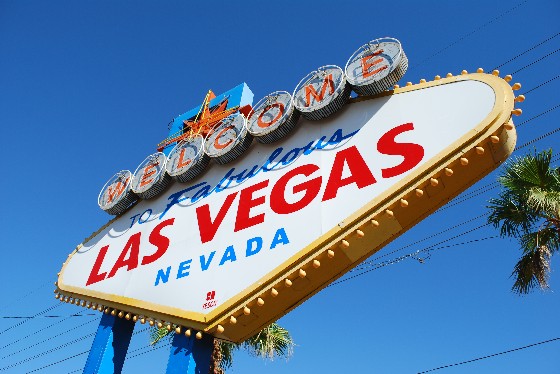
    The Las Vegas Sign - The old neon sign on Las Vegas Blvd has been the sight that welcomes visitors to the city for decades.  It’s now an attraction in its own right and there’s even a small parking area in the middle of the road so you can stop for a photo.  If you want to walk, it’s about 10 minutes further along the strip from the Mandalay Bay.  More info, pics, links & map…

    Hoover Dam – This is another out of town excursion you can take and it’s a truly fascinating structure to see.  The Dam was a miracle of engineering when it was built and the lake it created, Lake Mead is absolutely huge!  Travelling to the Dam takes around half an hour from Vegas in a hire car, or you can take one of the many organised trips.  Some combine Hoover Dam with seeing the Grand Canyon.

    SEE OUR MINI GUIDE TO THE BEST SHOPPING IN LAS VEGAS
    SEE OUR MINI GUIDE TO THE TOP 10 FREE THINGS TO DO IN LAS VEGAS

    The incredible roof in downtown Las Vegas

    The incredible roof in downtown Las Vegas

    OUR TOP TIP IN LAS VEGAS

    The Fremont Street Experience - Away from the modern hotels, Las Vegas has made a huge effort to attract tourists back to the old “Downtown” area where you’ll find hotels like the Golden Nugget.  All the streets here are closed off and they’ve constructed a roof on which light and picture shows are shown.  You’ll also see some of the old neon signs dotted around as exhibits in the Las Vegas Neon Museum.  To get downtown, hop on the busses that run up and down the strip or for a quicker journey, hail a cab.  More info, pics, links & map…

    GETTING AROUND LAS VEGAS

    Las Vegas is making real efforts to improve  its public transport system and there are quite a few options now for getting around.  One of the simplest is the Deuce busses which cruise the strip.  You can buy single journey, 24 hour or 3 day tickets to get the best value, but the busses are fairly slow.  The Las Vegas monorail has stations at the MGM Grand, Paris/Bally’s, The Flamingo, Harrah’s, The Convention Centre, The Hilton and the Sahara.  It’s not cheap though, so we only took it when our feet ached from walking the strip.  Many of the hotels have free transport systems too, so make the most of them when you can.  There’s a tram which runs from Mandalay Bay to Excalibur, the City Center Tram runs from Aria to the Bellagio and there’s also a little tram linking the Mirage and TI. Cabs on the strip are easy to hail and not that expensive. 

    McCarran International airport is right next to the strip and cab journeys should be cheap (typically $20 or less for the nearest strip hotels).  Beware that you’re not taken on a long detour via the freeway though and always ask for the cheapest and most direct route to your hotel. 

    MORE ON LAS VEGAS

    Hotels in Las Vegas – Great rates from Hotels.com
    More Las Vegas Hotels - Up to 30% off from Expedia.co.uk
    Flights to Las Vegas - Airfare.com
    Books on Las Vegas
    VisitLasVegas.com – Official Las Vegas site
    DVDs on Las Vegas

  • New Web Code Draws Concern Over Risks to Privacy


    Jock Fistick for The New York Times

    Samy Kamkar created software to show how thoroughly computers could be infiltrated by the latest Web technology.


    October 10, 2010

    New Web Code Draws Concern Over Risks to Privacy

    Worries over Internet privacy have spurred lawsuits, conspiracy theories and consumer anxiety as marketers and others invent new ways to track computer users on the Internet. But the alarmists have not seen anything yet.

    In the next few years, a powerful new suite of capabilities will become available to Web developers that could give marketers and advertisers access to many more details about computer users’ online activities. Nearly everyone who uses the Internet will face the privacy risks that come with those capabilities, which are an integral part of the Web language that will soon power the Internet: HTML 5.

    The new Web code, the fifth version of Hypertext Markup Language used to create Web pages, is already in limited use, and it promises to usher in a new era of Internet browsing within the next few years. It will make it easier for users to view multimedia content without downloading extra software; check e-mail offline; or find a favorite restaurant or shop on a smartphone.

    Most users will clearly welcome the additional features that come with the new Web language.

    “It’s going to change everything about the Internet and the way we use it today,” said James Cox, 27, a freelance consultant and software developer at Smokeclouds, a New York City start-up company. “It’s not just HTML 5. It’s the new Web.”

    But others, while also enthusiastic about the changes, are more cautious.

    Most Web users are familiar with so-called cookies, which make it possible, for example, to log on to Web sites without having to retype user names and passwords, or to keep track of items placed in virtual shopping carts before they are bought.

    The new Web language and its additional features present more tracking opportunities because the technology uses a process in which large amounts of data can be collected and stored on the user’s hard drive while online. Because of that process, advertisers and others could, experts say, see weeks or even months of personal data. That could include a user’s location, time zone, photographs, text from blogs, shopping cart contents, e-mails and a history of the Web pages visited.

    The new Web language “gives trackers one more bucket to put tracking information into,” said Hakon Wium Lie, the chief technology officer at Opera, a browser company.

    Or as Pam Dixon, the executive director of the World Privacy Forum in California, said: “HTML 5 opens Pandora’s box of tracking in the Internet.”

    Representatives from the World Wide Web Consortium say they are taking questions about user privacy very seriously. The organization, which oversees the specifications developers turn to for the new Web language, will hold a two-day workshop on Internet technologies and privacy.

    Ian Jacobs, head of communications at the consortium, said the development process for the new Web language would include a public review. “There is accountability,” he said. “This is not a secret cabal for global adoption of these core standards.”

    The additional capabilities provided by the new Web language are already being put to use by a California programmer who has created what, at first glance, could be a major new threat to online privacy.

    Samy Kamkar, a California programmer best known in some circles for creating a virus called the “Samy Worm,” which took down MySpace.com in 2005, has created a cookie that is not easily deleted, even by experts — something he calls an Evercookie.

    Some observers call it a “supercookie” because it stores information in at least 10 places on a computer, far more than usually found. It combines traditional tracking tools with new features that come with the new Web language.

    In creating the cookie, Mr. Kamkar has drawn comments from bloggers across the Internet whose descriptions of it range from “extremely persistent” to “horrific.”

    Mr. Kamkar, however, said he did not create it to violate anyone’s privacy. He said was curious about how advertisers tracked him on the Internet. After cataloging what he found on his computer, he made the Evercookie to demonstrate just how thoroughly people’s computers could be infiltrated by the latest Internet technology.

    “I think it’s O.K. for them to say we want to provide better service,” Mr. Kamkar said of advertisers who placed tracking cookies on his computer. “However, I should also be able to opt out because it is my computer.”

    Mr. Kamkar, whose 2005 virus circumvented browser safeguards and added more than a million “friends” to his MySpace page in less than 20 hours, said he had no plans to profit from the Evercookie and did not intend to sell it to advertisers.

    “That wouldn’t have been difficult,” he said. Instead, he has made the code open to anyone who wants to examine it and says the cookie should be used “as a litmus test for preventing tracking.”

    A recent spate of class-action lawsuits have accused large media companies like the Fox Entertainment Group and NBC Universal, and technology companies like Clearspring Technologies and Quantcast, of violating users’ privacy by tracking their online activities even after they took steps to prevent that.

    Most people control their online privacy by adjusting settings in today’s most common Web browsers, which include Internet Explorer by Microsoft, Firefox by Mozilla, Safari by Apple and Opera, which is used mostly in Europe and Asia and on mobile devices.

    Each browser has different privacy settings, but not all of them have obvious settings for removing data created by the new Web language. Even the most proficient software engineers and developers acknowledge that deleting that data is tricky and may require multiple steps.

    “Now there are so many sources of data storage, it’s very hard for browser manufacturers to handle that,” Mr. Cox said.

    Mr. Kamkar and privacy experts say that makers of Web browsers should agree on one control for eliminating all tracking capabilities at once. “There should be simple enough controls to take care of every single thing,” said Ms. Dixon, who added that some browsers automatically collected large amounts of data unless a user told them not to.

    Mr. Lie acknowledged that such companies “do have a lot of power.” But he said they worry that the privacy settings they develop could be too strict. For example, he said Opera once tried to put more controls on certain types of cookies, but users in Russia complained that the controls prevented a popular social networking site from working properly.

    But software developers and the representatives of the World Wide Web argue that as technology advances, consumers have to balance its speed and features against their ability to control their privacy.

    “You can do more, but you need to be aware of how your information might be used or misused,” Mr. Jacobs said. “It’s the human questions.”


    Copyright. New York Times Co. 2010 All Rights Reserved

  • From a Mysterious Mansion to a Ralph Lauren Store

    Office for Metropolitan History

    The Gertrude Rhinelander Waldo house, as it looked in 1899. By most accounts, Mrs. Waldo never lived there.


    October 7, 2010

    From a Mysterious Mansion to a Ralph Lauren Store

    THE super-luxe new Ralph Lauren palazzo, at the southwest corner of Madison Avenue and 72nd Street, is scheduled to open in mid-October. But across the street, hidden for months behind a veil of netting, is the old store, a limestone mansion with a mournful past, built in 1898 by an heiress who never lived in it.

    Gertrude Rhinelander was born about 1837 into a family that had lived in New York since the 17th century, and in 1876 she married Francis Waldo, a stockbroker who had been ruined in the Panic of 1873. Her lifestyle, however, was never less than genteel; at her death in 1914, The New York Sun said she had inherited $2 million.

    Mr. Waldo died in 1878, and in 1882 Mrs. Waldo bought the southeast corner of 72nd Street and Madison Avenue, which despite its horsecar line was dotted with the mansions of those who eschewed the show of Fifth. The Real Estate Record and Guide reported that Mrs. Waldo was going to erect a mansion “quite unique in design.” She did not go ahead, but five years later bought the inside lot on the side street.

    Mrs. Waldo still did not build, and lived with her sister, Laura, in a row house across 72nd from the site. According to The Oswego Daily Palladium in 1889, Mrs. Waldo was “a very pretty woman,” and by some accounts she was keeping company with Charles Schieffelin, a lawyer.

    But in 1889 she sued him for stealing $12,000 she had given him to invest. Mr. Schieffelin, a Union Club member separated from his wife, counterclaimed that he and Mrs. Waldo were to be married, and that he had invested the money as directed. She protested that marrying a divorced man would have been “too dreadful” to contemplate. The disposition of the case is not clear.

    It was not until 1894 that Mrs. Waldo, then living at the old Hotel Savoy, began to build an impressive limestone mansion, along with a smaller house on the inside lot. In the French Renaissance style, it would have fit in just fine with those on Fifth. In any event, it had elegant company on Madison Avenue, which north of 59th attracted perhaps a dozen mansions. Consuelo Vanderbilt was living in one on the southwest corner of 72nd when she married the Duke of Marlborough in 1895.

    Kimball & Thompson received design credit in architectural periodicals, but a photograph of the mansion published at or near the end of construction included the notation that it was designed by Alexander Mackintosh, an obscure local practitioner. With delicate, lacy Loire Valley trim, it has so many windows, it looks as if somebody had taken a shotgun to it. There was said to be a top-floor ballroom and 2,000 electric lights, but only two bedrooms for servants. The New York Times opined that such a house would require a staff of at least a dozen.

    Mrs. Waldo’s overwrought dwelling was completed by 1898. One directory lists her as residing there, but that is probably an error. All other period sources say she remained in her sister’s much more modest row house across the street, and never moved in.

    At her death in 1914, The New York Sun described Mrs. Waldo as “of forceful manner and some unusual views” on art, dress and society, and said that she had vowed to leave the United States several times. Mrs. Waldo was often in court, and not just with Mr. Schieffelin. In 1901 a subcontractor on the house filed a claim against her for $2,600. In 1909, she began an extensive legal battle with a servant, Mary Madden, who complained she was owed $5; there were suits and cross-suits for $250, $15,000 and a claim of false arrest.

    Mrs. Waldo resigned from a club in indignation in 1909 when another member criticized her dress. And in 1912 The Sun reported that she was sued for illegally transferring assets to her sister to avoid payment of a debt. The outcome of most of these complaints is hazy.

    At the same time, Mrs. Waldo personally collected rents in her twin apartment buildings, the Kaiser and the Rhine, at Second Avenue and 89th Street; in 1904, when a fire broke out, she tried to get through police lines to rescue her tenants; no one was killed.

    In 1909 The Times reported that her remarkable house, built and furnished at a cost of $1 million, was in foreclosure, its limestone badly discolored, its great glass dome cracked.

    By the 1920s the house was the headquarters of Olivotti & Company decorators, with apartments upstairs. Polo Ralph Lauren arrived in the late 1980s, and the building is still a Ralph Lauren store. The company has just treated it to an extensive exterior restoration, simultaneous with the completion of a second store across the street on the site of Consuelo Vanderbilt’s mansion. For the new building, Weddle Gilmore Architects has produced an assured and demure neo-Classic design, French in character. At the time of proposal it was challenged by some preservationists as a fake, but as it stands, it is magnificent.

    The peculiar story of Mrs. Waldo is not unusual; New York has other private houses that for unexplained reasons were never occupied by their rich owners. But Mrs. Waldo’s case is a particularly sorry one; although she had inherited millions, in 1915 The Times reported that she died in debt for $135,000.

    E-mail: streetscapes@nytimes.com

    Copyright. 2010. The New York Times Company. All Rights Reserved


  • Sebastian Vettel Wins 2010 Japanese Grand Prix

    There was mayhem from the beginning of the Formula One Japanese Grand Prix, as soon as the lights went out, with five cars retiring before it had barely started. However, polesitter Sebastian Vettel managed to avoid all of that, and he maintained the lead from team mate Mark Webber. For only the second time this season, the German driver, successfully converted pole position into a race victory, with the last occasion occurring at the European Grand Prix. Webber made it a Red Bull one-two finish, with Fernando Alonso taking the final spot on the podium.

    See large picture
    Sebastian Vettel, Red Bull Racing.

    Despite Vettel taking the win over his Australian team mate, Webber did have a taste of success on the final lap, as he recorded the fastest lap of the race over the other front-runners. His very quick lap to top the timesheets was 1:33.474s, and the race winner completed the last lap in 1:33.653s.

    Even though he was not quite as fast as Webber at the very end, Vettel was very pleased to take the first place podium finish, and the points that come with it.

    “This circuit is very special – the fans are incredible here and to get my second win in Suzuka is fantastic. It was a nice Sunday; to have qualifying and the race in one day is a unique experience and to finish top in both is great. Thanks to the team, to those here and also back in the UK – they all work very, very hard. We had some small upgrades here and they were a step forward. Our car loves this type of circuit and I’m very happy and very proud of today’s result”

    The first cause for the safety car to be deployed on lap one, was as a result of Vitaly Petrov for Renault, veering off the track and into the wall. As he turned to the left, he had contact with the Williams of Nico Hulkenberg, who then made an early exit from the race as well.

    The race stewards subsequently investigated the incident, and deemed it to be an avoidable collision. The Russian rookie will now face the consequences of his actions in the incident, and he will suffer a five-place grid penalty for the next race in South Korea.

    The stewards had another incident to look into as well, when Felipe Massa went up the inside of Force India’s Vitantonio Liuzzi, as the Ferrari driver went into Turn one. The gathering between the two drivers added them, onto the list of retirements early on in the race. It has now been declared that no further action will be taken with regard to the collision.

    Robert Kubica also followed suit on lap three, with a suspected driveshaft problem, which then saw his right rear tyre detach itself from the car. This came at an unfortunate time for the Renault driver, as he was running in second place when the safety car was still on track.

    When the race was re-started on lap six as the safety car went in, all of the top five contenders fighting for the Drivers’ title, were in the first five places, with Vettel leading Webber, Alonso in third, Lewis Hamilton in fourth and Jenson Button was fifth at the time.

    The McLaren drivers had a fairly steady race until the end, although Lewis Hamilton did lose third gear, and reported the problem to the team on lap forty. The 2008 World Champion nursed his car to a fifth place finish, just behind his team mate, defending World Champion, Jenson Button, who made the most of the opportunity to nip passed, and take fourth place from him.

    Button did lead the race from lap twenty-six, while the other front-runners decided to pit. Vettel did regain the lead from lap thirty-eight though, and he kept it all the way to the chequered flag. Up until the point with the gearbox issue, Hamilton was running quite well after pitting on lap twenty-three, and he managed to steal fifth position from Kamui Kobayashi in his Sauber.

    The Japanese driver had an eventful home race, and was definitely in the limelight for his performance today. Just a few laps previously, he was fighting for position with Adrian Sutil for Force India. Kobayashi made an impressive manoeuvre on the German driver, to grab ninth place from him. Sutil sadly joined the other retirees in the race on lap forty-four, but was able to drive himself back to the pits. He is thought to have had an engine failure, which left traces of oil on the track, for the rest of the field to dodge passed.

    In the latter stages of the race, Kobayashi fought for position with the Toro Rosso driver, Jaime Alguersuari, for eleventh place at the notorious 130R corner and did take it. Alguersuari did not benefit from this, and as a result of them banging wheels, he had to make a swift pit stop. The Spaniard finished in eleventh place, with his team mate, Sebastian Buemi just beating him, to the last top ten point scoring position.

    Kobayashi suffered slight damage on his car, but that did not stop him from chasing down the Williams driver, Rubens Barrichello. He was aiming to take ninth place from the Brazilian, and did follow it through on lap forty-seven. Barrichello picked up a few points for the team, as he secured ninth position back, and crossed the finish line there. Luck was clearly on Kobayashi’s side on his home soil, and he was able to go two places better by the end, to finish in seventh position and just ahead of team mate, Nick Heidfeld.

    Other in-team battles were seen between the two Mercedes drivers. While the safety car was out on lap one, Nico Rosberg took advantage of the situation, and decided to pit for new tyres. The German seemed to reap the reward later on, when his team mate and fellow countryman pitted on lap twenty-three. Rosberg was then ahead of the seven time World Champion, to take eighth place at that moment. Sadly, things took a different turn, and Rosberg retired from the race on lap forty-nine. He was in thirteenth place at that stage, and travelling at 130mph towards Turn five, when his left rear tyre came off, and this spelt the end of the race for him. Meanwhile, Schumacher brought home some valuable points for the team as he secured sixth place.

    The outsiders towards the back of the pack, should by no means be forgotten for their efforts. Throughout the season as a new team in Formula One, Lotus have impressed with the performances, that Heikki Kovalainen and Jarno Trulli have delivered, leading up to and on race days. Today was no different and both drivers, did a good job once again. The UK based team looks set to take tenth place in the Constructor’s Championship, which gives them one up on their rivals, and a solid end to their first season.

    In the race today though, Kovalainen managed to snatch twelfth place from his Italian team mate, Trulli, who finished just ahead of Virgin Racing’s Timo Glock. The two Hispania cars finished next, with Bruno Senna ahead of team mate, Sakon Yamamoto. The Japanese driver did not end the race in quite as good a slot as his fellow countryman, Kobayashi, but did still complete his home race.

    There would have probably been an extra car in the mix with the back markers, but Lucas Di Grassi in the sister Virgin car, did not even make the starting grid. On his way to line up for the race, the Brazilian driver lost control at the famous 130R corner, and the formation lap crash ended his race before the lights had even gone out.

    After today’s race around the Suzuka circuit, both Championship standings are even tighter between those battling at the top. There are just thirty-one points covering the top five for the Drivers’ title, and Mark Webber leads the way with 220 points, from Fernando Alonso, who currently ties with third placeman, Sebastian Vettel and both have 206 points. However, the Red Bull driver does have the upper hand, in terms of race victories. Lewis Hamilton is fourth in the line up, with 192 points, and his team mate, Jenson Button is in fifth place, with 189 points, ahead of Felipe Massa who trails in sixth position.

    Where the Constructors’ title is concerned, Red Bull seem to be building up quite a gap, and lead by 426 points, while McLaren follow behind, with 381 points. The Ferrari team are in third place at present, carrying 334 points.

    As Formula One heads for round seventeen, of the race calendar in two weeks time, the drivers and teams will be on new territory, as they land in South Korea for the first Grand Prix to be held there. With only three races to go until the end of the season, when the titles will definitely be confirmed, there are still 75 points up for grabs which is a race win, and if the changes in the weather are anything to go by, then it is quite possible that the lead, could still adapt before the last race of the season.


    Photos for Japanese GP


    Copyright. 2010. Motorsport.com All Rights Reserved


  • Tod’s Shoes. Classic Italian Footwear

    Nadia Shira Cohen for The New York Times

    A design room of Tod’s breathes tradition. Its chairman refuses to move production outside Italy. More Photos »

    Tod’s: A Shoemaker That Walks but Never Runs
    October 8, 2010

    A Shoemaker That Walks but Never Runs

    Sant’Elpidio a Mare, Italy

    SOMETHING wasn’t right about the black sport shoes that Diego Della Valle wore on a recent stroll around the sleek campus and factory that form the heart of the Tod’s luxury shoe empire here.

    “I don’t like the way they feel,” declares Mr. Della Valle, the chairman of Tod’s, stopping mid-stride to study his feet more closely. “It’s the part around the toes,” he says. “It needs to be rounder.”

    Mr. Della Valle does things the old-fashioned way: by instinct. To find out if a new style of shoes will work in the marketplace, he doesn’t need focus groups or poll testing — he wears them. After a few days, if they’re not to his liking, he renders his verdict: “These won’t go into production.”

    Despite running Tod’s like a traditional, Old World family business, Mr. Della Valle has turned it into a successful multinational, multibillion-dollar company, whose buttery leather moccasins adorn the feet of Princess Stéphanie of Monaco, Gwyneth Paltrow and thousands of other loyalists around the world.

    Around his sweeping white office, there are no computers and no iPhones; Mr. Della Valle, 56, feels more comfortable clinging to an outdated Motorola cellphone. Above him looms the painted silhouette of President John F. Kennedy, one of his idols.

    His father, Dorino, 85, whose business in hand-cobbled shoes was transformed by Mr. Della Valle into a family empire, still shuffles in each day with a silver-knobbed cane to inspect things. Across the hall, Mr. Della Valle’s younger brother, Andrea, manages operations; he is also co-owner of the Fiorentina soccer team that Tod’s bought in 2002.

    But if relying on tradition is a fading style in the modern luxury market, that is what has kept this company growing. “We don’t take risks,” says Mr. Della Valle, who has kept the business concentrated on shoes and handbags. “We want to guarantee our customers we’re giving them the best.”

    While he never gambles with Tod’s itself, he occasionally does go out on a limb. Since 2009, he has amassed a 9 percent holding in Saks Inc., making him the second-largest shareholder, behind the Mexican billionaire Carlos Slim Helú.

    Mr. Della Valle says he became interested in the retailer on his first visit to the United States as a youth, when he stopped in at a Saks Fifth Avenue store — to which his father used to sell high-quality shoes — and was “overwhelmed by the size of the store and by the amount of people shopping.” He says he views Saks as having “enormous potential for growth with an excellent management in place.”

    All the investment comes from Mr. Della Valle’s own private purse and is not linked to Tod’s. Though he refuses to say if he is pursuing a takeover, he bought the shares when they were a bargain and has said he has no plans to sell.

    Something else he hasn’t done is follow the trend of other Italian-based multinational companies that are moving production to cheaper points like China, even as the luxury industry stakes much of its future on the growing ranks of wealthy people there. Tod’s has 24 stores in China, and Mr. Della Valle is making Beijing his first stop on an Asian tour this month.

    A men’s crocodile loafer, which retails for 3,500 euros, or about $4,850, costs 1,590 euros for Tod’s to produce in Italy. Making it in China would reduce the cost by half. But while “Made in Italy” may cost more, Mr. Della Valle says he still thinks it is worth the price. He sniffs at companies like Geox, which has sent most manufacturing of its Italian-designed shoes abroad.

    Thanks to cheaper labor, Geox had strong margins until the financial crisis hit, but now its performance has stumbled. Tod’s, by contrast, must defend its margins by passing the costs of hand-stitching, expensive leathers and continued innovation on to consumers, which it can do only by promoting exclusivity.

    “For true luxury brands, lowering prices by outsourcing is not something they could really ever consider as a strategy for growth,” said Davide Vimercati, the chief analyst for luxury goods at UniCredit in Milan. On the other hand, he said, Tod’s is “certainly giving up some profitability because they don’t spend less on manufacturing.”

    Even if outsourcing shoes and handbags could plump the bottom line, the strategy of Tod’s has paid off — and seems likely to keep doing so as long as it stays a premium brand with universal appeal. It was one of the few luxury companies worldwide to increase sales and profits through the financial crisis: profit grew from 77 million euros in 2007 to 83 million in 2008 and 86 million last year.

    Today, shares of Tod’s have recovered to around 70 euros after falling to around 30 euros in 2008 and 2009, when frightened consumers — and a worldwide flight from stocks — sent the luxury industry reeling. And while the wisdom of Mr. Della Valle’s holding in Saks remains a question, the investment will not ricochet back to the steady business that is Tod’s.

    “Tod’s is proof that if you manage your brand consistently and you build brand equity over the years, you reach a stage where demand remains strong, even in tough times,” Mr. Vimercati says.

    COMING off a decade when Jimmy Choos and Manolo Blahniks flew from the shelves, Tod’s marched quietly ahead by fabricating subtle variations of its signature gommini, or driving moccasin, into which tired feet could slip chicly when the stilettos came off.

    The secret is pure Italian style, which Mr. Della Valle says is identifiable anywhere in the world. “When I am walking in Central Park, I recognize the Italians,” he says. “Because an Italian, even when he jogs, he’s dressed perfect.”

    Mr. Della Valle says he makes sure this is reflected in Tod’s shoes and handbags. “There is a time to be chic and sportive, there is a time to be sexy and feminine, but it’s hard to find the balance, and Tod’s has done that,” he says.

    A perfectionist himself, he has the final word on new styles, new markets and new stores. Running the business, he says, has been like an obsession ever since he dropped out of law school in Bologna.

    YET his acute focus could also prove his biggest future nemesis, analysts say.

    The key for close-knit companies like Tod’s is a patriarch like Mr. Della Valle, who projects the family’s values into the product as “part of a promise from the company that’s incorporated into one person,” says Stefania Saviolo, director of the master’s program in fashion at the Bocconi University Business School in Milan.

    But Mr. Della Valle “cannot be on top of everything,” argues Mr. Vimercati. “He needs to prepare the company for a transition from an entrepreneurial-style company to a managerial-run company.”

    That has worked for companies like Luxottica, the Italian eyeware maker, which has grown since it delegated more control to outsiders. It was a stiffer challenge for big family-run businesses like Benetton, which also hired outsiders but whose family is still engaged in decision-making, sowing confusion sometimes about the chain of command, Mr. Vimercati says.

    Yet even if a corporate makeover could lift growth, Tod’s, with a market capitalization of 2.15 billion euros, is still worth a fortune. And so is Mr. Della Valle.

    The Tod’s headquarters is 10 minutes from his hilltop home in Casette d’Ete, the Villa Brancadoro, a restored 12th-century monastery and the home of a former count. It serves as a family retreat.

    At the end of an impeccably manicured Mediterranean garden there, a white-aproned maid wearing black suede Tod’s slip-ons awaits visitors at the door.

    Inside, the décor is much like a Tod’s shoe: expensive, but subtle. Matching apricot-velvet sofas are crowned with paintings by Alexander Calder and Lucio Fontana. Three photographs signed by Henri Cartier-Bresson sit near two ceramic statues of Mao.

    The family lounges in the basement in summer, where there is a pool, a gym and a sauna. For all of his paparazzi moments, Mr. Della Valle says he prefers the refuge of his family and friends. “When it is possible,” he says, “I choose to have a quiet life.”

    Mr. Della Valle, who decided to start his own brand in 1978, named the company J. P. Tod’s after the name caught his eye in a Boston phonebook. (The initials were later dropped.) He acknowledges that he is “very lucky because I do what I like — I guide my life.”

    The villa is only one of six houses he owns. The others are in Capri, Milan, Paris, New York and Miami. “Nobody said stop,” Mr. Della Valle says.

    He keeps two Ferraris, among other cars; a helicopter; a private jet; and a personal bodyguard. In 2005, he bought President Kennedy’s mahogany cruiser, the Marlin, at a Christie’s auction while lunching with Ralph Lauren. Today, it functions as his water taxi between the Amalfi Coast and Capri.

    The company’s headquarters is festooned with large deconstructed images of Tod’s shoes by the Italian artist Giovanni Gastel, as well as two vast lunar landscapes compiled with photographs from the Apollo 11 moon landing. The first Ferrari in which Michael Schumacher won a Grand Prix is mounted in a hallway, a gift from the Ferrari chairman Luca Cordero di Montezemolo.

    Mr. Della Valle’s own office abuts a waiting room where three secretaries keep tabs on the company’s activities worldwide. On this afternoon, his father appeared, wearing a blue jogging suit and white Tod’s sport shoes. The only person allowed to smoke, he lit a slim cigarette as the secretaries showed him an itinerary for Paris and made him an espresso.

    “He has a word for everyone, from the newest worker to the most senior manager,” Andrea Della Valle says of his father, who sometimes speeds his visits with a bicycle that he pedals around the halls.

    Is his father proud of the empire his son has built? “It depends on the day,” says Diego Della Valle. “If it rains, no. If it’s sunny, yes.”

    Determined and philosophical, Diego Della Valle draws inspiration from leaders who he says had the energy to foster change, including President Obama and Mikhail S. Gorbachev, the former Soviet leader.

    Mr. Della Valle says President Kennedy’s vision and tenacity gripped him as a youth. “He was a man who helped along the imagination of the young generation and the poor people of the time,” he said, sweeping his arm toward the giant painting in his office.

    Mr. Della Valle’s family started off poor. His mother, a worker in a leather factory, would often ask for food from the cook at the count’s villa that he now owns. Italian politicians suit him less.

    In 2006, he brawled publicly with his former friend, Prime Minister Silvio Berlusconi, whom he chastised as eroding Italy’s economy and prestige. Mr. Berlusconi accused Mr. Della Valle of having “skeletons in his closet” for sympathizing with the left wing, remarks that Mr. Della Valle said could only come from a man “on the edge of a nervous breakdown.”

    Mr. Della Valle says their friendship has since resumed. But he still laments what he describes as weak political leadership that makes Italian corporate icons more famous than the country’s politicians. When it comes to Italy’s reputation, he says, “the best ambassadors around the world are the most successful Italian companies.”

    And maintaining a quality image is one reason he says he continues to insist that all Tod’s work be done close to home.

    IN the light-filled design campus designed by Mr. Della Valle’s wife, the architect Barbara Pistilli, sketches are sent to a modeling room where about 20 employees print three-dimensional casts for patterns. In a workshop, about 50 people make prototype shoes from leather cut manually along the blueprints.

    After Mr. Della Valle approves a model, it moves into Tod’s vast leather and sewing factory, one of six in Italy, and a constant reminder of how his childhood was spent “inhaling leather.”

    Here, 300 people stitch shoes by hand from an exotic selection of colorful leathers, as well as python, alligator and crocodile hides. The most expensive, said Antonio Ripani, Tod’s leather master, is the Australian marine crocodile, at $1,000 a skin. It takes five to make a handbag that then sells for around $10,000.

    Back in the offices, Andrea Della Valle points to photos including one of Hillary Rodham Clinton wielding a Tod’s handbag on her first day as first lady, and Tom Hanks wearing Tod’s as he sprinted from danger in “The Da Vinci Code.” “We’ve come a long way in 20 years,” Andrea said.

    The brothers paused in front of an old wooden table that they, their grandfather and their father had sat around, cutting leather and stitching shoes by hand.

    Diego says, “It’s there so we don’t forget our roots.”


    Copyright.2010. New York Times Company. All Rights reserved

  • Largest U.S. Bank Halts Foreclosures in All States

    Brendan Hoffman/Bloomberg News

    “We’ll go back and check our work one more time,” Brian Moynihan, the chief of Bank of America, said Friday in Washington.


    October 8, 2010

    Largest U.S. Bank Halts Foreclosures in All States

    Bank of America, the nation’s largest bank, said Friday that it was extending its suspension of foreclosures to all 50 states.

    The plan swept states with some of the highest foreclosure levels, including California, Nevada and Arizona, into a swelling crisis over lenders’ flawed paperwork that had been mostly confined to 23 other states that require judicial review of foreclosures.

    Bank of America instituted a partial freeze last week in those 23 states, and three other major mortgage lenders have done the same. The bank’s decision on Friday increased pressure on other lenders to extend their moratoriums nationwide as well.

    An immediate effect of the action will be a temporary stay of execution for hundreds of thousands of borrowers in default. The bank said it would be brief, a mere pause while it made sure its methods were in order.

    But as the furor grows over lenders’ attempts to bypass legal rules in their haste to reclaim houses from delinquent owners, there is a growing expectation that foreclosures will dwindle for months as the foreclosure system is reworked.

    Stan Humphries, an economist with the housing site Zillow.com, said what was initially cast as a problem of sloppy record-keeping is rapidly evolving into one that suggests the banks’ procedures for recording loans might not have followed the law.

    “The former scenario represents a hiccup for the market, maybe a 30- to 90-day slowdown in foreclosure initiations,” Mr. Humphries said. “The latter scenario is more like hitting a wall.”

    The uncertainty is putting the housing market in turmoil and causing vast confusion. Bank of America, for example, said it was not halting sales of foreclosed properties to new owners, but Fannie Mae, the giant mortgage holding company, is doing exactly that with properties it bought from Bank of America.

    One real estate agent in Florida said Friday that he had six deals involving former Bank of America properties that had been at least temporarily scuttled. Representatives for Fannie, which was taken over by federal regulators after it failed two years ago, did not return calls.

    Real estate agents said the extent of any disruption depended on how long the moratorium lasted, how many lenders ultimately participated — and what people in default decided to do.

    “If it’s still January, February, March, and they’re not foreclosing, you’ll see a big effect,” said Jim Klinge, an agent in San Diego. “It’ll be a banker’s holiday, free rent for everybody and a lawyers’ gold mine.”

    As soon as Bank of America announced its freeze in a terse press release, Senate Majority Leader Harry Reid and Edolphus Towns, the New York Democrat who leads the House Committee on Oversight and Government Reform, both pointedly asked other lenders to follow suit.

    Increased pressure also came from Christopher J. Dodd, the chairman of the Senate Banking Committee, who announced a Nov. 16 hearing on foreclosures.

    The other lenders, however, did not seem to be swayed.

    JPMorgan Chase, which has halted foreclosures in the 23 states where they need a judge’s permission, says it is putting hundreds of lawyers and executives to work addressing what it characterizes as a “technical” paperwork problem with 56,000 mortgages with improper documentation. Officials have no plans to halt foreclosures nationwide, and believe they can fix the problems within weeks, they said.

    Chase officials acknowledge they had a flawed process, but they say they have not mistakenly foreclosed on any homeowners, because the underlying information is accurate. People close to the bank say that about one-third of the properties tied to mortgages under scrutiny are vacant, in line with their assessment of the overall industry.

    The average borrower that Chase has foreclosed on, these people added, has not made a payment on the mortgage for about one and a half years — a figure that they say is also consistent with the industry.

    Inside Citigroup, which has not suspended foreclosures, officials said they were breathing a sigh of relief. Sanjiv Das, the head of CitiMortgage, began a review of loan servicing processes about 18 months ago in anticipation of a groundswell of foreclosures.

    At that time, Citi stepped up its employee training and tightened its documentation processes, giving officials there confidence that they have sidestepped the document issue. But given the huge number of mortgages it processed and its sprawling operations, Citi — which has faced one embarrassment after another — is not publicly declaring victory.

    On Friday, Wells Fargo, another big lender that has not halted foreclosures, continued to maintain that its foreclosure processes were accurate and said it was not planning to initiate a nationwide moratorium.

    “As a standard business practice, we continually review and reinforce our policies and procedures,” said Vickee Adams, a Wells Fargo spokeswoman. “If we find an error or if an improvement is needed, we take action.”

    Bank of America’s chief executive, Brian T. Moynihan, speaking at the National Press Club in Washington, said he did not believe the bank’s action would disrupt the housing market.

    “We haven’t found any problems with the foreclosure process and what we’re saying is that we’ll go back and check our work one more time,” he said.

    Not only is Bank of America watched more closely as the nation’s largest bank, it also finds itself deeper in the subprime mortgage mess. It holds $102 billion in subprime loans on its balance sheet from the period when lending standards were most lax — 2005 to 2007 — more than JPMorgan Chase, Citigroup or Wells Fargo, according to a report by Christopher Kotowski, an analyst with Oppenheimer.

    Bank of America’s troubled mortgage portfolio is a legacy of its July 2009 acquisition of Countrywide, a subprime specialist that was among the financial institutions with the most troubled loans, as well as its January 2009 merger with Merrill Lynch, which was a major player in the business of taking mortgages and transforming them into securities to be sold to investors.

    In addition, as the beneficiary of two capital infusions by Washington under the federal bailout, Bank of America was among the banks most dependent on Washington to help survive the financial crisis, receiving $45 billion from taxpayers. Of that, $20 billion came in emergency aid after Merrill’s losses were revealed.

    That money has been paid back, but several analysts said the company was eager to maintain good relations with the government, and emphasized that restoring the bank’s public image was a crucial factor in the action on Friday.

    “What prompted Bank of America is they see the political writing on the wall, and this has clearly become a political issue,” said Guy D. Cecala, the editor of Inside Mortgage Finance. “Almost every lawmaker is calling for a national mortgage foreclosure moratorium, and given the momentum out there, they wanted to deal with it on their own terms.”

    In fact, earlier this year, with a government ban on automatic overdraft fees for debit cards looming, Bank of America actually went further than its rivals and pre-emptively eliminated the overdraft option entirely. Other banks allow customers to now opt in to the program, which can result in huge charges for small overdrafts.

    Another reason for Bank of America’s broader action, suggested Richard X. Bove, an analyst with Rochdale Securities, is that the attorney general of the state where it is based, North Carolina, has called on the bank to halt foreclosures there.

    “It’s a pre-emptive strike,” he said. “The smartest thing to do is to get ahead of the attorneys general around the country on this.”

    Eric Dash and Binyamin Appelbaum contributed reporting.


    More in Business Day (1 of 26 articles)

    Whistle. Then Worry and Wait.

    Read More »


  • Bankrupt Culture At Cicago Tribune

    Charles Rex Arbogast/Associated Press

    THE TAKEOVER In Chicago on Dec. 20, 2007, Sam Zell discussed his purchase of the Tribune Company. David Hiller of The Los Angeles Times, left; Randy Michaels, a newly appointed corporate chief; and Scott Smith of The Chicago Tribune listened


    October 5, 2010

    At Flagging Tribune, Tales of a Bankrupt Culture

    In January 2008, soon after the venerable Tribune Company was sold for $8.2 billion, Randy Michaels, a new top executive, ran into several other senior colleagues at the InterContinental Hotel next to the Tribune Tower in Chicago.

    Mr. Michaels, a former radio executive and disc jockey, had been handpicked by Sam Zell, a billionaire who was the new controlling shareholder, to run much of the media company’s vast collection of properties, including The Chicago Tribune, The Los Angeles Times, WGN America and The Chicago Cubs.

    After Mr. Michaels arrived, according to two people at the bar that night, he sat down and said, “watch this,” and offered the waitress $100 to show him her breasts. The group sat dumbfounded.

    “Here was this guy, who was responsible for all these people, getting drunk in front of senior people and saying this to a waitress who many of us knew,” said one of the Tribune executives present, who declined to be identified because he had left the company and did not want to be quoted criticizing a former employer. “I have never seen anything like it.”

    Mr. Michaels, who otherwise declined to be interviewed, said through a spokesman, “I never made the comment allegedly attributed to me in January 2008 to a waitress at the InterContinental Hotel, and anyone who said I did so is either lying or mistaken.”

    It was a preview of what would become a rugged ride under the new ownership. Mr. Zell and Mr. Michaels, who was promoted to chief executive of the Tribune Company in December 2009, arrived with much fanfare, suggesting they were going to breathe innovation and reinvention into the conservative company.

    By all accounts, the reinvention did not go well. At a time when the media industry has struggled, the debt-ridden Tribune Company has done even worse. Less than a year after Mr. Zell bought the company, it tipped into bankruptcy, listing $7.6 billion in assets against a debt of $13 billion, making it the largest bankruptcy in the history of the American media industry. More than 4,200 people have lost jobs since the purchase, while resources for the Tribune newspapers and television stations have been slashed.

    The new management did transform the work culture, however. Based on interviews with more than 20 employees and former employees of Tribune, Mr. Michaels’s and his executives’ use of sexual innuendo, poisonous workplace banter and profane invective shocked and offended people throughout the company. Tribune Tower, the architectural symbol of the staid company, came to resemble a frat house, complete with poker parties, juke boxes and pervasive sex talk.

    The company said Mr. Michaels had the support of the board.

    “Randy is a tremendous motivator, very charismatic, but he is very nontraditional,” said Frank Wood, a member of the Tribune board. “He has the kind of approach that motivates many people and offends others, but we think he’s done a great job.”

    The company is now frozen in what seems to be an endless effort to emerge from bankruptcy. (The case entered mediation in September after negotiations failed, and a new agreement between two primary lenders was recently announced.) But even as the company foundered, the tight circle of executives, many with longtime ties to Mr. Michaels, received tens of millions of dollars in bonuses.

    Behind the collapse of the Tribune deal and the bankruptcy is a classic example of financial hubris. Mr. Zell, a hard-charging real estate mogul with virtually no experience in the newspaper business, decided that a deal financed with heavy borrowing and followed with aggressive cost-cutting could succeed where the longtime Tribune executives he derided as bureaucrats had failed.

    And while many media companies tried cost-cutting and new tactics in the last few years, Tribune was particularly aggressive in planning publicity stunts and in mixing advertising with editorial material. Those efforts alienated longtime employees and audiences in the communities its newspapers served.

    “They threw out what Tribune had stood for, quality journalism and a real brand integrity, and in just a year, pushed it down into mud and bankruptcy,” said Ken Doctor, a newspaper analyst with Outsell Inc., a consulting firm. “And it’s been wallowing there for the last 20 months with no end in sight.”

    Mr. Zell has acknowledged that the deal has not turned out how he hoped. But noting a recent upturn in results, he said through a spokesman, “Tribune has made significant strides in becoming a current, competitive and sustainable media company. The measure of management’s performance is reflected in the increased profitability of Tribune’s media properties.”

    The Purchase

    An Innovative Deal for Little Cash

    When Mr. Zell purchased the Tribune Company in December 2007, he bought into an industry desperately in need of new ideas. And Mr. Zell, a consummate deal maker, had a barrelful.

    Tribune, home to some of the most important newspapers in the country — The Baltimore Sun, The Hartford Courant and The Orlando Sentinel as well as The Chicago Tribune and The Los Angeles Times — had been battered by big drops in advertising and circulation. According to Mr. Zell, the company was also suffering from stodgy thinking and what he called “journalistic arrogance.”

    “There’s a new sheriff in town,” he said, in speeches that were peppered with expletives, as he toured the Tribune’s offices.

    It was a message that some within the company initially welcomed.

    “Sam Zell was sort of a rock star when he went around and toured the various properties,” said Ann Marie Lipinski, the former editor of The Chicago Tribune who left less than a year after the takeover. “People had been living with uncertainty for so long and they hoped something good would come from an owner with a proven track record of success in other businesses.”

    Mr. Zell’s first innovation was the deal itself. He used debt in combination with an employee stock ownership plan, called an ESOP, to buy the company, while contributing only $315 million of his own money. Under the plan, the company’s discretionary matching contributions to the 401(k) retirement plan for nonunionized Tribune employees were diverted into an ownership stake. The structure of the deal allowed Tribune to become an S corporation, which pays no federal taxes; its shareholders are responsible for all taxes.

    The $8 billion in new loans used to finance the deal left the company with $13.8 billion in debt. But Mr. Zell was convinced that by quickly selling the Chicago Cubs and other assets while improving operating margins, the company could emerge as a valuable property. It was typical Zell: a risky approach to gain control over a large, distressed asset while minimizing his own exposure, something he acknowledged in a company newsletter:

    “I’ve said repeatedly that no matter what happens in this transaction, my lifestyle won’t change,” he wrote to his combination employees/shareholders. “Yours, on the other hand, could change dramatically if we get this right.”

    His second innovation was bringing in a new management team, largely from the radio business, that, like Mr. Zell, had little newspaper experience, which constituted more than 70 percent of the company’s business.

    Mr. Michaels, who was initially in charge of Tribune’s broadcasting and interactive businesses as well as six newspapers, was a former shock jock who made a name for himself — and a lot of money for Mr. Zell — by scooping up radio stations while at the Zell-controlled Jacor Communications. Jacor was later sold to Clear Channel Communications for $4.4 billion.

    In turn, Mr. Michaels remade Tribune’s management, installing in major positions more than 20 former associates from the radio business — people he knew from his time running Jacor and Clear Channel — a practice that came to be known as “friends and family” at the company.

    One of their first priorities was rewriting the employee handbook.

    “Working at Tribune means accepting that you might hear a word that you, personally, might not use,” the new handbook warned. “You might experience an attitude you don’t share. You might hear a joke that you don’t consider funny. That is because a loose, fun, nonlinear atmosphere is important to the creative process.” It then added, “This should be understood, should not be a surprise and not considered harassment.”

    The new permissive ethos was quickly on display. When Kim Johnson, who had worked with Mr. Michaels as an executive at Clear Channel, was hired as senior vice president of local sales on June 16, 2008, the news release said she was “a former waitress at Knockers — the Place for Hot Racks and Cold Brews,” a jocular reference to a fictitious restaurant chain.

    A woman who used to work at the Tribune Company in a senior position, but did not want to be identified because she now worked at another media company in Chicago, said that Mr. Michaels and Marc Chase, who was brought in to run Tribune Interactive, had a loud conversation on an open balcony above a work area about the sexual suitability of various employees.

    “The conversation just wafted down on all of the people who were sitting there.” She also said that she was present at a meeting where a female executive jovially offered to bring in her assistant to perform a sexual act on someone in a meeting who seemed to be in a bad mood.

    Staff members who had concerns did not have many options, given the state of the media business in Chicago, the woman said. “Not many people could afford to leave. The people who could leave, did. But it was not in my best interest to have my name connected to an E.E.O.C. suit,” she said, referring to the Equal Employment Opportunity Commission. (Indeed, there are no current E.E.O.C. complaints against the Tribune Company.)

    There have been complaints about Mr. Michaels in the past, however. In 1995, Mr. Michaels and Jacor settled a suit brought by Liz Richards, a former talk show host in Florida who filed an E.E.O.C. complaint and a civil suit, saying she had been bitten on the neck by Mr. Michaels and that he walked through the office wearing a sexual device around his neck.

    “They were like 14-year-old boys — no boundaries at all — but with money and power,” Ms. Richards said in an interview.

    During and immediately after Mr. Michaels’s tenure at Clear Channel, three lawsuits were filed contending sexual harassment at the company. One plaintiff, Karen Childress, a senior executive, said she was fired after complaining about receiving lewd e-mail from senior company executives. In her complaint, Ms. Childress also stated that women who slept with male executives at the firm were promoted. The cases were settled out of court. Clear Channel declined to comment on the lawsuits.

    On Dec. 11, 2008, the Tribune board was made aware that not everyone appreciated the new cultural dynamics at the company. The board received an anonymous letter detailing a hostile work environment and a pattern of hiring based on personal relationships and suggested that the company was leaving itself open to “potential litigation risk.”

    The letter also suggested that a senior executive and a female employee had been discovered by a security guard engaged in a consensual sexual act on the 22nd-floor balcony. The board took the allegation seriously enough that it hired an independent law firm to investigate it. A company spokesman said the investigation found that the executive and the woman denied the incident and the inquiry could find no evidence that such an incident had occurred or that any harassment had taken place. But a person who worked in security at the time confirmed to The New York Times that a security guard reported seeing the incident. That person declined to be identified because of the sensitivity of the issue.

    By September 2008, the historic Tribune Tower had someone new in charge of security: John D. Phillips, a former traffic reporter who had previously worked for Mr. Michaels. In June 2009, a party for management was held in the former office of Col. Robert R. McCormick, the newspaper baron and grandson of the founder, on the 24th floor of the Tribune Tower. Smoke detectors were covered up and poker tables were brought in.

    Mr. Phillips posted pictures of the party on his Facebook page, showing Mr. Michaels and Mr. Chase, along with Lee Abrams, a former radio programmer who had joined Tribune earlier that year, playing poker and drinking in the ornate office. The Chicago media writer Robert Feder first reported about the Facebook photographs.

    “We are in the office of the guy who ran the company from the 1920s to 1955,” Mr. Phillips wrote on his Facebook page. “It’s normally a shrine. We pretty much desecrated it with gambling, booze and cigars.”

    A New Culture

    Staff Cutbacks and Promotions

    While the new owner and managers went about changing the corporate tone at Tribune, they were also under pressure to service the enormous debt. In his initial tour of the company, Mr. Zell promised there would be no job cuts. But like other media companies caught in the downdraft of advertising revenue, the company was forced to cut staff and slash budgets. Elsewhere, the company introduced promotions that seemed to have been drawn from the radio playbook. At four of the company’s television stations, an event called “CA$H GRAB,” in which a viewer was led into a bank vault and allowed to scoop up dollar bills, was inserted in the middle of the station’s newscasts. At WPIX-TV in New York, the viewers were cheered on by clapping Hooters waitresses, giving the station the appearance of televised shock radio.

    Mr. Abrams, who describes himself as an “economic dunce,” was made Tribune’s chief innovation officer in March 2008. In his new role, he peppered the staff with stream-of-consciousness memos, some of which went on for 5,000 typo-ridden, idiosyncratic words that left some amused and many bewildered.

    “Rock n Roll musically is behind us. NEWS & INFORMATION IS THE NEW ROCK N ROLL,” he wrote in one memo, sent in 2008. He expressed surprise that The Los Angeles Times reporters covering the war in Iraq were actually there.

    James Warren, the former managing editor and Washington bureau chief of The Chicago Tribune, said: “They wheeled around here doing what they wished, showing a clear contempt for most everyone that was here and used power just because they had it. They used the notion of reinventing the newspapers simply as a cover for cost-cutting.” (As a contributor to the Chicago News Cooperative, Mr. Warren writes a column that appears in the Chicago edition of The New York Times.)

    In Chicago, Ms. Lipinski said, it became clear that Mr. Zell was not above using the newspaper as a tool for his other business interests. In June 2008, Mr. Zell approached her at a meeting, saying that The Chicago Tribune should be harder on Gov. Rod Blagojevich. She reminded him that the newspaper had aggressively investigated the governor and that its editorial page had already called for his resignation.

    “Don’t be a pussy,” he told her. “You can always be harder on him.”

    In a news meeting later the same day, she found out that Mr. Zell was in negotiations to sell Wrigley Field to the state sports authority.

    “It was hard to avoid the conclusion that he was trying to use the newspaper to put pressure on Blagojevich.”

    Through a spokeswoman, Terry Holt, Mr. Zell denied he used the newspaper to business ends. “From Day 1, Sam vowed never to interfere with the editorial content at any of Tribune’s media properties, and he has always honored that commitment,” Ms. Holt said.

    In a criminal complaint, federal authorities accused Mr. Blagojevich of trying to trade public financing of the stadium for the dismissal of some members of the Tribune’s editorial board. An aide to the governor charged with pursuing the matter reported back that Mr. Zell “got the message and is very sensitive to the issue,” according to a criminal complaint filed by the United States attorney’s office for the Northern District of Illinois. (In August, Mr. Blagojevich was convicted on one of the 24 felony counts he faced, lying to F.B.I. agents about his involvement in campaign fund-raising.)

    Ms. Lipinski said it was that episode and other conflicts with management that prompted her resignation in July 2008, just one month after Scott Smith, the paper’s longtime publisher, left.

    “I was plenty used to crisis, in many ways thrived on it,” said Ms. Lipinski, who had joined the newspaper as an intern in 1978. “But this nonsense was a form of intentional man-made distraction that made the work impossible. I couldn’t protect my staff from what they could see plainly with their own eyes.”

    Mr. Zell’s various approaches didn’t slow the company’s decline. In the third quarter of 2008, the company posted a loss of $124 million, and the recession made it difficult to sell the Cubs. His purchase of Tribune became, as even he described it, “the deal from hell” and the company filed for bankruptcy on Dec. 8, 2008.

    It wasn’t simply the huge debt that burdened the company; the performance under new management continued to slide. While its television division has since done well in the advertising rebound — over all, the 23 stations are on track in 2010 to pass $1 billion in revenue for the first time since 2007 — Tribune’s newspapers have continued to underperform the rest of the industry.

    Advertising has been inserted into The Los Angeles Times in new and unsettling ways. In March, an ad mimicking the front page for Disney’s “Alice in Wonderland” was wrapped around the first section and in July, a fake version of the newspaper’s section for late breaking news, called LATExtra, was wrapped around the real one, promoting Universal Studios’ King Kong attraction, with a lead “story” that read “Universal Studios Partially Destroyed.” In April 2009, an advertisement posing as a news article about NBC’s new show “Southland” appeared on the front page.

    In July, the Los Angeles County Board of Supervisors, the governing body of the county of Los Angeles, sent a letter of protest, saying that the use of advertising disguised as news “makes a mockery of the newspaper’s mission.”

    The ads do not seem to have helped. The Chicago Tribune’s circulation continues to slide, with weekday circulation down 9.8 percent in the first half of 2010. The Los Angeles Times is in worse shape, having lost 14.7 percent of its weekday circulation in the period. (Over all, the industry lost 8.7 percent weekly circulation in the period.)

    Radio, which was the core expertise of the management, has had a mixed record since the takeover. After bringing in many longtime associates of Mr. Michaels, WGN-AM, the company’s well-known talk radio station in Chicago, lost market share in 2009. The station manager sent a note last month to Tribune managers, asking them to call in to one of the new hosts, because few actual listeners were. But a company spokesman said that ratings in the morning were up 20 percent for the month of August.

    In an effort to shake up the station, the management jettisoned a sports talk show at night and installed someone with no radio experience, Jim Laski, an Illinois politician who had been convicted of a felony.

    Steve Cochran, a longtime midday host who has said he was dismissed as he was walking out of the bathroom this summer, said the changes seemed aimed at destroying WGN.

    “This was supposed to be their comfort zone, what they were good at, and they have ruined a radio station that has had an 80-year relationship with its listeners,” he said.

    “This is a collection of carnival workers who are only looking after their friends, giving jobs to their buddies. Blagojevich is on trial and you bring in a politician who has done time in jail?”

    The Bankruptcy

    Creditors Lose, as Do Workers

    More than the Tribune’s creditors took a haircut: the shares that about 10,000 nonunion employees received in the ESOP deal are now worthless as a result of the bankruptcy, although at the beginning of this year, the company replaced the ESOP plan with a cash incentive contribution. But if and when the Tribune exits bankruptcy, the value of the company will be worth substantially less than when Mr. Zell bought a controlling interest. Under a proposed settlement filed recently with the court, senior lenders, including the Angelo Gordon hedge fund and Oaktree Capital Management, would receive $5.5 billion, while other lenders with less priority would receive far less. The case is in mediation.

    “How can anybody say that they have done a good job?” said Henry Weinstein, a former Los Angeles Times reporter who filed a lawsuit, still pending, that contends that the use of employee pensions to finance the deal was illegal.

    “Anybody can make money when you are not servicing the debt and cutting people. Zell and the people he brought in had no idea what they were doing.”

    And Mr. Zell? On Aug. 13, his lawyers suggested that if other junior creditors were paid, he should get his money back as well.

    Until the bankruptcy is resolved, Mr. Zell’s handpicked team will continue to run the company, but it is frozen out of any large strategic alliances or purchases. The issue of who will run the company will remain unsettled until the bankruptcy is resolved. Mr. Zell remains the chairman of the board and is no longer involved in the day-to-day operations of the company.

    Despite the company’s problems, the managers have been rewarded handsomely. From May 2009 to February 2010, a total of $57.3 million in bonuses were paid to the current management with the approval of the judge overseeing the bankruptcy. In 2009, the top 10 managers received $5.9 million at a time when cash flow was plummeting.

    Mr. Wood, the board member, said, “We think they earned those bonuses. They’ve done a fabulous job in very difficult circumstances.”

    At the time, the court-appointed trustee in the bankruptcy case filed an objection, writing that while the current owners argued for “shared sacrifice,” they “fail to understand what the concept means when it comes to compensating their management,” and then added, “now is not the time for yet another round of bonuses.”

    Other proposed bonuses on the table for 2010 could bring the figure for management pay enhancements to more than $100 million, and those bonuses are heavily weighted to top management. (Earlier this week, management announced that beginning in 2011, it would begin awarding merit raises to nonunion employees of about 3 percent.)

    “You have advertising wrapping around sections and being disguised as news and empty desks all around you, and then you read about these ridiculous bonuses and feathering their nests with severances, you want to scream,” said Steve Lopez, a longtime columnist at The Los Angeles Times.

    The creditors, which also include JPMorgan Chase and the Deutsche Bank Trust Company, have acquiesced to the lucrative bonuses in part because they fear that antagonizing management could further hold up the company’s emergence from bankruptcy, according to two lawyers representing creditors who did not want to be quoted publicly during bankruptcy negotiations.

    “No one is in charge there,” said an adviser to one of the senior creditors, who declined to speak on the record because it was not in his business interest to be in conflict with the current board or management.

    Mr. Michaels suggested in public statements that his current team was very much in charge. According to the company’s monthly statements, cash flow is on the rise and the company has $1.6 billion in cash on hand, about half of it from the sale of the Cubs, which Mr. Zell eventually managed to sell. “We are just getting started,” he said in the announcement.

    And management still is confident that the new thinking has Tribune on the right track. The company recently announced the creation of a new local news format in which there would be no on-air anchors and few live reports. The newscasts will rely on narration over a stream of clips, a Web-centric approach that has the added benefit of requiring fewer bodies to produce.

    “The TV revolution is upon us — and the new Tribune Company is leading the resistance,” the announcement read. And judging from the job posting for “anti-establishment producer/editors,” the company has some very strong ideas about who those revolutionaries should be: “Don’t sell us on your solid newsroom experience. We don’t care. Or your exclusive, breaking news coverage. We’ll pass.”

    Sydney Ember contributed research.

    This article has been revised to reflect the following correction:

    Correction: October 7, 2010

    An article on Wednesday about the business culture at the Tribune Company after its acquisition by Sam Zell referred incorrectly to federal taxes on an S corporation, which Tribune became after the deal. S corporations pay no federal taxes because shareholders are responsible for all taxes; therefore, taxpayers do not become “essentially silent partners in the deal.”


    Copyright. 2010. New York Times. Co. All Rights reserved
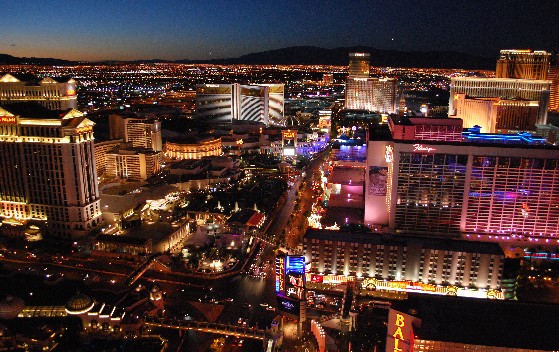
  • Apple getting with Verizon

    AT&T Inc. is about to lose its lock on the iPhone.

    Apple Inc. is making a version of its iPhone that Verizon Wireless will sell early next year, according to people familiar with the matter, ending an exclusive deal with AT&T and sharpening the competition with Google Inc.-based phones.

    Walt Mossberg and Marcelo Prince discuss the possible benefits and drawbacks of having the iPhone on Verizon’s wireless network, including whether it will suffer some of the same problems that have plagued AT&T. Plus, Verizon readies 4G service.

    While Apple is on track to sell 40 million iPhones across the globe this year, the touchscreen handset is facing pressure in the U.S. from phones running Google’s Android software, which have been heavily promoted by Verizon Wireless, the biggest U.S. carrier by subscribers.

    Apple plans to begin mass producing the new iPhone by the end of the year, and it would be released in the first quarter of 2011, these people said. The phone would resemble the iPhone 4 currently sold by AT&T, but would be based on an alternative wireless technology used by Verizon, these people said.

    The new iPhone spells the end of the exclusive arrangement that AT&T has had since 2007, when Apple Chief Executive Steve Jobs introduced the original iPhone. Since then, the iPhone fueled much of the AT&T’s growth.

    Verizon Wireless has been meeting with Apple, adding capacity and testing its networks to prepare for the heavy data load by iPhone users, according to one person familiar with the matter. The carrier is seeking to avoid the kind of public-relations hit that AT&T took when the boom in data-hungry iPhones overtaxed its network, especially in New York and San Francisco.

    The iPhone is finally coming to the Verizon wireless network as Apple gears up to produce a CDMA version of its popular smartphone that will be available in the first quarter of next year. Marcelo Prince and Julia Angwin discuss.

    The move would give consumers more choice in terms of networks and perhaps pricing. Verizon’s network is untested in terms of whether it can withstand millions of iPhone users, but studies by Consumer Reports and others have concluded Verizon has a better network than AT&T. Verizon also still offers unlimited Internet data plans.

    Apple is facing increasing pressure to find new avenues of growth in the U.S. market as most AT&T customers who wanted the iPhone have now bought them. Meanwhile, phones running Google’s software—built by Motorola Inc., HTC Corp. and others—have surged this year.

    Android smartphone subscribers in the U.S. reached 10.9 million as of August, from 866,000 a year earlier, according to comScore Inc., a market research firm. In comparison, there were 13.5 million iPhone subscribers at the end of August, up from 7.8 million last year, comScore says.

    [APPLE-front]

    Separately, Apple is also developing a new iPhone model, said people briefed on the phone. One person familiar said the fifth-generation iPhone would be a different form factor than those that are currently available, said one person familiar with the new iPhone plan. It was unclear how soon that version would be available to Verizon or other carriers.

    At a press conference Wednesday, Verizon Communications Inc. President Lowell McAdam declined to comment on whether his company would soon sell an iPhone. “At some point our business interests are going to align,” he said, referring to Apple. “I fully expect it, but I don’t have anything to say.”

    A spokeswoman for Apple declined to comment. The Wall Street Journal in March reported on Apple’s plans to build an iPhone that works on code division multiple access, or CDMA, technology used by carriers like Verizon Wireless and Sprint Nextel Corp.

    Toni Sacconaghi, a Sanford Bernstein analyst, estimates Verizon could add more than 10 million U.S. iPhone customers, adding it could help stem the rapid adoption of devices that run Android.

    [APPLE-jump]

    It was unclear whether Sprint Nextel and CDMA operators in countries such as South Korea, Japan and Latin America would get the CDMA iPhone as well.

    Many Verizon customers have been clamoring for the iPhone for years. “This is the longest running tease in the history of consumer products,” said Garret Bedrin, a 31-year-old Apple fan in Glen Rock, N.J., who plans to buy a Verizon iPhone as soon as it’s available. “As loyal as I am to Apple, I won’t leave Verizon,” he said.

    John Donovan, AT&T’s chief technology officer, wouldn’t comment on whether AT&T is losing exclusivity next year but said iPhone buyers would have reason to chose his network over Verizon’s. AT&T’s network lets users browse the Web while making calls, while Verizon’s can’t, he said.

    “It’s not like we sit around and don’t prepare for the future,” Mr. Donovan said in an interview Wednesday, noting AT&T also has compelling offerings in Android phones, as well as Research In Motion Ltd.’s new BlackBerry Torch.

    Editors’ Deep Dive: Carriers Vie for Mobile-Phone Plans

    Access thousands of business sources not available on the free web. Learn More

    AT&T has been taking steps all year to answer concerns about a loss of exclusivity, adding new phones to its lineup. It has also said more than four-fifths of its contract subscribers are on family or business plans, which make switching to a new carrier more burdensome.

    Apple’s CDMA iPhone is being made by Pegatron Technology Corp., the contract manufacturing subsidiary of Taiwan’s Asustek Computer Inc., said the people briefed on the matter. A spokesman for Pegatron declined to comment.

    Apple originally decided against developing a phone for Verizon to focus on a version based on GSM, a more prevalent mobile technology used by AT&T and most mobile operators in the world, people familiar with the decisions have said.

    Verizon, in those earlier discussions, balked at Apple’s requirement that Verizon not allow its retail partners to sell the phone, people familiar with the discussion said at the time. Verizon also declined to give up its ability to sell content like music and videos through its proprietary service, these people said.

    This time around, Apple considered a dual-mode phone that would let users roam on GSM-based networks, one of the people briefed said. But the company ultimately went with a device that would only work on a CDMA network. Qualcomm Inc. is providing a key chip set for the new iPhone, according to a person familiar with the matter. A spokeswoman for Qualcomm declined to comment.

    —Roger Cheng and Spencer E. Ante contributed to this article.

    Write to Yukari Iwatani Kane at yukari.iwatani@wsj.com

    Copyright. 2010. Dow Jones Company. All Rights Reserved

  • Foreclosure Furor Rises; Many Call for a Freeze

    October 5, 2010

    The uproar over bad conduct by mortgage lenders intensified Tuesday, as lawmakers in Washington requested a federal investigation and the attorney general in Texas joined a chorus of state law enforcement figures calling for freezes on all foreclosures.

    Representative Nancy Pelosi, the House speaker, and 30 other Democratic representatives from California told the Justice Department, the Federal Reserve and the comptroller of the currency that “it is time that banks are held accountable for their practices.”

    In a request for an investigation into questionable foreclosure practices by lenders, the lawmakers said that “the excuses we have heard from financial institutions are simply not credible.”

    Officials from the federal agencies declined to comment.

    Texas Attorney General Greg Abbott, a Republican, sent letters to 30 lenders demanding they stop foreclosures, evictions and the sale of foreclosed properties until they could provide assurances that they were proceeding legally.

    Both developments indicated that scarcely two weeks after the country’s fourth-biggest lender, GMAC Mortgage, revealed that it was suspending all foreclosures in the 23 states where the process requires judicial approval, concerns about flawed foreclosures had mushroomed into a nationwide problem.

    Some of the finger-pointing was also being directed back at Congress. The Ohio secretary of state, Jennifer Brunner, suggested in a telephone interview on Tuesday that a bill passed by Congress last week about notarizations could facilitate foreclosure fraud.

    Dubious notary practices used by banks to justify foreclosures have come under scrutiny in recent weeks as GMAC and other top lenders suspended homeowner evictions over possible improper procedures.

    Ms. Brunner, who has recently referred possible cases of notary fraud in her state to federal authorities, worries that the legislation would allow the lowest standard for notaries to become a nationwide practice. She said she also worried that the changes were coming in the middle of a foreclosure storm where people could lose their homes improperly.

    “A notary’s signature is that of a trusted, impartial third party, whose notarization bolsters the integrity of the document,” Ms. Brunner said. “To take away the safeguards of notarization means foreclosure procedures could be more susceptible to fraud.”

    As banks’ foreclosure practices have come under the microscope, problems with notarizations on mortgage assignments have emerged. These documents transfer the ownership of the underlying note from one institution to another and are required for foreclosures to proceed.

    In some cases, the notarizations predated the preparation of the legal documents, suggesting that signatures were not reviewed by a notary. Other notarizations took place in offices far away from where the documents were signed, indicating that the notaries might not have witnessed the signings as the law required.

    Notary practices vary from state to state and the bill, sponsored by Representative Robert B. Aderholt, a Republican from Alabama, would essentially require that one state’s rules be accepted by others. If one state allows its notaries to sign off on electronic signatures, for example, documents carrying such signatures and notarized by officials in that state would have to be recognized and accepted in any state or federal court.

    Ms. Brunner pointed out that some states had adopted “electronic notarization” laws that ignored the requirement of a signer’s personal appearance before a notary. “Many of these policies for electronic notarization are driven by technology rather than by principle, and they are dangerous to consumers,” she said.

    Mr. Aderholt had introduced the bill twice before and both times it passed the House of Representatives but not the Senate. Mr. Aderholt reintroduced the bill last October and it passed the Senate on Sept. 29. It is awaiting President Obama’s signature.

    Mr. Aderholt’s press secretary, Darrell Jordan, said there was no connection between the timing of the bill and the current notarization problems with foreclosures. In a statement announcing the bill’s passage, Mr. Aderholt said: “This legislation will help businesses around the nation by eliminating the confusion which arises when states refuse to acknowledge the integrity of documents notarized out of state.”

    Last week, JPMorgan Chase and Bank of America joined GMAC in suspending foreclosures in the states where they must be approved by a judge. The judicial states do not include California or Texas. But Mr. Abbott, the Texas attorney general, told lenders in letters dated Oct. 4 that if they used so-called robo-signers — employees who signed thousands of foreclosure affidavits a month, falsely attesting that they had reviewed the material — it would be a violation of Texas law.

    As a result, he wrote, “the document and therefore the foreclosure sale would have been invalid.”

    The three lenders who are at the center of the controversy, GMAC Mortgage, JPMorgan Chase and Bank of America, declined to comment. Other lenders singled out by Mr. Abbott include Wells Fargo, CitiMortgage, HSBC and National City.

    Meanwhile, shares of a major foreclosure outsourcing company, Lender Processing Services of Jacksonville, Fla., fell 5 percent on Tuesday, adding to a slide that began last week.

    The company’s documentation practices are stirring questions, including how the same employee can have wildly varying signatures on mortgage documents. L.P.S. blamed a midlevel manager’s decision to allow employees to sign forms in the name of an authorized employee. It says it has stopped the practice.

    The United States Attorney’s Office in Tampa began investigating L.P.S. in February. An L.P.S. representative could not be reached Tuesday for comment.

    Other calls for investigations came from Senators Al Franken, a Democrat from Minnesota, and Robert Menendez, a Democrat from New Jersey.


    Copyright. 2010. The New York Tmes Company. All Rights Reserved

  • Change or Perish

    Damon Winter/The New York Times

    Roger Cohen

    October 4, 2010

    Change or Perish

    Correction Appended


    LONDON — Before leggings, when there were letters, before texts and tweets, when there was time, before speed cameras, when you could speed, before graffiti management companies, when cities had souls, we managed just the same.

    Before homogenization, when there was mystery, before aggregation, when the original had value, before digital, when there was vinyl, before Made in China, when there was Mao, before stress management, when there was romance, we had the impression we were doing all right.

    Before apps, when there were attention spans, before “I’ve got five bars,” when bars were for boozing, before ring-tone selection, when the phone rang, before high-net-worth individuals, when love was all you needed, before hype, when there was Hendrix, we got by just the same.

    Before social media, when we were social, before thumb-typing, when a thumb hitched a ride, before de-friending, when a friend was for life, before online conduct, when you conducted yourself, before “content,” when we told stories, we did get by all the same.

    Before non-state actors, when states commanded, before the Bangalore back office, when jobs stayed put, before globalization, when wars were cold, we did manage O.K., it seemed.

    Before celebrities, when there were stars, before Google maps, when compasses were internal, before umbilical online-ism, when we off-lined our lives, before virtual flirtation, when legs touched, we felt we managed all the same.

    Before identity theft, when nobody could steal you, before global positioning systems, when we were lost, before 24/7 monitoring and alerts by text and e-mail, when there was idleness, before spin doctors, when there was character, before e-readers, when pages were turned, we did get by just the same.

    Before organic, when carrots weren’t categorized, before derivatives, when your mortgage was local, before global warming, when we feared nuclear winters, before “save the planet,” when we lived in our corners, before the Greens, when we faced the Reds, it seemed we did somehow manage just the same.

    Or did we? Before iPads and “Search,” in the era of print, before portable devices, when there were diaries, before the weather channel, when forecasts were farcical, before movies-on-demand, when movies were demanding, before chains and brands, in the time of the samizdat, before curved shower curtain rods, when they were straight, before productivity gains, when Britain produced things, and so did Ohio, did we really and honestly get by just the same?

    Before January cherries, when fruit had seasons, before global sushi, when you ate what you got, before deep-fried Mars bars, when fish were what fried, before New World wine, when wine was tannic, before fast food and slow food, when food just was, before plate-size cookies, when greed was contained, before fusion, in scattered division, before the obesity onslaught, in our ordinariness, could we — could we — have gotten by all the same?

    Before dystopia, when utopia beckoned, before rap, in Zappa’s time, before attention deficit disorders, when people turned on, before the new Prohibition, when lunches were liquid, before Lady Gaga, when we dug the Dead, before “join the conversation,” when things were disjointed, before Facebook, when there was Camelot, before reality shows, when things were real, yes, I believe we got by just the same.

    Before “I’ll call you back,” when people made dates, before algorithms, when there was aimlessness, before attitude, when there was apathy, before YouTube, when there was you and me, before Gore-Tex, in the damp, before sweat-resistant fabric, when sweat was sexy, before high-tech sneakers, as we walked the walk, before remotes, in the era of distance, I’m sure we managed just the same.

    Before “carbon neutral,” when carbon copied, before synching, when we lived unprompted, before multiplatform, when pen met paper, before profiling, when there was privacy, before cloud computing, when life was earthy, before a billion bits of distraction, when there were lulls, before “silent cars,” when there was silence, before virtual community, in a world with borders, before cut-and-paste, to the tap of the Selectra, before the megabyte, in disorder, before information overload, when streets were for wandering, before “sustainable,” in the heretofore, before CCTV, in invisibility, before networks, in the galaxy of strangeness, my impression, unless I’m wrong, is that we got by quite O.K.

    Before I forget, while there is time, for the years pass and we don’t get younger, before the wiring accelerates, while I can pause, let me summon it back, that fragment from somewhere, that phrase that goes: “The bourgeoisie cannot exist without constantly revolutionizing the instruments of production … and with them the whole relations of society.”

    Yes, that was Marx, when he was right, before he went wrong, when he observed, before he imagined, with terrible consequences for the 20th century.

    And if back in that century — back when exactly? — in the time before the tremendous technological leap, in the time of mists and drabness and dreams, if back then, without passwords, we managed just the same, even in black and white, and certainly not in hi-def, or even 3-D, how strange to think we had to change everything or we would not be managing at all.

    Correction: May 10, 2010

    An earlier version of this column misspelled the brand name Gore-Tex.

    Copyright. 2010.New York Times Company. All Rights Reserved