| Oct. 24, 2010 Copyright © Las Vegas Review-Journal TANGLED WEB: Internet tracking via ‘cookies’ extends beyond your hard drive Cookies not all bad Big Brother has a new secret weapon, and he’s using it to watch your every Internet move. Computer files called Flash cookies may have told him which websites you visited this morning, what purchases you made in the past year, even your credit card number. More than half of the Internet’s top websites use Flash cookies to store information about their visitors, according to a 2009 report by the University of California, Berkeley. This includes amazon.com, bankofamerica.com and even whitehouse.gov. Yet Flash cookies are unknown to most Internet users. In fact, of 10 companies advertising computer repair services in the Las Vegas Yellow Pages, the first nine phoned by the Review-Journal had never heard of them. Standard tracking cookies — known to the majority of savvy surfers — are routinely deposited into your hard drive by commercial Internet sites and their advertisers. “They can grab data from a porn site, recent search criteria, all sorts of things like that,” says Sal Arango, manager of Las Vegas-based AnyTime Computer Services. These cookies can be deleted via Internet browser privacy controls, where they also can be blocked entirely (although some sites will not allow access to cookie-blocking computers). But Flash cookies — quietly rolled out in 2001 — cannot be deleted from your hard drive because they’re not stored there. They exist, permanently, on a remote database maintained by San Francisco-based Adobe, which calls them “local shared objects.” This database identifies, and gives itself access to, every computer that has downloaded its popular Flash Player software (which, according to Adobe, is 98 percent of them). Adobe’s website says that Flash cookies help sites “provide a more customized experience for you.” Indeed, they save preferences, credit card numbers and bank passwords so you don’t have to type them the next time you visit the same site. They also can store 100 kilobytes of information (including load-heavy graphics and photos) — versus 4 kilobytes for a computer-stored cookie. “They can be used for good,” Arango says. “But for the most part, they’re definitely leveraged toward the site that issues them versus the consumer.” This gibes with a use that thousands of websites have found for Flash cookies: to regenerate standard, computer-stored cookies after users go through the trouble of deleting them. (Thus, their nickname: zombie cookies.) Essentially, users who think their privacy is protected still are being tracked. This summer, Dallas-based privacy attorney Joseph Malley filed separate, multimillion-dollar lawsuits against Specificmedia, Quantcast and Clearspring, alleging that these companies broke federal laws against computer surveillance by using Flash cookies to “respawn” deleted tracking cookies. (Malley is the same attorney who won a $9.5 million settlement from Facebook in March, over software that monitored what users bought or rented from its sponsors.) To be fair, the current version of Flash does not allow the sharing of Flash cookies across different websites. That means an adult website cannot detect your Bank of America password. However, this does not guarantee against misuse. “They can be used for a whole bunch of different things,” Arango says. “It’s based on the integrity of the person who writes it.” According to Arango, for instance, Flash cookies are frequently used as a conduit to install more devious spyware and malware. Some of the worst of these programs can track your every keystroke and lead to identity theft; but even the most harmless will usually slow your computer down. “One of our common things is to go into a slow computer and clear (the Flash cookies) out to see if that helps,” Arango says. “Usually, it does.” Adobe’s own website contains the following warning: “Like browser cookies, Flash Player local shared objects are used to create great Web experiences for users, but they might be misused by some advertisers and websites.” Contact reporter Corey Levitan at clevitan@ reviewjournal.com or 702-383-0456. |
Month: October 2010
-
Internet tracking via ‘cookies’ extends beyond your hard drive
-
Fernando Alonso wins Korean Grand Prix from Lewis Hamilton
Copyright. BBC Sport. 2010. All Rights reserved.
Highlights – Korean Grand Prix
By Richard Rae
Ferrari’s Fernando Alonso moved into the championship lead after winning a rain-affected Korean Grand Prix.
McLaren’s Lewis Hamilton was second and Ferrari’s Felipe Massa came third, but Jenson Button finished 12th to all but end his hopes of retaining the title.
Alonso now leads by 11 points from Red Bull’s Mark Webber, who crashed early on, and 21 points from Hamilton.
Red Bull’s Sebastian Vettel retired from the lead with an engine failure and is now 25 points behind Alonso.
With only two races remaining in the season, however, Alonso insisted nothing had really changed.
“We know with the new points system everything can change in one race – if you don’t score, you lose 25 points to your opponents,” said the Spaniard.
“Here it was bad luck for Mark and Sebastian. Anything can happen in the next two races. As we repeat many times, being consistent is very important, we cannot forget we need to be on the podium and fighting for the victory in the last two races.”

Korean Grand Prix – Top three drivers
Hamilton said it was a great result for him.
“My tyres were shot at the end, so it was just about trying to get the car home,” he said.
Button, in contrast, said it had been an horrific day.
“I just didn’t have any grip, and at times I was the slowest person on the circuit. Also I was just destroying tyres. It’s been a sad Grand Prix.”
With rain falling, race director Charlie Whiting decided the start should take place behind the safety car.
Three laps in, with Alonso describing conditions as “the worst I have ever driven in”, the race was suspended and the cars returned to the grid.
After a 45 minute delay the rain had eased sufficiently for the race to be re-started, still under the safety car.
It was to be another 13 increasingly frustrating laps before the safety car finally came in at the end of lap 17.
The drama began almost immediately, as coming out of Turn 12, Webber ran wide and was unable to collect his car before spinning across the track, hitting the wall, spinning back and colliding with the unfortunate Nico Rosberg.
“Totally my fault, I got on the kerb,” said the Australian. “It’s frustrating, because I thought I could catch it. Conditions were fine.”
It meant more work for the safety car, and the pack closed in behind Vettel. Alonso was second, ahead of Hamilton, Massa and Button.
With conditions steadily improving, Button was the first of the leading pack to switch to intermediate tyres, with a shallower tread depth for drier conditions.
He re-emerged disastrously behind a train of five midfield runners, but when Sebastien Buemi crashed his Toro Rosso into the Virgin of Timo Glock it meant another safety car period.
Vettel still led, but there was bad news for Alonso when he came in for intermediates on lap 32. A wheel-nut problem on his front right delayed the Spaniard sufficiently for Hamilton to pass him for second.
Not for long. As soon as the race resumed Hamilton ran wide through Turn 1, enabling Alonso to retake the position.
Button, still bottled up down the field, was forced wide by Force India’s Adrian Sutil and lost more places on lap 36.
Up front Vettel was still in control, and Alonso responded as Hamilton began to close up.

Title not out of reach – Hamilton
With 20 minutes left on the race clock, dusk was beginning to fall as Renault’s Vitaly Petrov crashed out at Turn 18.
At the front, Alonso began to close in on Vettel and the Red Bull driver predictably began to complain about the light, but he had a lot more to complain about on lap 46 when, with Alonso by now right behind him, his engine gave up in a cloud of smoke and oil.
Alonso still had Hamilton behind him but the McLaren dropped back as the Englishman’s tyres began to wear more than the Ferrari’s and as the darkness descended the Spaniard took both a remarkable win and the lead in the drivers’ world championship.
After the race, stewards announced that Buemi and Sutil would take five-place grid penalties in Brazil for their part in their crashes. Sutil also receives a $10,000 (£6,400) fine for driving in the way he did despite knowing he had a brake problem.
-
United States and Great Britain. Armed Forces Exposed by Wiki Leaks
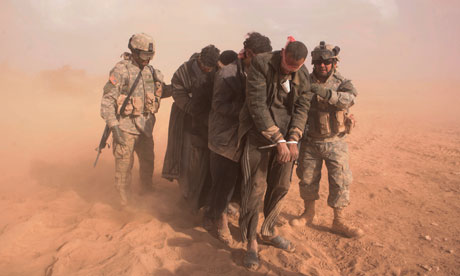
Insurgent suspects are led away by US forces. Some of those held in Iraqi custody suffered appalling abuse, the war logs reveal. Photograph: Sean Smith for the Guardian A grim picture of the US and Britain’s legacy in Iraq has been revealed in a massive leak of American military documents that detail torture, summary executions and war crimes.
Almost 400,000 secret US army field reports have been passed to the Guardian and a number of other international media organisations via the whistleblowing website WikiLeaks.
The electronic archive is believed to emanate from the same dissident US army intelligence analyst who earlier this year is alleged to have leaked a smaller tranche of 90,000 logs chronicling bloody encounters and civilian killings in the Afghan war.
The new logs detail how:
• US authorities failed to investigate hundreds of reports of abuse, torture, rape and even murder by Iraqi police and soldiers whose conduct appears to be systematic and normally unpunished.
• A US helicopter gunship involved in a notorious Baghdad incident had previously killed Iraqi insurgents after they tried to surrender.
• More than 15,000 civilians died in previously unknown incidents. US and UK officials have insisted that no official record of civilian casualties exists but the logs record 66,081 non-combatant deaths out of a total of 109,000 fatalities.
The numerous reports of detainee abuse, often supported by medical evidence, describe prisoners shackled, blindfolded and hung by wrists or ankles, and subjected to whipping, punching, kicking or electric shocks. Six reports end with a detainee’s apparent death.
As recently as December the Americans were passed a video apparently showing Iraqi army officers executing a prisoner in Tal Afar, northern Iraq. The log states: “The footage shows approximately 12 Iraqi army soldiers. Ten IA soldiers were talking to one another while two soldiers held the detainee. The detainee had his hands bound … The footage shows the IA soldiers moving the detainee into the street, pushing him to the ground, punching him and shooting him.”
The report named at least one perpetrator and was passed to coalition forces. But the logs reveal that the coalition has a formal policy of ignoring such allegations. They record “no investigation is necessary” and simply pass reports to the same Iraqi units implicated in the violence. By contrast all allegations involving coalition forces are subject to formal inquiries. Some cases of alleged abuse by UK and US troops are also detailed in the logs.
In two Iraqi cases postmortems revealed evidence of death by torture. On 27 August 2009 a US medical officer found “bruises and burns as well as visible injuries to the head, arm, torso, legs and neck” on the body of one man claimed by police to have killed himself. On 3 December 2008 another detainee, said by police to have died of “bad kidneys”, was found to have “evidence of some type of unknown surgical procedure on [his] abdomen“.
A Pentagon spokesman told the New York Times this week that under its procedure, when reports of Iraqi abuse were received the US military “notifies the responsible government of Iraq agency or ministry for investigation and follow-up”.
The logs also illustrate the readiness of US forces to unleash lethal force. In one chilling incident they detail how an Apache helicopter gunship gunned down two men in February 2007.
The suspected insurgents had been trying to surrender but a lawyer back at base told the pilots: “You cannot surrender to an aircraft.” The Apache, callsign Crazyhorse 18, was the same unit and helicopter based at Camp Taji outside Baghdad that later that year, in July, mistakenly killed two Reuters employees and wounded two children in the streets of Baghdad.
Iraq Body Count, the London-based group that monitors civilian casualties, says it has identified around 15,000 previously unknown civilian deaths from the data contained in the leaked war logs.
Although US generals have claimed their army does not carry out body counts and British ministers still say no official statistics exist, the war logs show these claims are untrue. The field reports purport to identify all civilian and insurgent casualties, as well as numbers of coalition forces wounded and killed in action. They give a total of more than 109,000 violent deaths from all causes between 2004 and the end of 2009.
This includes 66,081 civilians, 23,984 people classed as “enemy” and 15,196 members of the Iraqi security forces. Another 3,771 dead US and allied soldiers complete the body count.
No fewer than 31,780 of these deaths are attributed to improvised roadside bombs (IEDs) planted by insurgents. The other major recorded tally is of 34,814 victims of sectarian killings, recorded as murders in the logs.
However, the US figures appear to be unreliable in respect of civilian deaths caused by their own military activities. For example, in Falluja, the site of two major urban battles in 2004, no civilian deaths are recorded. Yet Iraq Body Count monitors identified more than 1,200 civilians who died during the fighting.
Phil Shiner, human rights specialist at Public Interest Lawyers, plans to use material from the logs in court to try to force the UK to hold a public inquiry into the unlawful killing of Iraqi civilians.
He also plans to sue the British government over its failure to stop the abuse and torture of detainees by Iraqi forces. The coalition’s formal policy of not investigating such allegations is “simply not permissible”, he says.
Shiner is already pursuing a series of legal actions for former detainees allegedly killed or tortured by British forces in Iraq.
WikiLeaks says it is posting online the entire set of 400,000 Iraq field reports – in defiance of the Pentagon.
The whistleblowing activists say they have deleted all names from the documents that might result in reprisals. They were accused by the US military of possibly having “blood on their hands” over the previous Afghan release by redacting too few names. But the military recently conceded that no harm had been identified.
Condemning this fresh leak, however, the Pentagon said: “This security breach could very well get our troops and those they are fighting with killed. Our enemies will mine this information looking for insights into how we operate, cultivate sources and react in combat situations, even the capability of our equipment.”
Copyright. 2010. Guardian.com All Rights Reserved
-
F1 drivers criticise ‘dangerous’ new Korea track
Highlights – Webber fastest in second practice
By Sarah Holt
BBC Sport in YeongamFormula 1 drivers have criticised the new Korean Grand Prix track, claiming the pit-lane entry is dangerous.
The pit entry is on the exit of a blind corner, and drivers are worried about the speed differential between cars racing and those coming into the pits.
Lotus’s Jarno Trulli said the drivers would raise the subject with race director Charlie Whiting, adding: “It’s very dangerous. It is a big issue.”
Renault’s Robert Kubica said: “It might be quite tight if someone’s pitting.”
Trulli, who has been racing in F1 since 1997 and won the 2004 Monaco Grand Prix, also said the layout of the pit exit and first corner could be improved, and criticised the fact that drivers had not been consulted on the design before the race meeting.
“They don’t even ask us anything about circuit layout,” he said. “Nothing.”
He added: “I had problems because I was twice stuck in gear.I knew they would finish it properly which is what they have done – people are too quick to criticise
Bernie Ecclestone
“While I was fine to make it back I was so slow that I had to look after myself when I was getting in. In this longer, blind right-hand corner I had to stay right in the racing line and I was so slow that I was wondering if someone might hit me in the back.
“This is a big issue in my opinion. There is no other option, it is right on the racing line, and the racing line is right on the far right-hand side facing the wall.”
Trulli’s concerns were echoed by other drivers, including Renault’s Robert Kubica and championship leader Mark Webber.
Kubica said: “If someone is pitting, you have to take a tighter line then it might be a bit dangerous if you are really close. It might be quite tight.”
The track construction was delayed by two months of wet weather, and the circuit was finished only two weeks ago and passed fit for racing on 12 October.I was quite surprised by the track layout – it is 10 times better than Abu Dhabi
Robert Kubica
Whiting has already requested that changes be made to Turn 16 where several cars were ‘bottoming out’, where the cars’ floors graze the track surface, and it has been reported that changes are to be made to the pit-lane entry and Turn 18.
While the controversial pit-lane entry was the focus of the drivers’ criticism, there were also complaints about the effects of the last-minute construction, particularly the dusty track surface.
But F1 boss Bernie Ecclestone defended the organisers.
“The whole world said it wasn’t going to happen, and I went out on a limb and said it would because I knew they would finish it properly which is what they have done,” Ecclestone told BBC 5 live.
“People are too quick to criticise and there’s so many other places we have been and they haven’t criticised.
“It rained continuously for 51 days, so that put them 51 days back but they have worked through that and they have managed to catch up.”
The drivers gave the layout of the track a mixed reception.
Kubica said: “The first few corners are quite boring. After Turn Nine there is quite a lot of action going on and Turn Nine, 10 is quite nice and also 11, 12, and from there it’s quite a nice track.
“The last corner is quite challenging. It’s quite blind.
“I was quite surprised by the track layout – it is 10 times better than Abu Dhabi (which made its debut in 2009).”SARAH HOLT’S BLOG
The immaculate finish associated with F1′s new circuits – just think of the polished gleam of Abu Dhabi – is still a long, long way off
World champion Jenson Button added: “I’m enjoying the circuit and felt we got to grips with it pretty quickly. The track feels quite flowing.
“There was a lot of dust which is the only problem. If you put a wheel slightly off line there is a huge amount of dust which might be a problem during the race.”
Sauber’s Nick Heidfeld said: “It’s great fun. Yesterday when I walked the track I thought it would be nice but driving it was even better.
“I think they did a good job and I found it very challenging especially the end of the sector. I enjoyed it a lot.”Mercedes driver Rosberg talks around a lap of Korea track
Copyright. 2010. BBCsport.com All Rights Reserved.
-
In Kansas, Climate Skeptics Embrace Cleaner Energy
 Steve Hebert for The New York Times
A family eats by candlelight at a restaurant in Salina, Kan., part of an effort to conserve power. More Photos »
In Kansas, Climate Skeptics Embrace Cleaner Energy By LESLIE KAUFMAN
SALINA, Kan. — Residents of this deeply conservative city do not put much stock in scientific predictions of climate change.
“Don’t mention global warming,” warned Nancy Jackson, chairwoman of the Climate and Energy Project, a small nonprofit group that aims to get people to rein in the fossil fuel emissions that contribute to climate change. “And don’t mention Al Gore. People out here just hate him.”
Saving energy, though, is another matter.
Last Halloween, schoolchildren here searched for “vampire” electric loads, or appliances that sap energy even when they seem to be off. Energy-efficient LED lights twinkled on the town’s Christmas tree. On Valentine’s Day, local restaurants left their dining room lights off and served meals by candlelight.
The fever for reducing dependence on fossil fuels has spread beyond this city of red-brick Eisenhower-era buildings to other towns on the Kansas plains. A Lutheran church in nearby Lindsborg was inspired to install geothermal heating. The principal of Mount Hope’s elementary school dressed up as an energy bandit at a student assembly on home-energy conservation. Hutchinson won a contract to become home to a $50 million wind turbine factory.
Town managers attribute the new resolve mostly to a yearlong competition sponsored by the Climate and Energy Project, which set out to extricate energy issues from the charged arena of climate politics.
Attempts by the Obama administration to regulate greenhouse gases are highly unpopular here because of opposition to large-scale government intervention. Some are skeptical that humans might fundamentally alter a world that was created by God.
If the heartland is to seriously reduce its dependence on coal and oil, Ms. Jackson and others decided, the issues must be separated. So the project ran an experiment to see if by focusing on thrift, patriotism, spiritual conviction and economic prosperity, it could rally residents of six Kansas towns to take meaningful steps to conserve energy and consider renewable fuels.
Think of it as a green variation on “What’s the Matter with Kansas?” Ms. Jackson suggested, referring to the 2004 book by Thomas Frank that contended that Republicans had come to dominate the state’s elections by exploiting social values.
The project’s strategy seems to have worked. In the course of the program, which ended last spring, energy use in the towns declined as much as 5 percent relative to other areas — a giant step in the world of energy conservation, where a program that yields a 1.5 percent decline is considered successful.
The towns were featured as a case study on changing behavior by the Department of Energy’s Lawrence Berkeley National Laboratory. And the Climate and Energy Project just received a grant from the Kansas Energy Office to coordinate a competition among 16 Kansas cities to cut energy use in 2011.
The energy experiment started as a kitchen-table challenge three years ago.
Over dinner, Wes Jackson, the president of the Land Institute, which promotes environmentally sustainable agriculture, complained to Ms. Jackson, his daughter-in-law, that even though many local farmers would suffer from climate change, few believed that it was happening or were willing to take steps to avoid it.
Why did the conversation have to be about climate change? Ms. Jackson countered. If the goal was to persuade people to reduce their use of fossil fuels, why not identify issues that motivated them instead of getting stuck on something that did not?
Only 48 percent of people in the Midwest agree with the statement that there is “solid evidence that the average temperature on earth has been getting warmer,” a poll conducted in the fall of 2009 by the Pew Research Center for the People and the Press showed — far fewer than in other regions of the country.
The Jacksons already knew firsthand that such skepticism was not just broad, but also deep. Like opposition to abortion or affirmations of religious faith, they felt, it was becoming a cultural marker that helped some Kansans define themselves.
Nevertheless, Ms. Jackson felt so strongly that this opposition could be overcome that she left a job as development director at the University of Kansas in Lawrence to start the Climate and Energy Project with a one-time grant from the Land Institute. (The project is now independent.)
At the outset she commissioned focus groups of independents and Republicans around Wichita and Kansas City to get a sense of where they stood. Many participants suggested that global warming could be explained mostly by natural earth cycles, and a vocal minority even asserted that it was a cynical hoax perpetrated by climate scientists who were greedy for grants.
Yet Ms. Jackson found plenty of openings. Many lamented the nation’s dependence on foreign oil. Some articulated an amorphous desire, often based in religious values, to protect the earth. Some even spoke of changes in the natural world — birds arriving weeks earlier in the spring than they had before — leading her to wonder whether, deep down, they might suspect that climate change was afoot.
Ms. Jackson settled on a three-pronged strategy. Invoking the notion of thrift, she set out to persuade towns to compete with one another to become more energy-efficient. She worked with civic leaders to embrace green jobs as a way of shoring up or rescuing their communities. And she spoke with local ministers about “creation care,” the obligation of Christians to act as stewards of the world that God gave them, even creating a sermon bank with talking points they could download.
Relatively little was said about climate.
“I don’t recall us being recruited under a climate change label at all,” said Stacy Huff, an executive for the Coronado Area Council of the Boy Scouts of America, which was enlisted to help the project. Mr. Huff describes himself as “somewhat skeptical” about global warming.
Mr. Huff said the project workers emphasized conservation for future generations when they recruited his group. The message resonated, and the scouts went door to door in low-income neighborhoods to deliver and install weatherization kits.
“It is in our DNA to leave a place better than we found it,” he said.
Elliot Lahn, a community development planner for Merriam, a city that reduced its energy use by 5 percent, said that when public meetings were held on the six-town competition to save energy, some residents offered their view that global warming was a hoax.
But they were very eager to hear about saving money, Mr. Lahn said. “That’s what really motivated them.”
Jerry Clasen, a grain farmer in Reno County, south of Salina, said he largely discounted global warming. “I believe we are going through a cycle and it is not a big deal,” he said. But his ears pricked up when project workers came to town to talk about harnessing wind power. “There is no sense in our dependency on foreign oil,” he said, “especially since we have got this resource here.”
Mr. Clasen helped organize a group of local leaders to lobby the electronics and energy giant Siemens to build a wind turbine factory in the area. When the company signed a deal in 2009 promising to create as many as 400 local jobs, it stirred a wave of excitement about the future of wind power.
Now, farmers expect to lease some of their land for turbines and rely on wind power as a stable source of income, he said, and land prices are rising as result.
“Whether or not the earth is getting warmer,” he said, “it feels good to be part of something that works for Kansas and for the nation.”
Copyright 2010. The New York Times Company.
-
Dhina’s Rare Earth Exports

Fred R. Conrad/The New York Times
Paul Krugman
Rare and Foolish By PAUL KRUGMAN
Last month a Chinese trawler operating in Japanese-controlled waters collided with two vessels of Japan’s Coast Guard. Japan detained the trawler’s captain; China responded by cutting off Japan’s access to crucial raw materials.
And there was nowhere else to turn: China accounts for 97 percent of the world’s supply of rare earths, minerals that play an essential role in many high-technology products, including military equipment. Sure enough, Japan soon let the captain go.
I don’t know about you, but I find this story deeply disturbing, both for what it says about China and what it says about us. On one side, the affair highlights the fecklessness of U.S. policy makers, who did nothing while an unreliable regime acquired a stranglehold on key materials. On the other side, the incident shows a Chinese government that is dangerously trigger-happy, willing to wage economic warfare on the slightest provocation.
Some background: The rare earths are elements whose unique properties play a crucial role in applications ranging from hybrid motors to fiber optics. Until the mid-1980s the United States dominated production, but then China moved in.
“There is oil in the Middle East; there is rare earth in China,” declared Deng Xiaoping, the architect of China’s economic transformation, in 1992. Indeed, China has about a third of the world’s rare earth deposits. This relative abundance, combined with low extraction and processing costs — reflecting both low wages and weak environmental standards — allowed China’s producers to undercut the U.S. industry.
You really have to wonder why nobody raised an alarm while this was happening, if only on national security grounds. But policy makers simply stood by as the U.S. rare earth industry shut down. In at least one case, in 2003 — a time when, if you believed the Bush administration, considerations of national security governed every aspect of U.S. policy — the Chinese literally packed up all the equipment in a U.S. production facility and shipped it to China.
The result was a monopoly position exceeding the wildest dreams of Middle Eastern oil-fueled tyrants. And even before the trawler incident, China showed itself willing to exploit that monopoly to the fullest. The United Steelworkers recently filed a complaint against Chinese trade practices, stepping in where U.S. businesses fear to tread because they fear Chinese retaliation. The union put China’s imposition of export restrictions and taxes on rare earths — restrictions that give Chinese production in a number of industries an important competitive advantage — at the top of the list.
Then came the trawler event. Chinese restrictions on rare earth exports were already in violation of agreements China made before joining the World Trade Organization. But the embargo on rare earth exports to Japan was an even more blatant violation of international trade law.
Oh, and Chinese officials have not improved matters by insulting our intelligence, claiming that there was no official embargo. All of China’s rare earth exporters, they say — some of them foreign-owned — simultaneously decided to halt shipments because of their personal feelings toward Japan. Right.
So what are the lessons of the rare earth fracas?
First, and most obviously, the world needs to develop non-Chinese sources of these materials. There are extensive rare earth deposits in the United States and elsewhere. However, developing these deposits and the facilities to process the raw materials will take both time and financial support. So will a prominent alternative: “urban mining,” a k a recycling of rare earths and other materials from used electronic devices.
Second, China’s response to the trawler incident is, I’m sorry to say, further evidence that the world’s newest economic superpower isn’t prepared to assume the responsibilities that go with that status.
Major economic powers, realizing that they have an important stake in the international system, are normally very hesitant about resorting to economic warfare, even in the face of severe provocation — witness the way U.S. policy makers have agonized and temporized over what to do about China’s grossly protectionist exchange-rate policy. China, however, showed no hesitation at all about using its trade muscle to get its way in a political dispute, in clear — if denied — violation of international trade law.
Couple the rare earth story with China’s behavior on other fronts — the state subsidies that help firms gain key contracts, the pressure on foreign companies to move production to China and, above all, that exchange-rate policy — and what you have is a portrait of a rogue economic superpower, unwilling to play by the rules. And the question is what the rest of us are going to do about it.
Copyright. 2010. The New York Times Company. All Rights reserved
-
Income Inequality: Too Big to Ignore

David G. Klein
Income Inequality: Too Big to Ignore By ROBERT H. FRANK
PEOPLE often remember the past with exaggerated fondness. Sometimes, however, important aspects of life really were better in the old days.
During the three decades after World War II, for example, incomes in the United States rose rapidly and at about the same rate — almost 3 percent a year — for people at all income levels. America had an economically vibrant middle class. Roads and bridges were well maintained, and impressive new infrastructure was being built. People were optimistic.
By contrast, during the last three decades the economy has grown much more slowly, and our infrastructure has fallen into grave disrepair. Most troubling, all significant income growth has been concentrated at the top of the scale. The share of total income going to the top 1 percent of earners, which stood at 8.9 percent in 1976, rose to 23.5 percent by 2007, but during the same period, the average inflation-adjusted hourly wage declined by more than 7 percent.
Yet many economists are reluctant to confront rising income inequality directly, saying that whether this trend is good or bad requires a value judgment that is best left to philosophers. But that disclaimer rings hollow. Economics, after all, was founded by moral philosophers, and links between the disciplines remain strong. So economists are well positioned to address this question, and the answer is very clear.
Adam Smith, the father of modern economics, was a professor of moral philosophy at the University of Glasgow. His first book, “A Theory of Moral Sentiments,” was published more than 25 years before his celebrated “Wealth of Nations,” which was itself peppered with trenchant moral analysis.
Some moral philosophers address inequality by invoking principles of justice and fairness. But because they have been unable to forge broad agreement about what these abstract principles mean in practice, they’ve made little progress. The more pragmatic cost-benefit approach favored by Smith has proved more fruitful, for it turns out that rising inequality has created enormous losses and few gains, even for its ostensible beneficiaries.
Recent research on psychological well-being has taught us that beyond a certain point, across-the-board spending increases often do little more than raise the bar for what is considered enough. A C.E.O. may think he needs a 30,000-square-foot mansion, for example, just because each of his peers has one. Although they might all be just as happy in more modest dwellings, few would be willing to downsize on their own.
People do not exist in a social vacuum. Community norms define clear expectations about what people should spend on interview suits and birthday parties. Rising inequality has thus spawned a multitude of “expenditure cascades,” whose first step is increased spending by top earners.
The rich have been spending more simply because they have so much extra money. Their spending shifts the frame of reference that shapes the demands of those just below them, who travel in overlapping social circles. So this second group, too, spends more, which shifts the frame of reference for the group just below it, and so on, all the way down the income ladder. These cascades have made it substantially more expensive for middle-class families to achieve basic financial goals.
In a recent working paper based on census data for the 100 most populous counties in the United States, Adam Seth Levine (a postdoctoral researcher in political science at Vanderbilt University), Oege Dijk (an economics Ph.D. student at the European University Institute) and I found that the counties where income inequality grew fastest also showed the biggest increases in symptoms of financial distress.
For example, even after controlling for other factors, these counties had the largest increases in bankruptcy filings.
Divorce rates are another reliable indicator of financial distress, as marriage counselors report that a high proportion of couples they see are experiencing significant financial problems. The counties with the biggest increases in inequality also reported the largest increases in divorce rates.
Another footprint of financial distress is long commute times, because families who are short on cash often try to make ends meet by moving to where housing is cheaper — in many cases, farther from work. The counties where long commute times had grown the most were again those with the largest increases in inequality.
The middle-class squeeze has also reduced voters’ willingness to support even basic public services. Rich and poor alike endure crumbling roads, weak bridges, an unreliable rail system, and cargo containers that enter our ports without scrutiny. And many Americans live in the shadow of poorly maintained dams that could collapse at any moment.
ECONOMISTS who say we should relegate questions about inequality to philosophers often advocate policies, like tax cuts for the wealthy, that increase inequality substantially. That greater inequality causes real harm is beyond doubt.
But are there offsetting benefits?
There is no persuasive evidence that greater inequality bolsters economic growth or enhances anyone’s well-being. Yes, the rich can now buy bigger mansions and host more expensive parties. But this appears to have made them no happier. And in our winner-take-all economy, one effect of the growing inequality has been to lure our most talented graduates to the largely unproductive chase for financial bonanzas on Wall Street.
In short, the economist’s cost-benefit approach — itself long an important arrow in the moral philosopher’s quiver — has much to say about the effects of rising inequality. We need not reach agreement on all philosophical principles of fairness to recognize that it has imposed considerable harm across the income scale without generating significant offsetting benefits.
No one dares to argue that rising inequality is required in the name of fairness. So maybe we should just agree that it’s a bad thing — and try to do something about it.
-
Tipping Point Author Malcolm Gladwell Says Facebook, Twitter Won’t Lead to Social Change
 By Sarah Perez / October 4, 2010 10:00 AM / 22 Comments
The Mississippi Pardons

Damon Winter/The New York Times
Bob Herbert
The Mississippi Pardons By BOB HERBERT
Gov. Haley Barbour of Mississippi has to decide whether to show mercy to two sisters, Jamie and Gladys Scott, who are each serving double consecutive life sentences in state prison for a robbery in which no one was injured and only $11 was taken.
This should be an easy call for a law-and-order governor who has, nevertheless, displayed a willingness to set free individuals convicted of far more serious crimes. Mr. Barbour has already pardoned four killers and suspended the life sentence of a fifth.
The Scott sisters have been in prison for 16 years. Jamie, now 38, is seriously ill. Both of her kidneys have failed. Keeping the two of them locked up any longer is unconscionable, grotesquely inhumane.
The sisters were accused of luring two men to a spot outside the rural town of Forest, Miss., in 1993, where the men were robbed by three teenagers, one of whom had a shotgun. The Scott sisters knew the teens. The evidence of the sisters’ involvement has always been ambiguous, at best. The teenagers pleaded guilty to the crime, served two years in prison and were released. All were obliged by the authorities, as part of their plea deals, to implicate the sisters.
No explanation has ever emerged as to why Jamie and Gladys Scott were treated so severely.
In contrast, Governor Barbour has been quite willing to hand get-out-of-jail-free cards to men who unquestionably committed shockingly brutal crimes. The Jackson Free Press, an alternative weekly, and Slate Magazine have catalogued these interventions by Mr. Barbour. Some Mississippi observers have characterized the governor’s moves as acts of mercy; others have called them dangerous abuses of executive power.
The Mississippi Department of Corrections confirmed Governor Barbour’s role in the five cases, noting that the specific orders were signed July 16, 2008:
• Bobby Hays Clark was pardoned by the governor. He was serving a long sentence for manslaughter and aggravated assault, having shot and killed a former girlfriend and badly beaten her boyfriend.
• Michael David Graham had his life sentence for murder suspended by Governor Barbour. Graham had stalked his ex-wife, Adrienne Klasky, for years before shooting her to death as she waited for a traffic light in downtown Pascagoula.
• Clarence Jones was pardoned by the governor. He had murdered his former girlfriend in 1992, stabbing her 22 times. He had already had his life sentence suspended by a previous governor, Ronnie Musgrove.
• Paul Joseph Warnock was pardoned by Governor Barbour. He was serving life for the murder of his girlfriend in 1989. According to Slate, Warnock shot his girlfriend in the back of the head while she was sleeping.
• William James Kimble was pardoned by Governor Barbour. He was serving life for the murder and robbery of an elderly man in 1991.
Radley Balko, in an article for Slate, noted that none of the five men were given relief because of concerns that they had been unfairly treated by the criminal justice system. There were no questions about their guilt or the fairness of the proceedings against them. But they did have one thing in common. All, as Mr. Balko pointed out, had been enrolled in a special prison program “that had them doing odd jobs around the Mississippi governor’s mansion.”
The idea that those men could be freed from prison and allowed to pursue whatever kind of lives they might wish while the Scott sisters are kept locked up, presumably for the rest of their lives, is beyond disturbing.
Supporters of the Scott sisters, including their attorney, Chokwe Lumumba, and Ben Jealous of the N.A.A.C.P., have asked Governor Barbour to intervene, to use his executive power to free the women from prison.
A spokeswoman for the governor told me he has referred the matter to the state’s parole board. Under Mississippi law, the governor does not have to follow the recommendation of the board. He is free to act on his own. With Jamie Scott seriously ill (her sister and others have offered to donate a kidney for a transplant), the governor should move with dispatch.
The women’s mother, Evelyn Rasco, told The Clarion-Ledger of Jackson, Miss.: “I wish they would just hurry up and let them out. I hope that is where it is leading to. That would be the only justified thing to do.”
An affidavit submitted to the governor on behalf of the Scott sisters says: “Jamie and Gladys Scott respectfully pray that they each be granted a pardon or clemency of their sentences on the grounds that their sentences were too severe and they have been incarcerated for too long. If not released, Jamie Scott will probably die in prison.”
As they are both serving double life sentences, a refusal by the governor to intervene will most likely mean that both will die in prison.
Copyright. 2010. The New York Times Company. All Rights ReservedSavoy Hotel
By JULIAN FELLOWES
![[Savoy1]](http://si.wsj.net/public/resources/images/EW-AJ301_Savoy1_G_20101014114456.jpg) Jean Cazals for The Wall Street Journal
Jean Cazals for The Wall Street Journal A doorman at the Savoy
When I was a little boy, I once asked my mother what was the smartest hotel in the world. She looked at me for a moment, thinking before she spoke. “You mean, apart from the Savoy?” she said. And it is true that one cannot easily imagine another hotel whose very name seems to conjure up glamour, chic, riches, fashion and romance in a single word. There are other hotels where one might expect to find movie stars or aristocrats or wits, but somehow only the Savoy can boast Lily Langtry, Noël Coward, George Gershwin, Fred Astaire, King Edward VII, Caruso, Winston Churchill and Marilyn Monroe, along with Rand millionaires, dukes, crooks and cabinet ministers, all squeezed into the Grill or waltzing round the ballroom. Yet somehow it has always retained an air of correctness, of cool gentility, of things properly done, and while it could, and did, feel exciting, it was never raffish or threadbare or thin.
ReutersA barman prepares a drink in the American Bar


From its distinctive entrance—the only place in England where it is legal to drive on the right—to its astonishing view of the Thames at the back, the Savoy is in a class of its own, and so it should be. It started life as a Royal palace, built for Count Peter of Savoy, an uncle of Henry III’s queen, before being rebuilt with even more splendor by John of Gaunt and burned to the ground in the Peasants’ Revolt of 1381, since when it has been a hospital and a prison and burned again in 1864. The site was bought by Richard D’Oyly Carte in 1880 to build the Savoy Theatre, but then the idea came to him that he might raise a hotel of such luxury and splendor as had never been seen before in these islands and, thanks to the profits from the Gilbert and Sullivan operettas, that is what came to pass. Under the care of its first manager, César Ritz and with the patronage of the fun-loving Prince of Wales, the hotel was a success from day one. Monsieur Ritz would leave in a cloud of financial jiggery-pokery and scandal in 1897, but nothing would tarnish the triumph of the new Savoy, not least because its provision of a bathroom for every bedroom (an almost other-worldly luxury in late 19th-century London) brought more or less every rich American bent on European travel to its wide and welcoming doors.
My first experience of the celebrated hotel was of being taken there for tea by ancient aunts, and that is part of its charm. It has always appealed to young and old, to the wildest and to the most straight-laced, and I would sit, eating delicious sandwiches while they criticized my parents and questioned me about my school. My next era as a Savoy familiar came in my late teens when its River Room was a popular venue for coming out dances and debutante cocktail parties and I spent many evenings staring at the river, wishing I had a partner, pretending to be more grown-up than I felt and wondering what the future would bring. In my twenties, a rather disreputable cousin of my father’s would take me to dinner as a counterweight to what he considered my simple and provincial upbringing. Rather confusingly, he shared my father’s name, Peregrine Fellowes, and later, to my mother’s embarrassment, figured in a sensational divorce featuring not one, but two, of London’s bandleaders, cited as correspondents in the case against his wife. Neither, I am fairly sure, led the band at the Savoy.
Once in show business, awards luncheons and dinners would bring me back to the hotel, and I would sit at tables with actors and directors, hiding their fury at not winning behind expensive smiles. I remember the old Savoy Grill from that time. It had been a favorite wartime haunt of our most famous prime minister, and I loved its distinctive murals before they were swept away in the last tranche of changes, which converted it into a sort of giant cigar box. I was back in the River Room in the 1990s, too, thanks to a generous cousin of my wife who would take us to splendid dinners in our young-married, broke years, when one would dance like one danced before music got loud, between the courses.
ReutersThe refurbished Beaufort Bar
And then, in December 2007, it closed. For a refit, we were told, and we went to the pre-sale gathering at Bonhams and saw the 1950s painted panels, the chandeliers, the ormolu light fittings, the fret-worked tables and the lattice chairs, all somehow sadder and more tatty away from their legendary surroundings, marking the end of an era. But the Savoy, like the proverbial phoenix, has a habit of being reborn, and now that time has come again. The hotel re-opened its doors on Sunday, Oct. 10, 2010, and my wife and I were lucky enough to find ourselves staying there, two days later.
My taxi driver could not have been more pleased. “It’s a long time since I’ve been asked for the Savoy,” he said. “Too long.” We arrived to find a brilliantly clean Art Deco fountain playing in the entrance court. “That’s new,” he said. Although I cannot swear to this. Maybe it was just that the whole place seems new, but in a good way. In fact, I was delighted to find that the curious mixture of Odéon and Belle Époque has survived in the entrance halls, giving it that same, distinctive air, grand and impressive, but the opposite of gloomy. The Wedgwood colors on the walls, the gilded capitals, feel clean and bright and optimistic. Checking in has been complicated by the current vogue of taking you into an inner room, where someone nice sits behind a bureau plat. There is something about this arrangement that reminds me uncomfortably of those interviews with one’s bank manager in the early years, but maybe everyone is used to it.
The great room at the heart of the hotel, now christened the Thames Foyer, has been vastly improved, with the tall and slightly flat landscapes of the 1980s banished, and a glass dome, loosely modelled on a scheme from the turn of the last century, letting in natural light and giving a terrific lift to the surrounding areas. And I was happy to find myself in one of the old lifts, restored to its original glory with glistening red 1920s Chinoiserie lacquer, which took me up to the Claude Monet Suite on the sixth floor. This, apparently, was the very room from which Monet painted his celebrated views of the Thames and the Houses of Parliament, hung in (acceptable) reproduction around the walls of the pretty, panelled sitting room. The view from the window confirmed this theory, which, I confess, rather overturned my image of Monet. If asked, I would have seen him as the usual garret-bound Impressionist, crumbling his bread into his gruel to give it a little thickness, not casually staring from the windows of one of the world’s great resorts, but I suppose it doesn’t diminish the pictures to know they were painted after an excellent lunch.
The charming man who showed me my rooms informed me that although my telephone promised a thousand options, Concierge and Laundry and In-Room Dining and so on, all I really needed to do was to contact the butler service, of which he was a living representative, and all my needs would be taken care of. He couldn’t have been nicer and I believed him, even if his pin-striped morning coat was faintly reminiscent of a Broadway revival of “Oh, Kay!” And in a way this is the key to the pleasure of hotel life, at least life in the great hotels: One has the chance, for a limited period, to live a fantasy version of the way rich people lived a hundred years ago, or as only the super rich live now. Just for a few days, maybe, or in my case for one night only, but it is nevertheless a pleasant place to take one’s rest, before returning to the real world.
ReutersA woman walks through the hotel’s upper Thames Foyer.
Emma arrived in time to change for dinner and as she is the expert on hotel bathrooms, having made an exhaustive study of the genus around the globe, I defer to her opinion that the bathroom of the Claude Monet Suite was perfectly marvellous, with its shining whiteness and huge, wide shower head and sloping tub and an endless supply of cleansers and unguents from Miller Harris. Actually, I thought it was all rather marvellous, the little sitting room, with its ‘traditional-but-new’ bright and chintzy cleanliness, the enormous and comfortable bed, draped for the Emperor Napoleon, the dressing area with its gleaming black-and-white marble floor, the mini-bar (slightly pointlessly renamed “the refreshment centre,” but even so), the wide televisions, the easy-listening radio, the absolute night-time silence, the pretty lilac hall with a cloakroom for your guests, in fact, the everything.
At half past seven, we went downstairs to the American Bar and to our amazement there was an hour’s wait for a seat. Two days after opening, this must mean they’re doing something right, so we repaired to the Beaufort Bar, painted dark black and filled with the tinkling of a piano. We had originally planned to dine in the famous Grill but when it came to it, we learned that the Grill’s re-fit will not be complete until November and so, instead, we repaired to the River Restaurant. And now we come to my only criticism of the whole experience, if criticism there must be. This is partly because the wine list was miniscule, which mattered less to me than to our wine buff dinner companion, although I agree it seems odd that, after a three-year restoration, they should produce a selection with roughly the choice of a small chain hotel in the midlands, and even if this was only an element of the teething process, it was impossible not to feel they had slightly missed a trick with the food.
It was not bad, not at all, but it was the same complicated, elaborate, over-decorated fare that we have been eating for the last decade, with sticky, reduced gravy and curious cages of gingersnaps built over tiny pieces of paté, that seemed oddly old hat in such a brilliant setting. None of which was made better by that infuriating custom, whereby the waiter, after delivering the plates, stands and describes what you are about to eat in sonorous and interminable phrases. Why? Has anyone ever complained because the waiter did not tell them that they had been served exactly what they had just ordered? I suppose I’d hoped that this reincarnation might break from the immediate past and provide a newer, cleaner cuisine, where everything is not over- or under-cooked, and not drizzled or sizzled or otherwise engulfed by gastronomic fashion. The menus also dictated the vegetables for every dish instead of giving the customer the option—although, in fairness, when I objected, they were very accommodating in allowing me to select my own. The rider to this beef being that the service, throughout, was exemplary and the tablecloths, each held in place by a silver frame, were a high point for my wife.
Next morning Emma stayed in our room for breakfast and I went downstairs. Again, there were tiny issues. The marmalade wasn’t marmalade at all but a sort of dense orange paste, chosen, one suspects, by a non-British executive, and while canned music is just about acceptable at dinner, it really isn’t, first thing. But Emma’s experience, as she ate her Bircher muesli and carrot juice (yikes), overlooking the Thames and its busy water traffic, was apparently quite perfect. And on the whole, despite my caveats, that would be my verdict, too. The new owners have had the good sense to restore this famous hotel to itself, not to alter it to something else. It has been made new again, with a sense of present pleasures and not just lovely memories, but it is still the old and dear Savoy, a treat and a treasure in contemporary London. I am pretty sure that anyone who plans a visit will not be disappointed. And I, for one, will certainly return.
“Downton Abbey” is on ITV1 Sunday nights at 9 p.m. and Julian Fellowes’ film “From Time To Time” is showing at selected cinemas throughout the U.K. this autumn
Copyright. 2010. Wall Street Journal. All Rights Reserved


